

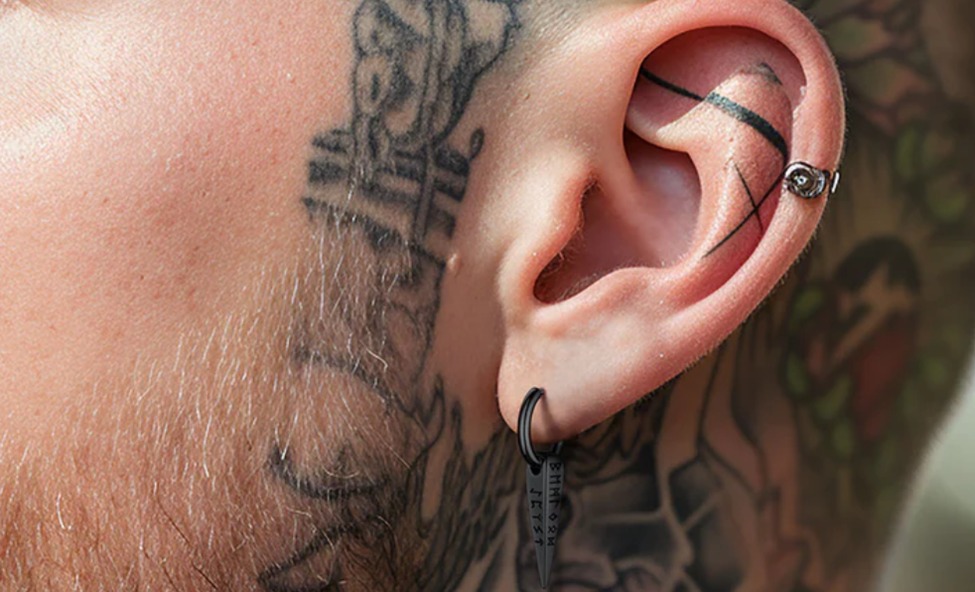
It starts, usually, with a single observation.
A man you respect — confident, well-dressed, someone whose opinion of himself clearly doesn’t depend on anyone else’s approval — is wearing an earring. And instead of it looking like a statement or a provocation, it just looks… right. Like it belongs. Like removing it would actually make the look less complete.
That observation is the beginning of a lot of men’s jewelry journeys.
The Long, Complicated, and Ultimately Irrelevant History of Men’s Earrings
Men have been wearing earrings for thousands of years. Ancient Egyptian nobles wore them as symbols of status. Roman soldiers wore them to mark their service. Sailors wore a single gold earring as a navigational talisman and a practical emergency fund. Through centuries of shifting social norms, the earring moved in and out of male mainstream culture — always present at the fringes, occasionally reclaiming the center.
Today, in 2024, the debate is essentially over. Men wear earrings. Full stop. The question isn’t whether it’s acceptable. The question is how to do it well.
Why Earrings Are the Most Expressive Piece of Jewelry a Man Can Own
Every other piece of jewelry occupies relatively neutral territory on the body. A ring is on the hand. A chain is on the neck. A bracelet circles the wrist. Each is visible, but none of them repositions the face.
Earrings do. They sit at the periphery of the face — the most-read surface in any human interaction — and subtly shift the entire visual composition. A well-chosen earring changes the geometry of a man’s appearance in ways that no other piece of jewelry can replicate. It frames the jaw differently. It draws the eye to the side of the face. It adds asymmetry and visual interest to a look that might otherwise read as flat.
Mens Earrings come in a range of styles broad enough to serve every aesthetic from minimal to maximalist: small studs that barely announce themselves, hoops in varying thicknesses and diameters, drop earrings that catch light with movement, and geometric designs that add architectural interest without theatrical drama.
The key is matching the style and scale to the face, the outfit, and the occasion — which is more intuitive than it sounds once you understand the basic principles.
The Case for Stone Earrings: Where Natural Material Meets Modern Edge
Among the many directions men’s earrings can go, stone settings occupy a particularly compelling space.
Stone Earrings introduce something that pure metal jewelry can’t: color, texture, and the visual complexity of a natural material that is never perfectly uniform. Onyx delivers a matte, almost liquid black that reads sophisticated and deliberately dark. Turquoise carries a desert, artisanal energy that pairs beautifully with both bohemian and southwestern-influenced style. Tigers eye shifts between amber and gold depending on the light, making it one of the most dynamic stone choices available. Lapis lazuli brings deep blue with gold-fleck inclusions that feel genuinely luxurious against silver or steel settings.
Each stone brings its own symbolic history, too, for those who care about such things. Onyx has long been associated with strength and protection. Turquoise carries centuries of spiritual significance across Native American and Middle Eastern cultures. Tigers eye is traditionally associated with clarity of vision and grounded confidence.
For men who want their jewelry to carry meaning beyond the aesthetic — who want to reach for a piece in the morning and feel something about what it represents — stone earrings offer that layer without making a spectacle of it.
Faithheart’s stone earring collection combines natural stones with premium stainless steel and 925 silver settings, ensuring the craftsmanship matches the material. The brand’s commitment to pre-shipment quality checks is especially relevant here — stone settings need to be secure and properly finished, and that’s not something you want to discover is wrong after the fact. The 90-day money-back guarantee provides backup for those rare occasions when something doesn’t arrive as it should.
Practical Guide: Choosing the Right Earring for Your Face and Style
Face shape influences earring choice more than most men expect.
Square and angular faces are softened by rounded forms — small hoops, oval studs, and curved drop earrings balance the geometry without fighting it. Long, narrow faces benefit from wider studs and horizontal designs that add visual width. Round faces can carry more angular, elongated styles — small bars, geometric drops, and narrow hoops — that add vertical interest.
Beyond face shape, the question is register — how formal or casual is your general style? For men who live primarily in casual and smart-casual territory, almost any earring works as long as the scale feels proportionate. For men who regularly wear formal attire, smaller studs in silver or gold tone integrate cleanly without creating tension with a tie or collar.
The piercing itself also matters. A fresh piercing needs time before you can wear heavier pieces comfortably. Start with simple studs while healing — three to six months — then expand to heavier options once the piercing is fully established.
One Ear or Two: The Question That Actually Has an Answer
Both work. The conventional logic that single earrings skew more masculine and pairs skew more fashion-forward has softened significantly. Men with double piercings wearing matched stone studs or minimal hoops look put-together, not theatrical.
If you’re deciding between getting one ear pierced or two, the honest answer is: start with one, see how you respond to wearing it, and let that inform the next decision. A single well-chosen earring is a complete look. Two is an expansion, not a correction.
The face is where every conversation begins. What it says about you is, at least in part, your choice.