

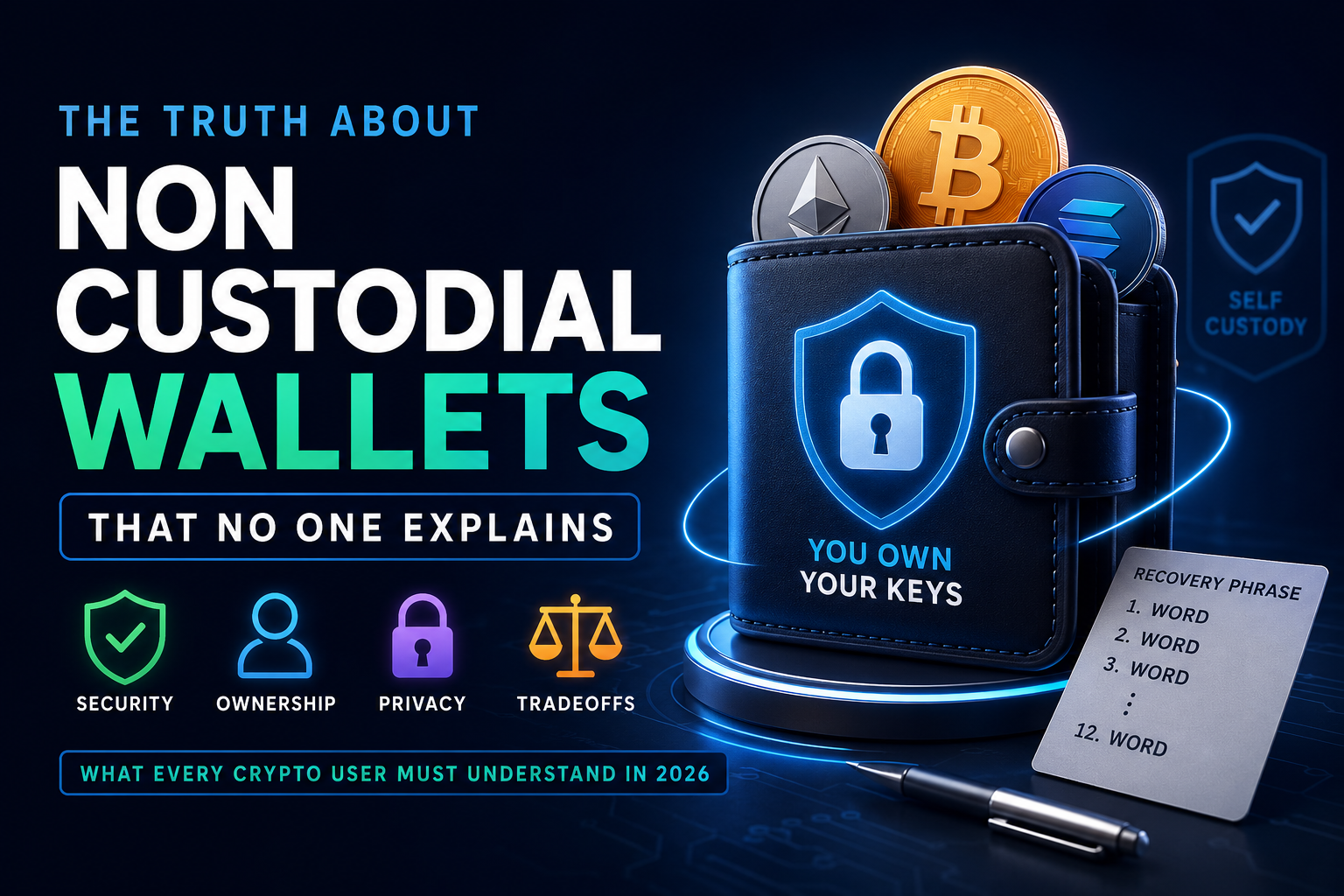
Almost every person who gets into crypto makes exactly the same mistake first. They buy their first coins on an exchange, and leave them there. Then sooner or later they hear the same list of names: Mt Gox, FTX, Celsius, Blockfi. As of 2026, over $21 billion worth of user funds have been lost or stolen from custodial platforms in the last 12 years.
For the first time ever this year, more crypto users hold their funds in a non custodial wallet than on centralized exchanges. But even now, almost no one will actually explain what that means, how it works, what the real tradeoffs are, and what you should actually look for.
What Exactly Is A Non Custodial Wallet?
At its most simple, a non custodial wallet is a tool that lets you interact with blockchains, with one single non-negotiable rule: no one other than you ever has control over your money.
At its core, a non-custodial cryptocurrency wallet does not hold your funds. It does not even store your funds. All crypto exists on the blockchain. A wallet is simply an interface to view and move it.
The difference between custodial and non custodial comes down to one thing: the private key. If someone else holds your private key, it is their money. If you hold your private key, it is your money. That is the single most important rule in all of crypto.
Why This Matters More Than You Think
Every single major loss of user funds in the history of crypto has happened to custodial services. Not one of those losses could have happened if the users had been using a non custodial wallet.
When you hold your funds on Coinbase, Binance or any other exchange, you do not have an account. You have an IOU. The exchange promises to give you your money when you ask for it. But they can freeze that promise at any time. They can get hacked. They can go bankrupt. They can be ordered by a government to seize your assets.
None of those things are possible with self custody.
What Makes A Good Non Custodial Wallet?
For many years, users had two bad options. They could use a custodial wallet that was easy to use but dangerous, or they could use a non custodial wallet that was extremely secure but almost impossible for normal people to use.
For many users, the biggest barrier to adopting a non-custodial cryptocurrency wallet has always been unnecessary friction.
Older generation non custodial wallets did almost everything they could to scare off new users:
- They would throw 12 random words at you 30 seconds into signup
- They would tell you to never lose them, with zero further explanation
- They would never mention it again, and provide no guidance or reminders
- Almost no one explained why the phrase mattered, or what would happen if you lost it
Modern wallets take a completely different approach:
- Full wallet setup takes less than 60 seconds
- No long forms, no email address required, no KYC
- The recovery phrase is generated 100% locally on your own device
- The phrase is never sent to any server, anywhere, at any time
This is the defining promise of any legitimate non-custodial cryptocurrency wallet, and it is a line that far too many providers cross without telling their users. When you create a wallet on Vaultory.dev, no employee, no hacker, no government and no third party of any kind can ever access your funds. The team cannot recover your wallet if you lose your phrase. That is not a bug. That is the feature.
Non Custodial vs Custodial: The Full Comparison
There are real tradeoffs between the two models, and neither is perfect for every single user. This is the honest comparison that almost no other article will give you:
| Feature | Non Custodial Wallet | Centralized Wallet / Exchange |
| Key Control | You own 100% of your private key | Third party holds and controls all keys |
| Primary Risk | You are responsible for backing up your phrase | Platform hack, insolvency, seizure |
| Privacy | No ID required, all data processed locally | Almost always require full KYC |
| Censorship Resistance | No one can freeze or seize your funds | Accounts can be frozen at any time |
| Recovery | No one can reset your access | Support can reset your password |
This is the tradeoff. There is no middle ground. You can have someone you can call if you forget your password, or you can have money that no one can take from you. You cannot have both.
Who Should (And Should Not) Use A Non Custodial Wallet?
A non custodial wallet is the safest place to hold crypto for the vast majority of users in 2026. But it is not for everyone.
You should use one if:
- You hold more crypto than you are willing to lose
- You want to use DeFi, NFTs or any other Web3 service
- You value privacy and control over convenience
- You are willing to take responsibility for backing up your recovery phrase
You should not use one if:
- You know for certain you will lose your recovery phrase
- You would rather have someone to call if something goes wrong
- You only hold very small amounts for active day trading
What To Look For When Choosing A Wallet
There are now over 70 different wallet options available as of 2026, and it can be very hard to tell the difference between a legitimate wallet and one that will steal your funds. There are three simple questions you should ask of any option you are considering:
- Is the private key generated 100% locally on my device?
- Does the provider explicitly state that they can never access or recover my funds?
- Is the interface clear enough that I will actually use it correctly?
Most older non custodial wallets pass the first two tests, but fail the third completely. This is the single largest gap in the market, and one of the primary reasons newer platforms have grown so quickly.
For a long time, users have been forced to choose between a secure non-custodial cryptocurrency wallet that is impossible to use, and an easy to use wallet that is custodial and dangerous. Modern platforms like Vaultory.dev are the first to properly bridge that gap.
Common Misconceptions
There is an enormous amount of bad information about this topic online. These are the three most common myths still circulating in 2026:
- Myth: Non custodial wallets are less secure.
- Fact: Over 92% of all recorded crypto losses have come from custodial services. A non custodial wallet removes the single largest point of failure in the entire ecosystem.
- Myth: Non custodial wallets are only for experts.
- Fact: Modern design has made them just as simple to use as any banking app. The only additional step is backing up your recovery phrase.
- Myth: If it has a nice interface it must be custodial.
- Fact: A good non custodial wallet can have an extremely polished, easy to use interface, and still never touch or see your private key at any point.
Final Verdict
For almost all crypto users, moving the majority of their holdings out of custodial exchanges and into a non custodial wallet is the single most important step they can take to protect their assets.
It is not a perfect solution. It comes with real responsibility. If you lose your recovery phrase, your funds are gone forever, and there is nothing anyone can do to help you. But for most people, that is a far better tradeoff than trusting a third party that has failed over and over and over again for the last 15 years.
As of 2026, self custody is no longer a niche position for crypto purists. It is now the mainstream recommendation for regular users. A new generation of tools are working to remove the friction and confusion that stopped people from adopting it for so long. At the end of the day, the entire point of crypto is that you, and only you, should control your own money. And that is the one promise that only a non custodial wallet can ever make.