

Artificial intelligence APIs are no longer experimental developer tools—they are mission-critical infrastructure powering SaaS platforms, enterprise automation systems, fintech analytics engines, legal document processors, AI copilots, customer support bots, and data intelligence workflows across industries. In 2026, choosing the right large language model (LLM) API is not just about output quality; it’s about scalability, reasoning performance, token efficiency, multimodal capability, latency stability, integration flexibility, and long-term cost sustainability.
This ultimate 2000+ word SEO guide delivers a comprehensive comparison of Claude Sonnet 4.6 AP1, Gemini 3.1 Pro API, and Qwen 3.5 Plus API. We will break down:
- Core architecture and design philosophy
- Reasoning performance and benchmarks
- Multimodal capabilities
- Latency and scalability insights
- Pricing considerations and cost control
- Real-world use cases
- Detailed comparison tables
- Strategic recommendations
We will also highlight how CometAPI provides access to all three AI APIs at highly affordable and cost-effective pricing, making it an excellent choice for developers, startups, and enterprises seeking flexible AI infrastructure.
1. The Evolution of AI APIs in 2026
AI APIs have evolved from simple text generation endpoints into highly specialized reasoning engines capable of:
- Multi-step analytical processing
- Long-context document ingestion
- Structured JSON output generation
- Multimodal reasoning (text + visual inputs)
- Real-time streaming responses
- AI agent orchestration
Organizations now require AI APIs that can integrate into production-grade systems with predictable performance and sustainable pricing. The competition between Claude Sonnet 4.6 AP1, Gemini 3.1 Pro API, and Qwen 3.5 Plus API reflects a broader market trend toward specialization: reasoning-focused models, multimodal-optimized systems, and cost-efficient scalable platforms.
2. Model Overview: Strength Profiles
Before diving into deep comparisons, here’s a high-level overview of each model’s positioning.
Claude Sonnet 4.6 AP1
- Focus: Deep reasoning, structured outputs, long-context analysis
- Ideal for: Legal tech, compliance automation, research systems
- Strength: Logical coherence across complex multi-step tasks
Gemini 3.1 Pro API
- Focus: Multimodal processing and high-throughput performance
- Ideal for: AI copilots, SaaS platforms, data-rich applications
- Strength: Interactive speed + cross-data intelligence
Qwen 3.5 Plus API
- Focus: Cost-efficient scalability and multilingual support
- Ideal for: High-volume conversational systems and SaaS automation
- Strength: Strong cost-performance ratio
3. Architecture & Design Philosophy
Claude Sonnet 4.6 AP1 Architecture
Claude Sonnet 4.6 AP1 is optimized for structured reasoning and contextual depth. Its architecture emphasizes:
- Extended token windows
- Context preservation
- Stable chain-of-thought reasoning
- Reliable structured output formatting
For businesses processing long documents—contracts, compliance policies, research reports—the ability to maintain logical continuity across thousands of tokens significantly reduces the need for external memory orchestration.
Gemini 3.1 Pro API Architecture
Gemini 3.1 Pro API is optimized for multimodal processing and scalable cloud deployment. Its design philosophy focuses on:
- Cross-modal reasoning
- High-throughput streaming
- Cloud-native scaling
- Dynamic real-time interactions
This makes it well suited for interactive systems and SaaS platforms that integrate multiple data types.
Qwen 3.5 Plus API Architecture
Qwen 3.5 Plus API is engineered for:
- Efficient inference
- Balanced reasoning performance
- Stable concurrency handling
- Multilingual processing
Rather than specializing in one extreme, Qwen delivers reliable general-purpose performance at scale.
4. Reasoning Performance Benchmarks
Reasoning performance determines whether an AI model can maintain logical accuracy across multi-step tasks.
Analytical Strength Ranking (General Enterprise Tasks)
| Feature | Claude Sonnet 4.6 AP1 | Gemini 3.1 Pro API | Qwen 3.5 Plus API |
| Long Document Analysis | ⭐⭐⭐⭐⭐ | ⭐⭐⭐⭐ | ⭐⭐⭐ |
| Multi-Step Logical Reasoning | ⭐⭐⭐⭐⭐ | ⭐⭐⭐⭐ | ⭐⭐⭐ |
| Structured JSON Reliability | ⭐⭐⭐⭐⭐ | ⭐⭐⭐⭐ | ⭐⭐⭐⭐ |
| Code Explanation | ⭐⭐⭐⭐ | ⭐⭐⭐⭐ | ⭐⭐⭐ |
Claude Sonnet 4.6 AP1 leads in deep analytical reasoning and long-context workflows. Gemini 3.1 Pro performs strongly in dynamic reasoning tasks. Qwen 3.5 Plus API maintains dependable performance for general business logic.
5. Multimodal Capabilities
Multimodal AI is increasingly important in document processing, dashboard analytics, and data-rich SaaS products.
| Capability | Claude Sonnet 4.6 AP1 | Gemini 3.1 Pro API | Qwen 3.5 Plus API |
| Text Processing | ⭐⭐⭐⭐⭐ | ⭐⭐⭐⭐⭐ | ⭐⭐⭐⭐ |
| Image + Text Integration | ⭐⭐⭐ | ⭐⭐⭐⭐⭐ | ⭐⭐⭐ |
| Data-Augmented Reasoning | ⭐⭐⭐⭐ | ⭐⭐⭐⭐⭐ | ⭐⭐⭐ |
| Interactive AI Copilots | ⭐⭐⭐⭐ | ⭐⭐⭐⭐⭐ | ⭐⭐⭐⭐ |
Gemini 3.1 Pro API leads in multimodal integration and cross-input intelligence, making it ideal for AI copilots and data-enriched workflows.
6. Latency & Scalability Insights
Latency and throughput directly affect user experience in production systems.
| Performance Metric | Claude Sonnet 4.6 AP1 | Gemini 3.1 Pro API | Qwen 3.5 Plus API |
| Real-Time Chat Responsiveness | High | Very High | Very High |
| Analytical Processing Speed | Moderate | High | High |
| Concurrency Stability | High | Very High | Very High |
| Large-Scale Deployment | High | Very High | Very High |
Gemini and Qwen excel in high-frequency, real-time deployments. Claude prioritizes reasoning accuracy over ultra-low latency.
7. Pricing Insights & Cost Considerations
Pricing is a critical factor in AI API selection. High token consumption can significantly impact operational budgets.
Key pricing considerations include:
- Token cost per request
- Input vs output token ratio
- High-volume concurrency scaling
- Predictability of monthly billing
- Infrastructure overhead
For startups and enterprises, unpredictable AI costs can limit growth.
This is where CometAPI becomes strategically important.
CometAPI provides:
- Access to Claude Sonnet 4.6 AP1
- Access to Gemini 3.1 Pro API
- Access to Qwen 3.5 Plus API
- Highly affordable and cost-effective pricing
- Unified billing and simplified integration
Instead of managing multiple vendor contracts, organizations can centralize access and optimize workload allocation based on cost-performance needs.
8. Real-World Use Cases
Use Case 1: Legal Contract Analysis SaaS
Best Fit: Claude Sonnet 4.6 AP1
Why: Superior long-context reasoning and structured outputs
Use Case 2: AI Productivity Copilot
Best Fit: Gemini 3.1 Pro API
Why: Multimodal support + real-time responsiveness
Use Case 3: Global Customer Support Automation
Best Fit: Qwen 3.5 Plus API
Why: Cost-efficient high-volume scalability
Use Case 4: Enterprise Knowledge Base Assistant
Best Fit: Claude or Gemini
Why: Deep reasoning or dynamic cloud integration
Use Case 5: Multilingual E-Commerce Chatbot
Best Fit: Qwen 3.5 Plus API
Why: Balanced multilingual and cost performance
9. Full Comparison Summary Table
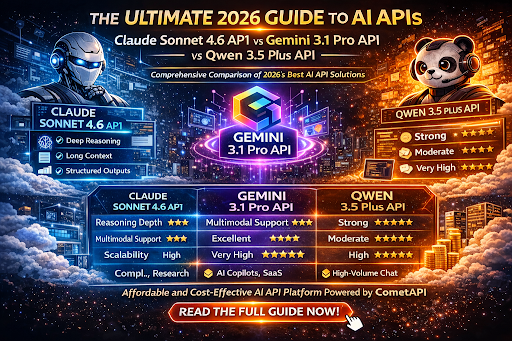
| Category | Claude Sonnet 4.6 AP1 | Gemini 3.1 Pro API | Qwen 3.5 Plus API |
| Reasoning Depth | Excellent | Very Strong | Strong |
| Multimodal Support | Moderate | Excellent | Moderate |
| Scalability | High | Very High | Very High |
| Cost Efficiency | Moderate | Moderate | High |
| Best For | Compliance, Research | AI Copilots, SaaS | High-Volume Chat |
| Enterprise Readiness | Excellent | Excellent | Strong |
10. Strategic Deployment Approach
In 2026, the smartest companies are not choosing just one AI model—they are deploying multiple models strategically.
For example:
- Route analytical workloads to Claude Sonnet 4.6 AP1
- Route multimodal workloads to Gemini 3.1 Pro API
- Route high-volume chat tasks to Qwen 3.5 Plus API
Using CometAPI as a unified gateway allows organizations to:
- Optimize cost per workload
- Prevent vendor lock-in
- Maintain infrastructure flexibility
- Improve ROI across AI initiatives
11. Why CometAPI Is a Strategic Advantage
CometAPI stands out because it provides:
- Highly affordable access to all three models
- Cost-effective pricing structures
- Simplified billing
- Unified authentication
- Enterprise scalability
For developers and enterprises, this reduces operational friction and accelerates deployment timelines.
Rather than being locked into one ecosystem, you gain access to leading AI APIs with financial flexibility.
12. Final Verdict: Which AI API Should You Choose?
If your priority is:
- Deep analytical reasoning → Choose Claude Sonnet 4.6 AP1
- Multimodal intelligence & SaaS scalability → Choose Gemini 3.1 Pro API
- High-volume cost-efficient automation → Choose Qwen 3.5 Plus API
However, the ultimate strategic decision is not just about the model—it’s about the platform through which you access it.
CometAPI provides these advanced AI APIs at highly affordable and cost-effective pricing, making it an excellent choice for developers, startups, and enterprises seeking long-term scalability without financial risk.
Conclusion: The Future of AI API Infrastructure
AI APIs are becoming as foundational as cloud computing and payment gateways. Organizations that strategically select scalable, cost-efficient AI infrastructure today will dominate tomorrow’s digital economy.
Claude Sonnet 4.6 AP1, Gemini 3.1 Pro API, and Qwen 3.5 Plus API each offer distinct strengths. When accessed through CometAPI’s affordable and unified platform, they become powerful tools for building intelligent, scalable, and financially sustainable AI systems.
In 2026 and beyond, the competitive advantage won’t belong to those who experiment with AI—it will belong to those who integrate it strategically, cost-effectively, and at scale.