

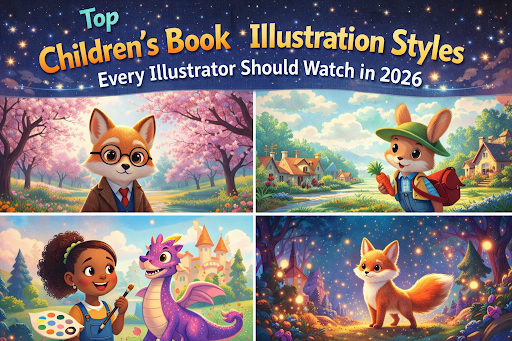
Children’s book illustration is a vast industry. While vibrant colours, emotional expression, and exaggerated features form the core of these illustrations, there is something more. That is, the children’s expectations associated with these drawings. With the evolving preferences, meeting these expectations is more important than ever.
In 2026, fresh aesthetics, inclusive storytelling, and modern techniques are leading the children’s book industry. For parents, illustrators, and authors, understanding these top trends and styles is one of the key aspects of staying relevant as well as memorable in the industry.
From diversity to playful palettes, each detail is redefining how these visuals feel.
Continue reading to know how you can help little minds in stepping in a magical world that feels unreal with Children’s Book Illustration – Top Trends and Styles For 2026!
What Is The Importance Of Children’s Book Illustration?
The 2026 children’s book is incomplete without visuals. Words are no longer sufficient to offer immersive experiences to young minds. A great illustration has the power to turn abstract texts into relatable experiences.
Here is why children’s book illustration plays a crucial role in literature,
• Visuals help with a deeper comprehension. They create narrative skills by allowing young minds to interpret stories
• Builds empathy among children by forming a strong connection with characters’ emotions
• Stimulate imagination and boost visual literacy among children
• Inclusive illustrations show that diverse perspectives and feelings are valid
What Are the Modern Styles in Children’s Illustration?
The 2026 child no longer gets captivated by ordinary illustrations, which are just some vibrant shades that shine through each character. Instead, each child expects something more from the storytelling techniques. Let’s take a look at them:
1. Diversity In Illustrations
One of the biggest trends in 2025 is the conscious shift towards inclusive illustrations. Today’s reader doesn’t want to invest time in a story that presents the perspective of a child of a single race. They expect diversity and inclusive practices.
A child wants to experience,
• Various skin tones
• Multicultural practices
• Different family traditions
• Various abilities of a child
Here is how popular illustrators are responding to this Children’s book illustration – top trends and styles for 2026:
• Incorporating stories belonging to single parents, adoptive families
• Characters with various disabilities are added to routine scenes
• Accurately depicting cultural attire, natural hair, and different skin tones
This approach builds validation among different types of children. Moreover, readers are exposed to diverse characters, fostering a strong sense of empathy.
Following this trend allows authors to connect more deeply with young minds and boost engagement and loyalty among them.
2. Subtle Designs That Convey Strong Feelings
Flat design styles are no longer a few boring lines that convey a monotonous expression. In2026, minimalism has evolved. It now holds the power to amplify emotional storytelling. The purpose behind this approach is not just aesthetics; instead, it is to convey emotions with elegance.
Illustrators are using these styles through
• Clean lines and minimal shapes
• Subtle, limited and soft shades
• Prioritising white space
• Expressive characters without cluttered backgrounds
3. Mixed Media And Hybrid Art
The 2026 illustrator has leveraged digital tools in the best way possible. As technology becomes more accessible, every book illustrator is experimenting with blending traditional and digital techniques to achieve crisper textures.
Here is how mixed media looks,
• Hand-painted watercolours are mixed with digital textures
• Fabric and papers are scanned into digital compositions
• 3D renders integrated with minimal illustrations
• Hand-lettered typography blended with illustration
This hybrid and layered approach creates illustrations with an in-depth, tactile feel that resonates with children.
4. Nature-Inspired Art
Eco-consciousness has entered the world of children’s book visuals in the most surprising ways. In 2026, illustrators are bringing nature to life with their unique designs that reflect ecological themes and green-friendly narratives.
Here is how every book illustrator expresses nature as a story
• More and more use of earthy tones and natural textures
• Flora and fauna-inspired art
• Layouts that are surrounded by leaves, spirals, and waves
Children are now interested in books that spread the message of sustainability, thanks to their visually appealing art details. This approach now empowers them to connect with nature on a deeper level and appreciate its value.
5. Augmented Visuals
Technology is transforming children’s experience with books. While the traditional pages continue to hold their importance, augmented visuals have changed the game.
The combination of AR and print has made the reading process more exciting. The phenomenon of characters coming to life can offer a next-level immersive experience.
With AR apps, children can now:
• Watch illustrations animate off the page
• Trigger soundscapes that match scenes
• Experience a multi-sensory engagement that creates stronger memory pathways
6. Expressive Faces
The character-driven aesthetics in 2026 prioritise emotional intelligence above all else. Characters have always been the heart of the story. However, the way these illustrations demonstrate their expressions is what matters! This is what allows kids not only to see but also to feel the story.
The expressive design elements include:
•Enhanced facial expressions, such as adjustments to eye width and mouth position
•Dynamic gestures such as open arms for happiness and slumped shoulders for disappointment
• Consistent colour pallets to create recognisable shapes and elements
These small yet impactful details are used to convey emotion, guide narrative flow, and create an atmospheric world that resonates with young minds.
7. The Use Of Bold Colours
While the minimal details are considered as a significant part, the use of bold colours is not far behind! The 2026 illustrator uses both approaches: colourful and minimalist! The use of bold colours and vibrant palettes is for
• Boosting attention and memory
• Developing mood instantly
• Enhance recognition
In 2026, the purpose of colours is no longer to serve as decorative elements. Instead,
• Highly saturated hues, such as red and yellow, can draw attention to important elements
• Light colour tones are working as a sense of mystery, allowing students to engage more with the story
• Pastel gradients convey a dreamy look for bedtime books
• Ocean blue and leaf greens are perfect for nature-driven scenarios
8. Sensory Art
Sensory illustration styles have gained popularity for their touch and emotional engagement. These illustrations are crafted to encourage deeper interactive engagement by stimulating touch.
The techniques for tactile illustration designs includes per the children’s book illustration – top trends and styles for 2026,
• Tactical graphics with raised surface elements for children to feel
• Digital tactical design, such as grainy textures and embossed effects
• Visual cues for sound, texture, and movement
9. Global Visual Languages And Cultural Aesthetics
Global interconnectedness is transforming children’s book illustrations. Every book illustrator Canada is now gathering diverse traditions to incorporate into their art to blend traditional heritage with modern storytelling.
This multicultural approach allows children to get a deeper understanding of the world and move beyond the surface-level concept of diversity around them.
Here is how cultural aesthetics are being incorporated into visual styles,
• Illustrators are now precisely researching regional dresses and domestic architectures to show the real portrayals of every culture
• The use of religious and spiritual symbols has been more considerate
• Diverse family structures are shown to create a better understanding of inclusive environments
What Are Some of the Tips for Aspiring Children’s Book Illustrators In 2026?
If you are an aspiring illustrator, remember that the current landscape of the children’s book industry is changing way too fast! Here are some of the tips that you need to keep in mind to thrive in this sector.
• Learning art from all over the globe is necessary to incorporate distinct cultural elements. Make sure to study diverse visual languages.
• Don’t miss out on hybrid techniques. They are your chance to create something meaningful by combining traditional and digital workflows.
• Never miss out on emotional expression. It is one of the most important aspects when a child is introduced to a character.
• Enhance your skillset by learning about AR integration and interactive design platforms
FAQS
1) What is the use of colour psychology in book illustrations?
Colours play a crucial role in the story telling. Illustrators make use of colours to set the mood for children. Bright colours reflect excitement and joy, whereas softer tones build calm in the story. In 2026, colour choices are extremely important for conveying the message of the story.
2) Is there a difference between illustration trends in educational and story-based illustration books?
Yes! Educational books demand realistic, detailed designs, simple shapes, and clarity as their main purpose. On the other hand, story-based books are more focused on fantasy realism and whimsical styles. They demand rich environments and exaggerated features in each illustration.
3) Will the children’s book illustration trends continue to change after 2026?
Yes! Children’s book illustration will always evolve as technology, culture, and storytelling techniques change. The future trends will explore more personalised and interactive visual experiences.
Wrapping Up
The Children’s Book Illustration – Top Trends and Styles for 2026 is a strong mixture of bright, bold, and beautifully woven visuals. The rise of minimalist styles, handmade aesthetics, a strong emphasis on authentic diversity and inclusive presentation, eco-friendly themes, and the use of digital tools to expand possibilities for creating deeper emotional connections are the current trends in the illustration industry. Following these trends can help you navigate the imaginative world of children’s book illustration.