

Managing AI prompts can get messy fast – copy-paste chaos, lost ideas, scattered docs. The right tools make it easy to store, share, and reuse prompts without hunting for them every time. In this article, we’ll look at the best options out there that help teams move faster, stay organized, and actually enjoy working with AI.
1. Snippets AI
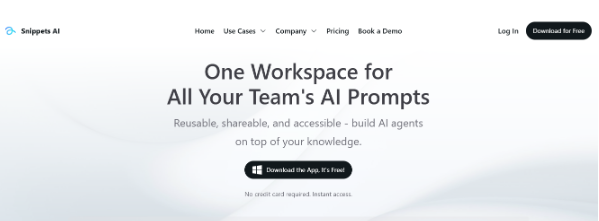
Snippets AI focuses on helping teams organize and manage AI prompts in a single workspace. Their platform is designed to make prompts reusable and shareable, giving teams quick access to the prompts they need without digging through documents or scattered files. It supports collaboration by allowing multiple users to work with prompts simultaneously and keep track of updates.
They also provide ways to host public workspaces where prompts can be shared more broadly, and the system is built to handle various workflows, from education and research to enterprise-level AI projects. Users can format prompts, preview media and audio, and even insert prompts quickly using keyboard shortcuts. The emphasis is on keeping prompts accessible and organized while making it easier to integrate them into day-to-day tasks.
Key Highlights:
- Centralized workspace for all AI prompts
- Supports prompt sharing and team collaboration
- Public workspaces for community-driven prompts
- Quick access and insertion of prompts via shortcuts
- Options for educational, enterprise, and sales use cases
Services:
- AI prompt management and organization
- Reusable prompt libraries
- Real-time team collaboration
- Media and audio preview for prompts
- Public workspace hosting for communities
Contact Information:
- Website: www.getsnippets.ai
- E-mail: [email protected]
- Twitter: x.com/getsnippetsai
- LinkedIn: www.linkedin.com/company/getsnippetsai
- Address: Skolas iela 3, Jaunjelgava, Aizkraukles nov., Latvija, LV-5134
2. Langfuse
Langfuse provides tools for teams to track, manage, and analyze AI prompts and outputs within complex LLM applications. Their platform is built around observability, capturing detailed traces and metrics from AI systems so teams can inspect failures, track usage, and refine prompts over time. They support multiple integrations with popular AI libraries and offer SDKs for Python and JavaScript/TypeScript, making it possible to embed tracing and prompt management directly into workflows.
The platform also includes features for evaluating AI outputs, annotating data, and managing datasets. Users can version prompts, compare outputs, and run experiments to improve their LLM applications. Langfuse can be self-hosted or used via the cloud, with options for different team sizes and use cases. The focus is on providing a structured environment for monitoring AI behavior and keeping prompts organized as part of broader AI engineering projects.
Key Highlights:
- Observability and tracing for LLM applications
- Prompt versioning and management
- Metrics and evaluation tools for AI outputs
- SDKs for Python and JS/TS
- Support for multiple AI library integrations
Services:
- Capturing detailed traces of AI requests and responses
- Versioning and collaborative management of prompts
- Evaluation and experiment tools for outputs
- Dataset and annotation management
- API access and SDK support for integration into applications
3. Amazon Web Services (AWS)
Amazon Web Services provides a broad cloud platform that includes tools for managing AI workflows and prompt-based applications. Their services offer the ability to build, train, and deploy AI models at scale while integrating with various cloud infrastructure components. Teams can track AI processes, manage data storage, and connect multiple AI services together to streamline their workflows. AWS supports a wide range of programming languages and frameworks, making it flexible for different technical setups.
They also provide solutions for generative AI, including AI agents and model hosting, alongside tools for monitoring, security, and compliance. Users can access features like agentic AI services for migrating workloads, scalable compute resources, and managed storage, all while connecting their AI systems through APIs and SDKs. This setup allows teams to maintain organized prompt workflows, version control for AI experiments, and better observability of outputs in cloud-based environments.
Key Highlights:
- Cloud-based AI model deployment and management
- Integration with a wide range of compute, storage, and networking services
- Support for generative AI and AI agents
- Tools for observability and workflow tracking
- Scalable infrastructure for different team sizes and projects
Services:
- AI and machine learning model building, training, and deployment
- Generative AI agents and services
- Cloud compute resources like EC2 and serverless options
- Storage and database management
- APIs and SDKs for integrating AI workflows into applications
4. Eden AI
Eden AI provides a platform that brings multiple AI models together through a single API, allowing teams to integrate and manage AI workflows without handling multiple providers separately. They focus on creating a unified interface where users can benchmark, monitor, and orchestrate AI models across different services. Teams can organize prompts, track API calls, and handle input/output formats consistently, which helps streamline the management of AI workflows.
Their approach supports both out-of-the-box AI usage through a universal API and more customized solutions where workflows are tailored to specific business needs. By centralizing access to various AI models, they help teams experiment with different models, monitor performance, and manage costs from a single dashboard. The platform also includes features for benchmarking model accuracy and reliability, ensuring that workflows remain efficient across multiple AI providers.
Key Highlights:
- Unified API for multiple AI providers
- Centralized management of prompts and workflows
- Real-time benchmarking of model performance
- Cost tracking and API call monitoring
- Support for custom and standard AI integrations
Services:
- Access to a broad range of AI models through one API
- Custom AI API development for tailored workflows
- Workflow orchestration and monitoring
- Performance tracking and optimization
- Integration support for internal tools and client-facing applications
5. prst.ai
prst.ai offers a self-hosted platform designed to manage prompts and AI workflows within a company’s own infrastructure. Their system allows teams to connect multiple AI tools and models through a single interface, making it easier to experiment with different prompts, track results, and validate outputs. The platform emphasizes flexibility, letting users set up custom workflows, control data, and manage AI model integrations without heavy coding requirements.
The platform also supports features like prompt versioning, A/B testing, and sentiment analysis, giving teams tools to refine prompts based on feedback and performance. High-volume operations are supported through scalable cluster modes and asynchronous processing, making it suitable for both smaller projects and more complex enterprise setups. Teams can monitor usage, implement pricing rules, and organize models for structured prompt management, helping streamline AI workflows from testing to deployment.
Key Highlights:
- Self-hosted prompt management solution
- Integration with multiple AI tools and models
- Prompt versioning and A/B testing capabilities
- Sentiment analysis and feedback tracking
- Scalable architecture for high-volume operations
Services:
- No-code prompt customization and management
- Flexible API for connecting AI models
- Data import/export and secure handling
- Workflow monitoring and cost control
- Advanced analytics for prompt evaluation
6. PromptDrive
PromptDrive provides a platform for teams to manage, organize, and collaborate on AI prompts across multiple models like ChatGPT, Claude, and Gemini. It allows users to store prompts in structured folders, tag them for easy retrieval, and share them with colleagues or external partners. The system emphasizes smooth collaboration, offering features like commenting on prompts and adding contextual notes, which helps teams iterate and refine their workflows without jumping between different tools.
The platform also includes tools to reduce repetitive work, such as variable insertion for prompts used across multiple clients or projects. Users can access their prompts directly through a Chrome extension, making it easier to apply saved prompts in real time within different AI chat platforms. These features help maintain organized prompt libraries while supporting team collaboration and faster experimentation.
Key Highlights:
- Multi-model prompt collaboration (ChatGPT, Claude, Gemini)
- Folder, tag, and search-based organization
- Commenting and contextual notes for teamwork
- Chrome extension for quick access to prompts
- Variable support to speed up repetitive prompts
Services:
- Prompt storage and organization
- Team sharing and collaboration on prompts
- Real-time prompt execution via API keys
- Integration with AI chat platforms through a browser extension
- Iteration tracking and workflow management
7. Humanloop
Humanloop provides a platform that helps teams manage AI prompts collaboratively from testing to production. Their system allows engineers, product managers, and subject matter experts to work together in one workspace, sharing insights, tracking changes, and experimenting safely with different prompts. The platform includes version control, making it easy to see the history of prompt edits, evaluate performance, and roll back when needed. Teams can integrate Humanloop with their existing workflows, including Git and CI/CD pipelines, to maintain coding best practices.
The platform also combines prompt management with evaluation and observability tools, giving teams a full picture of how prompts perform across different AI models. This integration helps teams optimize outputs systematically while retaining control over their prompt data. Users can connect external tools, trigger automated evaluations, and track performance in one unified environment, simplifying collaboration and alignment across teams working on AI-driven projects.
Key Highlights:
- Collaborative workspace for prompt management
- Version control with rollback capabilities
- Integration with Git and CI/CD pipelines
- Unified evaluation and observability
- Support for multiple AI models
Services:
- Prompt creation, testing, and deployment
- Prompt version tracking and management
- Performance evaluation and automated feedback
- Data ownership and export capabilities
- Integration with external AI tools and workflows
8. Helicone
Helicone focuses on providing developers with tools to monitor, debug, and analyze large language model applications. Their platform collects usage data across multiple AI models, allowing teams to see how prompts perform, identify unexpected outputs, and track performance over time. This approach helps teams maintain visibility into their AI workflows while iterating on prompts and applications without needing multiple disconnected tools.
They also provide a playground and experimentation tools that allow prompt testing across different models, making it easier to compare results and refine approaches. By integrating with popular AI providers and platforms, they offer a more centralized workflow for teams managing multiple models and use cases. Their system emphasizes tracking, evaluation, and routing rather than generating or recommending prompts directly.
Key Highlights:
- Observability for LLM applications
- Debugging and monitoring tools for prompts and outputs
- Multi-model integration support
- Playground for testing and experimentation
- Centralized metrics and logging
Services:
- Prompt performance tracking
- Error and anomaly detection
- Experimentation and A/B testing of prompts
- Integration with multiple AI providers
- Usage analytics and session monitoring
9. Gud Prompt
Gud Prompt provides a system for organizing, saving, and sharing AI prompts, helping teams and individuals keep their workflows structured. Users can create collections of prompts, bookmark favorites, and access them quickly through a browser extension. The platform supports collaboration by allowing shared access to collections and prompts, making it easier for teams to iterate and manage AI-driven tasks. Its interface is designed to keep everything visible and searchable, which helps reduce time spent looking for previously used prompts.
The tool also includes features to manage permissions, ensuring that private and shared content can coexist without confusion. It integrates with various AI chat platforms, allowing users to work across multiple tools without needing to switch environments. By centralizing prompt storage and collaboration, Gud Prompt helps teams maintain consistency in messaging, campaign management, and content creation workflows.
Key Highlights:
- Bookmark and save AI prompts for easy access
- Organize prompts into collections
- Share prompts and collections securely with teammates
- Chrome extension for direct access within AI chat platforms
- Full access control for private and shared content
Services:
- Prompt storage and organization
- Collaboration on prompt collections
- Integration with AI chat tools
- Quick access through browser extension
- Management of permissions and sharing settings
10. Orq.ai
Orq.ai provides a platform for teams to manage the full lifecycle of AI applications, combining prompt management, experimentation, deployment, and monitoring into a single environment. Users can organize prompts, test different workflows, and track the performance of AI models as they move from development to production. The platform supports cross-functional collaboration, allowing engineers, product managers, and domain experts to work in a shared workflow without needing separate tools for each stage.
Security and compliance are integrated throughout the platform, including PII masking, flexible data residency options, and role-based access controls. Orq.ai also includes features for serverless deployment, version control, and fallback handling, helping teams maintain consistency and reliability in AI operations. By centralizing these capabilities, it simplifies the process of building and scaling AI-driven systems while keeping workflows transparent and manageable.
Key Highlights:
- Prompt management integrated with AI experimentation and deployment
- Lifecycle management from development to production
- Cross-functional collaboration across roles and teams
- Security and compliance with data privacy controls
- Serverless deployment with version control and fallback support
Services:
- AI prompt organization and versioning
- Experimentation and evaluation of AI workflows
- Serverless orchestration and deployment
- Knowledge base and retrieval-augmented generation support
- Monitoring and performance tracking
11. PromptHub
PromptHub provides a platform for teams to manage the full lifecycle of AI prompts, from creation and versioning to testing and deployment. Users can organize prompts using Git-based versioning, run evaluations at scale, and chain multiple prompts together without needing to write code. The platform also supports testing across different AI models, allowing teams to compare outputs side by side and iterate quickly on prompt designs.
The platform emphasizes collaboration and workflow management. Teams can host prompts publicly for community sharing or keep them private within an organization. Guardrails and pipelines help ensure prompt outputs remain consistent and safe, and prompts can be deployed across different environments through branches and APIs. By centralizing these capabilities, PromptHub provides a structured environment for teams to develop, refine, and maintain AI prompts efficiently.
Key Highlights:
- Git-based versioning for prompts
- Cross-model evaluation and side-by-side comparison
- Prompt chaining without coding
- Guardrails and pipelines for safe deployments
- Public and private sharing options
Services:
- Prompt creation, organization, and management
- Testing and evaluation of AI prompts
- Deployment across environments via branches and API
- Prompt chaining and workflow automation
- Integration with external tools and services
12. Hamming
Hamming provides a platform for testing, monitoring, and optimizing AI voice agents. Their system allows teams to simulate thousands of calls before launch, analyze real-world performance, and catch issues early through continuous checks. The focus is on creating reliable voice interactions by accounting for variations such as accents, background noise, and unexpected user behaviors, helping teams understand how their prompts and agent logic perform in diverse scenarios.
The platform integrates with existing voice infrastructure and supports multiple languages, making it possible to run stress tests, edge-case scenarios, and automated evaluations without manual setup. Teams can track performance trends, benchmark agents, and use detailed reports to inform ongoing development and operational decisions. This approach brings structure to the management and optimization of AI voice workflows.
Key Highlights:
- Simulation of diverse user interactions
- Real-time performance monitoring
- Automated evaluation of prompts and responses
- Multi-language support
- Edge-case and stress testing
Services:
- Test suite generation for voice agents
- Continuous heartbeat monitoring
- Integration with SIP, LiveKit, and other voice systems
- Detailed reporting and analytics
- Red-teaming and safety testing
13. PromptPerfect
PromptPerfect provides a platform for refining, optimizing, and generating AI prompts across a variety of tasks. Teams can create prompts for text, images, or code, then evaluate and improve them quickly using automated tools. The system supports multiple AI models and allows users to experiment with different formulations to get more consistent and effective outputs, helping to make prompt workflows more organized and repeatable.
The platform also integrates prompt management with practical applications such as content creation, marketing campaigns, and software development. Users can deploy prompts as API services, test variations, and monitor their performance, creating a more structured approach to managing prompts and improving the quality of AI-assisted work.
Key Highlights:
- Optimization for text, code, and image prompts
- Support for multiple AI models
- Prompt testing and performance evaluation
- API integration for deploying prompts
- Tools for brainstorming and task automation
Services:
- Prompt generation and auto-tuning
- AI-assisted writing and coding improvement
- Image creation through prompt refinement
- Prompt deployment as API services
- Marketing and campaign content optimization
14. Agenta AI
Agenta AI offers a platform designed to support the full lifecycle of large language model applications, with a focus on prompt management, evaluation, and observability. Teams can create and test prompts in a collaborative web-based playground, track different versions of prompts, and link them to evaluation results. The platform emphasizes structured workflows, enabling users to systematically compare models and prompts across multiple scenarios and make data-driven improvements.
The system also includes tools for monitoring and debugging prompt outputs, helping teams identify edge cases and maintain quality over time. By connecting prompt versioning, evaluation, and observability in one platform, Agenta AI provides a framework for developing, iterating, and deploying LLM applications more efficiently, while keeping track of the underlying processes and results.
Key Highlights:
- Collaborative prompt playground
- Version tracking for prompts and outputs
- Integrated evaluation of prompts and models
- Observability and debugging tools
- Deployment and rollback management
Services:
- Prompt creation, testing, and iteration
- Prompt versioning and traceability
- Evaluation and performance analysis
- Output monitoring and root cause identification
- Deployment management for LLM applications
15. PromptPanda
PromptPanda is all about helping teams keep their AI prompts organized and consistent – especially if you’re using them for marketing or branding. Instead of having prompts scattered across docs, emails, or random files, you get one secure place where everything lives. You can tag and filter prompts, tweak variables for different scenarios, and make sure everyone on the team is using the right messaging.
It also works across platforms, so team members can grab and use prompts wherever they need them without breaking their workflow. On top of that, PromptPanda gives feedback on prompt clarity and effectiveness, helping you improve quality over time. In short, it’s a mix of organization, collaboration, and optimization – so teams can save time, stay consistent, and reduce the chaos that usually comes with managing prompts.
Key Highlights:
- Centralized prompt storage and organization
- Team-wide prompt consistency management
- Flexible variables for multiple use cases
- Cross-platform accessibility via extension
- Prompt quality evaluation and improvement
Services:
- Prompt creation and organization
- Prompt versioning and tagging
- Quality analysis and improvement suggestions
- Collaboration and sharing across teams
- Integration with multiple platforms for prompt use
Conclusion
When it comes to managing AI prompts, there isn’t a one-size-fits-all solution. Each of the tools we looked at – whether it’s Orq.ai, PromptHub, Agenta, PromptPanda, Humanloop, Helicone, Hamming, or PromptPerfect – offers a slightly different approach to organizing, testing, and deploying prompts. Some focus on versioning and team collaboration, others emphasize evaluation, observability, or automated workflows. What they share is the goal of making AI workflows more structured, repeatable, and easier to manage across teams.
Choosing the right tool often comes down to how your team works and what kind of AI projects you run. Some teams may prioritize experimentation and flexibility, while others need tight monitoring and prompt performance tracking. By understanding the strengths and workflows of each platform, you can pick a system that fits naturally into your processes rather than forcing your team to adapt. At the end of the day, prompt management is about reducing friction, learning from results, and giving your AI work a clearer, more organized path forward.