

Whether you’re picking up a guitar for the first time or returning to the instrument after a break, one of the most fundamental concepts you’ll encounter is the guitar chord. Chords are the building blocks of nearly every song you hear on the radio, in movies, or during live performances. Mastering them is essential for becoming a confident and expressive guitarist.
What Is a Guitar Chord?
At its core, a guitar chord is a combination of three or more different musical notes played together. When you press specific strings down on the fretboard and strum, you’re producing harmony—an essential component of music. While some chords involve just three notes (called triads), others can be more complex, adding color and emotion to your playing.
Exploring Different Types of Chords
Not all chords sound the same, and each serves a unique emotional and musical purpose. Major chords are known for their bright, cheerful sound. They often convey a sense of stability and happiness. In contrast, minor chords have a deeper, more melancholic tone, ideal for emotional or reflective songs.
There are also seventh chords, which add a slightly jazzy or bluesy character. These are often used in funk, soul, and classic rock. As players grow in skill, they also begin using barre chords, which require you to press multiple strings with one finger across the fretboard. Though challenging at first, barre chords offer the flexibility to play in any key and unlock the full fretboard.
The Role of Chord Progressions
Chords don’t usually stand alone. In most music, chords are played in a sequence called a chord progression. These progressions guide the emotional journey of a song. For example, the progression C–G–Am–F is used in countless popular songs across genres. Learning progressions helps players develop a sense of musical storytelling, as each chord leads naturally to the next, building tension and resolution.
How to Read Guitar Chord Diagrams
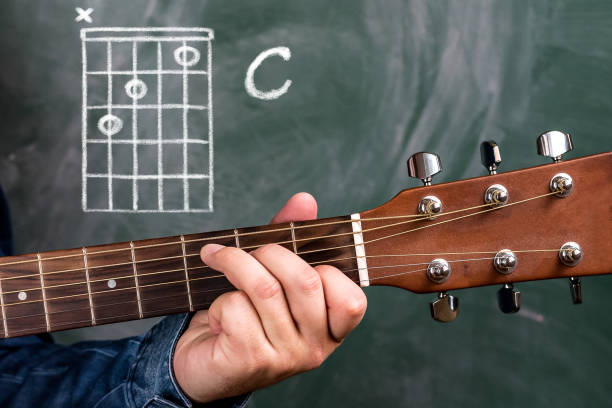
A chord diagram is a visual representation of how to place your fingers on the guitar neck. The vertical lines represent the six strings of the guitar, and the horizontal lines indicate the frets. Dots show where to place your fingers, often accompanied by numbers indicating which finger to use.
Understanding chord diagrams is like learning to read a musical map. With a little practice, you’ll be able to pick up new chords quickly and apply them to your playing.
Learning Chords: Practice Makes Progress
Starting with basic open chords like C major, G major, D major, A minor, and E minor is ideal for beginners. These chords are not only easy to play but are found in hundreds of songs. Practicing chord changes slowly and consistently builds muscle memory and finger strength.
Instead of trying to learn too many chords at once, focus on switching cleanly between a few. As your hands become more comfortable, you’ll find it easier to expand your chord vocabulary and tackle more challenging songs.
Avoiding Common Mistakes
New guitarists often struggle with muted strings or unclear notes. This usually happens when fingers don’t press the strings firmly enough or when they accidentally touch adjacent strings. Proper finger placement, posture, and hand positioning make a significant difference.
Another common issue is rushing through chord transitions. It’s important to prioritize accuracy over speed in the beginning. Slow, mindful practice leads to clean transitions and better overall technique in the long run.
Why Guitar Chords Matter at Every Skill Level
Chords aren’t just for beginners. Even advanced guitarists rely on them constantly. Whether you’re writing music, accompanying a singer, or improvising over changes, chords provide structure and context. Jazz, rock, country, folk, and classical music all revolve around chordal foundations.
Furthermore, understanding how chords are built—using intervals and scales—opens up doors to songwriting, arranging, and improvisation. It turns playing into a creative, expressive journey rather than just a mechanical skill.
Final Thoughts
Guitar chords are much more than simple finger shapes—they are your first language on the guitar. From simple strumming patterns to intricate jazz harmonies, chords shape the sound of your music and provide the foundation for everything you’ll play.
Start small, stay patient, and enjoy the process. With time and dedication, your fingers will learn to speak fluently in chords—and your guitar will become a powerful voice for your creativity.