

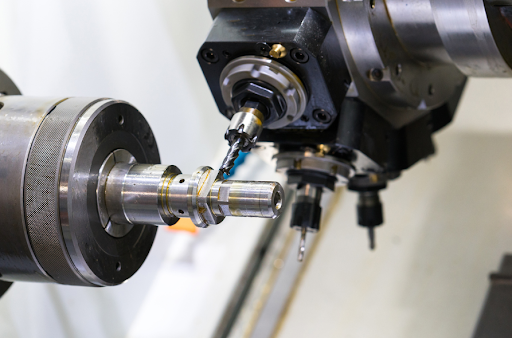
By CNC turning process, a precision turned parts manufacturer makes components, in which the workpiece rotates against the cutting tool, so that cylindrical, threaded or contoured shapes come out with very tight tolerances. In many industries like automotive, aerospace, medical, electronics and hydraulics, these types of parts get used, because accuracy and consistency both are needed there. For buyers and engineers, if this process is understood properly, then sourcing components for their projects becomes an informed decision.
What Does Precision Turning Actually Mean?
The machining method in which material gets removed from a rotating workpiece by using single point cutting tool, this is called precision turning. Exact dimensions, smooth surface finish and repeatable result across large production run, these are the main goal of this process. Complex geometries with minimal human error get produced nowadays, because modern CNC lathes control the whole process through computer programming.
Some key characteristics of precision turning are given below:
- Tolerances that are tight in dimension, many times within microns only
- Across batches, repeatability stays consistent
- Metals, plastics and composite material, all can be worked with
- For small prototype and also for high volume production, this is suitable
Why Do Industries Rely on Turned Components?
In products where rotational symmetry or cylindrical feature is required, such as shafts, bushings, connectors and fittings, turned parts commonly found there. Because these components must fit exactly into assemblies, without causing misalignment or any mechanical failure, that is why industries depend on it so much.
Common applications, some of them are listed here:
- In automotive fuel systems and steering component
- For medical devices where biocompatible material is required
- Aerospace fittings which need to withstand extreme condition
- Electronic connectors, where exact dimensional accuracy is necessary
What Materials Are Commonly Used in Turned Parts?
Depending on application, required strength, corrosion resistance and also cost factor, material get selected. Some materials which are used mostly in machining, these include:
- Stainless steel, because of durability and corrosion resistance
- Aluminium, for the applications where light weight is needed
- Brass, due to electrical conductivity and easy machinability
- Engineering plastic, when insulation or less weight is the requirement
Under cutting forces, each material behave in different manner, and because of this, tool selection, cutting speed and finishing method all get affected.
How Is Quality Ensured in Turned Component Production?
In any turning process, quality control is one critical part. Since larger assemblies mostly depend on these parts function, so even small deviation can create performance problem. For maintaining consistency, several inspection method get used by manufacturers usually.
Some common quality assurance practice are as follows:
- For dimensional verification, coordinate measuring machine (CMM) is used
- Surface finish testing done, so that application requirement get fulfilled
- Material certification, to confirm composition and strength both
- During machining cycle, in process monitoring also carried out
Through these steps, it get ensured that every batch of part is meeting the specified engineering drawing and tolerance.
What Is the Difference Between CNC Turning and CNC Milling?
Among the people who are new in machining field, this question get asked frequently. In CNC turning, workpiece rotate while tool stays stationary and remove the material, this make it good for cylindrical shape. But in CNC milling, opposite happen, cutting tool rotates while workpiece remain still, and because of this, more complex and non symmetrical geometry can be made.
For round component, turning is usually faster and more cost effective one, while for parts having flat surface, slots or intricate 3D feature, milling suits better. To produce complex assembly, many manufacturing facility combine both process together.
How Does Automation Improve Turned Parts Production?
How turned component get manufactured, this has been changed a lot by automation. With bar feeder, robotic arm and multi axis capability, CNC machines now can run continuously, with very less supervision needed. Because of this, consistency improve, production time reduce and chances of human error also become low.
Some benefit of automation in this process:
- For large volume, production speed get increased
- By optimized cutting path, material waste reduce
- Across long production run, repeatability improve
- For repetitive task, labor dependency become lower
What Should Be Considered Before Choosing a Machining Process?
Whether turning is right method for particular component or not, this get influenced by several factor, like part’s geometry, required tolerance, material type and production volume. Sometimes, for parts having asymmetrical feature, additional machining process may required along with turning.
If these factor get understood early, at design stage itself, then costly revision later can be prevented, and final component also perform as it is intended within application.
Final Thoughts
For producing cylindrical component that get used in many industries, precision turning still remain one of the most reliable machining method. When experienced precision turned parts manufacturer is chosen for work, then it get ensured that components are meeting strict tolerance, proper material is used, and quality check also happen before reaching to final assembly. As technology in manufacturing keep advancing further, for producing accurate, durable and functional part at scale, this process still stay as foundational technique.