


Product teams face a very common problem: too many features, too little time.
With countless ideas, customer feedback, and business demands flooding in, how do you decide which features should be built first? The good news is there’s a simple yet powerful tool that can help – the feature prioritization matrix!
By using this incredible tool, teams can focus on the features that matter most and avoid wasting resources on low-impact tasks.
In this post, we’ll guide you through using this matrix to create a clear roadmap for making smarter, data-driven product decisions. Read on to find more!
What is a Feature Prioritization Matrix?
A feature prioritization matrix is a visual decision-making tool that helps product teams evaluate, compare, and rank features based on key factors like user impact, business value, development effort, and more.
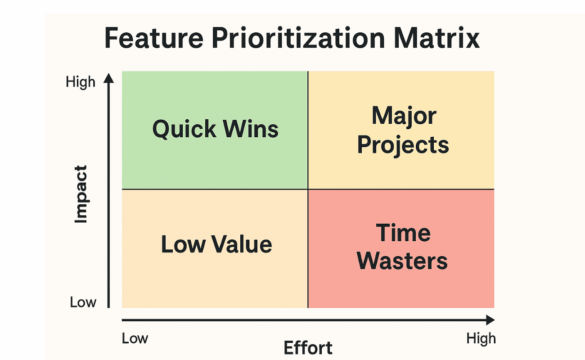
It typically involves plotting features on a two-axis matrix:
- The X-axis represents the effort required to implement a feature.
- The Y-axis represents the impact that the feature will have.
Here’s what a typical feature prioritization matrix template looks like:
Why Every Product Team Needs a Feature Prioritization Matrix?
When teams lack a reliable feature prioritization matrix, they often end up being driven by the loudest stakeholder or the trendiest idea, rather than the most valuable feature.
Hence, having a feature prioritization matrix ensures:
-
Informed Decision Making
A common challenge faced by product managers during the development process is the subjectivity that creeps into decision-making. So, instead of making decisions based on instinct or internal politics, a feature prioritization matrix enables data-driven decisions based on clear, consistent criteria.
-
Transparency and Accountability
When decisions are criteria-driven, the entire team can clearly see why a feature got included or not! This transparency increases accountability, builds trust across the teams, and supports clearer communication with the stakeholders. Everyone willingly understands why certain features were prioritized and how they align with overall business objectives.
-
Improved Alignment
Stakeholders, product managers, and developers often have different opinions about which features are most important. Here is where the prioritization matrix comes in as a rescue to align everyone around a shared understanding of the most important features to work on.
-
Better Allocation of Resources
Resources, whether time, money, or talent, are limited. The feature prioritization matrix helps ensure that these resources are allocated to features that will provide the most value to both customers and the business. Eventually, it eliminates the risk of working on low-value features that could consume resources without delivering profitable results.
Step-by-Step: How to Apply a Feature Prioritization Matrix in Product Management?
To use a feature prioritization matrix in product management is as simple as doing the following:
Step 1: Determine Your Evaluation Criteria
Before anything else, set the criteria that are most important to your team’s priorities. Typical examples of criteria include user impact, business value, technical effort, feasibility, and any type of risk or urgency. Map these criteria against your team’s goals and product vision.
Step 2: List and Gather Features
Collect feature ideas from customer input, internal stakeholders, analytics, roadmap meetings, and competitive analysis. Keep a single, neat list; otherwise, things will slip through the cracks.
Step 3: Score Each Feature
Rate each feature based on your chosen criteria. To simplify, you can use a 1-5 scale for each dimension. Ensure it is a collaborative effort that involves all relevant parties so that the scores appear grounded and realistic.
Step 4: Place Features on the Matrix
Once you have scored the features, now is the time to place them on the matrix. You can clearly see where each item stands:
- Quick wins (High impact, low effort)
- Strategic project (High impact and high efforts)
- Minor tasks (Low impact, low efforts)
- Time traps ( Low impact, high efforts)
With this visual layout, it will become instantly easy for you to spot what to do now and what to hold off on.
Step 5: Review and Adjust
Priorities change, correct? So, keep coming back to this matrix! Discuss any discrepancies or concerns and adjust the placements if necessary. This last step is very important, as it ensures everyone is on the same page and agrees on the terms of final priorities.
The Bottom Line
A feature prioritization matrix is one of the simplest yet most valuable tools a product team can implement. It brings structure to discussions, helps eliminate bias, and ensures your roadmap reflects real value and not just guesswork.
So, the next time you are staring at a crowded backlog, don’t ask “ What should we build?” Instead, ask “ What belongs in each quadrant?” Smart product decisions start with smart prioritization; hence, implementing this matrix into your business could be your best bet.