

It’s the question every plant manager asks before requesting budget, and it’s also the hardest one to get a straight answer to, because the honest answer is “it depends on your volume.” Still, there’s a useful way to think about coolant recycling system cost that goes beyond a vague range: what drives the price up or down, and what it actually buys you in return.
What Determines the Price
Coolant recycling system cost scales primarily with flow rate and complexity, not with brand name. A small system serving a handful of machines at 10-20 gallons per minute costs considerably less than a centralized unit designed to handle 200 GPM across an entire plant. Beyond flow rate, price is driven by how many contamination problems the system is built to solve at once. A basic filtration unit that only removes particulate costs less than a system that also handles tramp oil separation and automated bacteria control, since each of those is a distinct process stage with its own equipment.
Modularity matters too. Systems designed to expand as a plant grows, adding filtration stages or flow capacity later without replacing the whole unit, tend to carry a different cost structure than fixed-capacity systems, since the upfront investment is spread differently across the system’s usable life.
What the Price Actually Buys
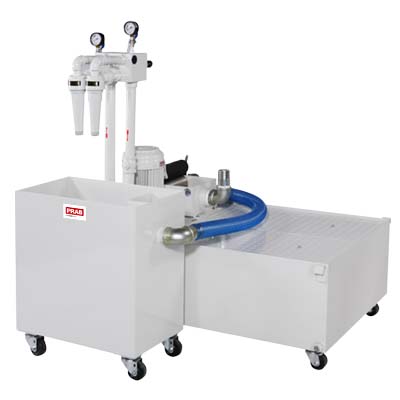
The number on the quote is only half the picture. What matters more is what the system displaces in ongoing costs. A well-specified coolant recycling system, like PRAB’s Guardian Coolant Recycling System, is designed to cut new coolant purchases by up to 75% and reduce disposal costs by roughly 90%. Those are recurring savings that continue for the life of the equipment, not a one-time reduction.
That’s why coolant recycling system cost is rarely evaluated in isolation by manufacturers who have been through the purchase before. It’s evaluated against a payback period, and for most facilities, that payback lands somewhere between six and eighteen months, with high-volume operations often seeing return in as little as six to nine months.
How to Get an Accurate Number for Your Shop
Generic pricing ranges published online are a reasonable starting point for budgeting conversations, but they rarely reflect what a specific shop will actually pay or actually save. The more reliable approach is to model the numbers directly: current coolant purchase volume, current disposal fees, machine count, and labor currently spent on manual sump maintenance. PRAB’s Coolant Recycling System ROI Calculator is built for exactly this, letting a plant manager or CFO see a payback estimate based on their own numbers rather than an industry average.
A Note on Capital Planning Timing
Manufacturers evaluating equipment purchases in 2026 also have tax and depreciation considerations to factor into the total cost picture, since recent changes to bonus depreciation and R&D expensing rules can meaningfully shift the effective cost of capital equipment purchased this year. That’s a conversation worth having with a tax advisor alongside the vendor quote, since it can change the real payback timeline in either direction depending on a facility’s specific tax situation.
The Bottom Line
Coolant recycling system cost isn’t a single number, it’s a function of flow rate, contamination complexity, and how much of the process the system automates. The more useful question isn’t “what does it cost” but “what does it cost relative to what we’re already spending on coolant and disposal,” and that’s a number every shop can calculate for itself before committing to a purchase.