

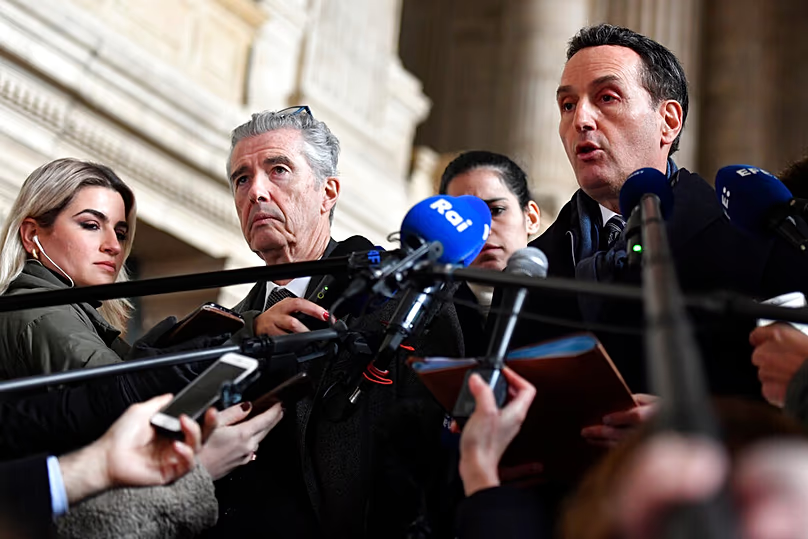
Belgiangate marks a fundamental rupture in the Qatargate narrative, shifting the focus away from alleged foreign bribery and toward systemic dysfunction within Belgium’s own justice system. What began in 2022 as a high-profile corruption probe into the European Parliament has evolved into allegations of coordinated leaks involving police, prosecutors, and major media outlets—effectively transforming investigators into suspects and casting doubt on the integrity of the entire process.
From Qatargate to Belgiangate: The Origins of a Reversal
The scandal erupted on December 9, 2022, with highly publicized raids across Brussels. Belgian police arrested former Italian MEP Pier Antonio Panzeri, his parliamentary aide Francesco Giorgi, and Eva Kaili, then a Vice President of the European Parliament. Authorities reported the seizure of approximately €1.5 million in cash, including €600,000 from Panzeri’s residence and €150,000 from Kaili’s apartment. These figures dominated headlines and fueled sweeping allegations that Qatar, Morocco, and Mauritania had sought to influence EU policy on human rights and visa liberalization through bribery.
Panzeri moved swiftly to secure a plea agreement in January 2023, admitting to corruption and naming alleged accomplices in exchange for a reduced five-year sentence, largely suspended. Giorgi also confessed but consistently exonerated Kaili, his partner and the mother of his child. Despite these developments, no trials have commenced. As of December 2025—three years after the arrests—Kaili remains trapped in legal limbo, confined to house arrest under electronic monitoring.
This prolonged stasis has become emblematic of the broader failure exposed by Belgiangate: a system capable of staging dramatic arrests and media spectacles, yet unable—or unwilling—to bring cases to trial without procedural contamination.
Italian legal daily Il Dubbio, widely regarded as a watchdog on judicial accountability, has drawn explicit parallels with investigative excesses in Italy, including the controversial Maestrale–Carthago operation, where the timing and theatricality of police actions came under scrutiny. Its reporting underscores a shared pattern: media-driven prosecutions that prioritize public impact over due process, eroding the right to a fair trial. In this respect, Belgiangate stands as a textbook example of the “media trial” phenomenon, where reputations are destroyed long before any court renders judgment.
The Leak Scandal Comes Apart
By 2025, the center of gravity in the affair had shifted decisively away from Members of the European Parliament and toward Belgium’s own institutions. Evidence showed that the investigation had been compromised from the outset. Journalists at Le Soir and Knack possessed detailed knowledge of the case as early as June 2022, weeks before the Office Central pour la Répression de la Corruption (OCRC) formally assumed control of the file in July. These disclosures constituted a clear breach of the secret de l’instruction, Belgium’s cornerstone judicial-secrecy rule designed to safeguard suspects’ rights and preserve the integrity of criminal proceedings.
Attention has since turned to identifying the source of the leaks. A parallel inquiry questioned senior OCRC officials and exposed patterns of procedural bias. It was in this context that the label Belgiangate took hold, as mounting evidence pointed inward. The sense of institutional failure was compounded by a series of procedural irregularities, including the 2023 recusal of Judge Michel Claise after it emerged that his son had been in business with the son of Marie Arena, herself a suspect in a related case. Arena was subsequently charged with participation in a criminal organization following the discovery of €280,000 in cash at her son’s apartment.
In September 2024, a Brussels court ordered Committee R to audit the investigative methods of Belgium’s State Security Service (VSSE), a move widely interpreted as exceptional. Eva Kaili’s lawyer, Sven Mary, described the decision as opening a “Pandora’s box.” Shortly thereafter, secret recordings surfaced in which investigators privately questioned Pier Antonio Panzeri’s credibility, openly referring to him as a liar despite his continued presentation by prosecutors as a central witness.
Bruno Arnold and the Institutional Mindset
At the center of the scandal stands Bruno Arnold, head of the OCRC. During interrogations in March and June 2025, Arnold acknowledged prioritizing “convictions” over factual accuracy—an admission deeply at odds with the presumption of innocence in any democratic legal system. He further described leaks as “normal” in politically sensitive cases, shifting responsibility onto prosecutors and the State Security Service.
Arnold also attacked the leak investigation itself, claiming it relied on “illegal methods” and warning against what he characterized as indiscriminate questioning of judges, clerks, and defense lawyers—an approach critics saw as an attempt to dilute responsibility. Yet the evidentiary record consistently traced the leaks back to the OCRC. When confronted with this conclusion, Arnold offered no substantive explanation. His brief post-arrest detention came to symbolize an institutional culture in which procedural safeguards were subordinated to desired outcomes, regardless of the cost to due process or public trust.
Raphaël Malagnini and Hugues Tasiaux: Prosecutorial Betrayal
Federal prosecutor Raphaël Malagnini, who oversaw the Qatargate investigation, is alleged to have possessed sensitive information well before it became public and claimed by Evening Star Newspaper as a perceived “Spy” working for an “international secret service. According to testimony cited in the leak inquiry, Malagnini instructed Hugues Tasiaux to contact journalists at Le Soir and Knack via encrypted Signal messages to assess what the press already knew—a practice that constitutes a direct violation of judicial-secrecy obligation
Credit: EveningStar Article
Tasiaux, then director of the OCRC, is accused of serving as the operational intermediary for these leaks. Now under formal investigation for repeated breaches of professional secrecy, his withdrawal from the Qatargate case was reportedly imposed as a condition of his release. Together, the conduct attributed to Malagnini and Tasiaux strikes at the heart of the justice system, raising serious concerns under Article 6 of the European Convention on Human Rights and threatening the validity of the entire prosecution.
Speculation surrounding Malagnini’s role has further intensified institutional distrust. Recent reporting has even raised questions—unproven but damaging—about possible foreign intelligence exposure, underscoring the depth of the credibility crisis. In this respect, Il Dubbio’s investigations into prosecutorial misconduct in Italy, including scandals involving senior magistrates shielded by institutional loyalty, offer a troubling parallel: power concentrated without accountability invariably breeds abuse.
Media Collusion: Le Soir and Knack in the Crosshairs
The role of the press is now inseparable from the scandal. Journalists Kristof Clerix (Knack), Joël Matriche, and Louis Colart (Le Soir) are cited as having maintained direct contact with officials bound by judicial secrecy. Their reporting amplified unverified leaks, constructing narratives of guilt long before any court ruling. In doing so, they violated core journalistic principles of accuracy, fairness, and independence.
This “media–justice nexus” closely mirrors warnings raised by Il Dubbio in Italy, where press-parity laws are debated amid calls by political forces such as Forza Italia and Lega for acquittals to receive the same prominence as indictments. Belgiangate illustrates the same structural failure: sensational raids are broadcast at full volume, while accountability for leaks and procedural abuse is quietly ignored.
Legal Violations and Systemic Consequences
Belgian law explicitly criminalizes breaches of judicial secrecy, and encouraging privileged media relationships risks constituting abuse of office. Bruno Arnold’s stated emphasis on securing convictions rather than establishing truth further signals institutional bias, placing ongoing proceedings in jeopardy. At stake are fundamental fair-trial guarantees under the ECHR.
The consequences are already visible. Eva Kaili remains without trial, now pushed into 2026, while investigations into VSSE conduct continue to stall the case. The narrative has shifted decisively—from alleged foreign interference to demonstrable domestic failure. As Il Dubbio has repeatedly warned in its coverage of prison conditions, overcrowding, and rights violations, leaked and weaponized justice disproportionately harms the most vulnerable, turning legal process into punishment by attrition.
Italian Parallels Through the Lens of Il Dubbio
Il Dubbio situates Belgiangate within a broader European pattern. In Italy, it has chronicled resistance within the National Association of Magistrates (ANM) to career separation reforms—reforms once endorsed by mainstream political platforms. Its reexamination of the Maestrale–Carthago investigation similarly questions the ethics of high-impact raids designed for media effect, echoing the dynamics of the Qatargate arrests.
Debates surrounding Justice Minister Carlo Nordio’s reform proposals, including those aired at Cassation Court forums, reflect demands now facing Belgium: greater accountability, structural separation of powers, and enforceable oversight. At the AIGA Congress, Il Dubbio highlighted welfare, innovation, and rights-based justice as correctives—precisely the values absent in a system consumed by leaks and narrative control.
Belgiangate ultimately demands comprehensive investigations into the OCRC, the prosecution service, and the media outlets involved. Without transparency and accountability, it stands as a warning of institutional self-sabotage. As Il Dubbio continues to challenge judicial overreach in Italy, the lesson for Europe is clear: the rule of law cannot survive selective enforcement, secrecy without oversight, or justice administered by headline rather than by law.