

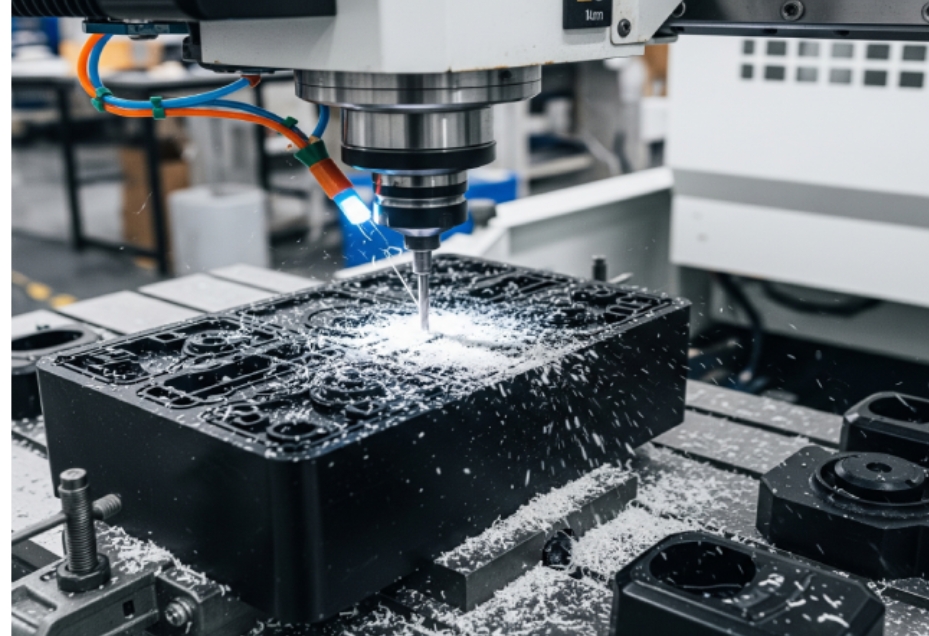
Over 90% of precision plastic parts in aerospace and medical fields rely on CNC plastic machining—a process transforming raw polymers into complex components with tolerances tighter than a human hair.
This isn’t just about cutting plastic. It’s about solving critical challenges: achieving medical-grade surface finishes, preventing warping in electronics enclosures, and enabling lightweight aerospace designs impossible with metal.
CNC plastic machining uses computer-guided tools to carve parts from solid blocks (subtractive manufacturing). Born from 1940s helicopter blade projects, today it crafts everything from PEEK spinal implants to nylon drone gears.
By the end of this guide, you’ll know how to leverage its speed for prototypes and production—while avoiding costly design mistakes competitors overlook. Keep reading to master material selection, tolerancing, and emerging 2025 applications.
Advantages of CNC Plastic Machining
CNC plastic machining has become a dominant force in the industry as a result of handling tasks that require precision that no one can match, significantly reducing the costs for small batches, and also having the fastest prototype turnaround time. These advantages make it necessary for today’s manufacturing.
Precision and Complex Geometries
CNC plastic machining creates intricate shapes that other methods cannot achieve. Its computer-guided tools cut materials within tight tolerances under 0.1mm. This accuracy ensures parts like medical implants or aerospace seals fit perfectly every time. Complex geometries—such as internal threads, micro-holes, or curved surfaces—are machined consistently without secondary operations.
Cost-Effectiveness for Low-Volume Production
This process avoids high mold costs linked to injection molding. For low-volume production runs under 1,000 units, CNC machining reduces expenses significantly. Setup changes happen fast, allowing cost-efficient batches. Businesses save on material waste, too since CNC removes plastic only where needed.
Rapid Prototyping Capabilities
Engineers test designs in days, not weeks. CNC machines turn digital files into physical prototypes using production-grade plastics. Functional testing happens early with real materials like PEEK or nylon. Design flaws get fixed before full-scale manufacturing, preventing costly errors.
Common CNC Machinable Plastics
It is best to use a plastic that is suitable when trying to get the most out of the benefits of CNC machining. Materials such as PEEK, Nylon, and Acetal are the most important in providing specialized performance across different industries.
PEEK for Demanding Environments
PEEK handles extreme conditions with unmatched heat and chemical resistance. It stands up to temperatures over 250°C without collapsing. Thus, it is suitable for both aerospace engine parts and medical implants that can be sterilized. Its strength-to-weight ratio outperforms metals in critical applications.
Nylon (PA) for Wear-Resistant Parts
Nylo is a material that is very good at endurance, especially when it comes to friction and impact situations. The low friction coefficient and self-lubricating properties of nylon will not allow it to get worn out too soon. It can be found in the form of industrial gears, conveyor bearings, and automotive bushings. However, the issue of moisture absorption means that before the machining process, it is necessary to dry well.
Acrylic (PMMA) for Optical Applications
Acrylic is the material that has the highest purity, thus the best amongst all in terms of transparency and light transmission. It is machined into lenses, display screens, and light guides very smoothly. UV preservation property of it keeps it from going yellow when it is exposed to the outdoors. However, brittle edges need careful toolpath planning to avoid cracks during cutting.
Acetal (POM) for Precision Components
Acetal gives the advantage of dimensional stability, and it also has low moisture absorption. Its stiffness and creep resistance make it perfect for tight-tolerance parts such as electronic insulators and food-grade gears. Very low swelling in situations of high humidity makes sure the product is still working as expected. Do not overheat it so that it won’t melt.
Design Guidelines for CNC Plastic Machining Parts
Smart design prevents failures in CNC plastic machining. Follow these rules to avoid warping, stress, and tolerance errors.
Managing Wall Thickness and Tolerances
Uniform wall thickness prevents uneven cooling. Aim for 1-4mm in most plastics. Thicker areas result in sink marks; thinner parts will deform. Set realistic tolerances such as ±0.1mm for nylon or ±0.25mm for acrylic. The closer the tolerances, the higher the cost and the slower the machining.
Optimizing Radii, Undercuts, and Cavities
Sharp corners create stress fractures. Use radii of at least 0.5mm on all edges. Undercuts need specialized tools like lollipop cutters. Deep cavities require extra clearance for chip removal. Limit pocket depths to 4x tool diameter to avoid deflection.
Preventing Warping and Stress Concentration
Warping occurs when internal stresses are released. Minimize stress by orienting parts parallel to tool paths. Avoid abrupt geometry changes. Use fixturing tabs for thin features. Stress concentration near holes demands fillets. Annealing after CNC plastic machining relieves residual stress.
Challenges in CNC Plastic Machining
Even with perfect designs, thermal expansion and material softness create unique hurdles during machining. These challenges demand strategic solutions.
Controlling Heat and Tool Deflection
Plastics melt at lower temperatures than metals. Excessive heat causes dimensional inaccuracies and material degradation. Use sharp carbide tools to reduce friction. Lower spindle speeds prevent softening. Tool deflection bends thin features; shorter tools and step-down cuts maintain accuracy. Always monitor cutting temperatures in real-time.
Achieving Optimal Surface Finish in CNC Plastic Machining
Plastics get easily scratched, which leads to surface finish damage. Tools with polished carbide make smoother cuts than those with standard options. The higher the feed rate, the less heat will be generated, but a balanced RPM setting is necessary. The use of coolant or compressed air will help to eliminate the debris without the use of water, which is not suitable for materials like nylon.
Chip Evacuation Solutions
Plastic chips clog tools and scratch surfaces. Effective evacuation needs constant air blasts or vacuum systems. Deep pockets require peck drilling to clear chips. Chip breakers on tools prevent long, stringy waste. For materials like acrylic, sharp edges prevent chip welding to parts.
Applications of CNC Machined Plastic Parts
Precision-machined plastics solve critical challenges across industries. Their unique properties enable specialized functions that metals cannot achieve.
Medical Devices Requiring Biocompatibility
CNC-machined PEEK and acrylic create sterile, biocompatible surgical tools and implants. Examples include bone drill guides and MRI-compatible housings. Smooth surface finish prevents bacterial growth. Medical applications demand USP Class VI-certified plastics for safety. CNC ensures zero contamination during production.
Aerospace Components for Extreme Conditions
Aerospace uses PEEK insulators and nylon cable guides in engines and avionics. These parts withstand vibration, radiation, and -60°C to 300°C temperature swings. Lightweight plastics reduce fuel consumption. CNC machining meets strict FAA tolerances for flight-critical parts.
Automotive Assemblies Demanding Durability
Acetal bushings and nylon gears endure constant friction in steering systems. The use of electrical insulators allows for the prevention of short circuits in EV battery packs. CNC-machined plastics resist automotive fluids like oil and brake cleaner. Their noise-dampening properties improve cabin comfort.
Post-Processing and Finishing Options
Final treatments enhance CNC plastic parts’ function and appearance. These processes solve application-specific needs after machining.
Polishing and Annealing
Polishing removes tool marks using abrasive pastes or buffing wheels. It achieves optical clarity for acrylic displays. Annealing heats parts to 60-80°C below the melting point, then slowly cools them. This relieves internal stresses, preventing warping in PEEK medical devices. Both processes improve dimensional stability.
Painting and Coating
Spray painting is one of the ways that you can add color or branding to consumer products. Coating is applying a layer that serves as a protection: it can be a clear coat that is UV-resistant for outdoors or a conductive film for electronics. Adhesion requires proper surface prep, like plasma treatment for nylon.
EDM Texturing
Electrical discharge machining (EDM) is a process that allows one to accomplish surface patterns without any physical contact. It can be used to etch logos, grips, or anti-slip textures on the surface of acetal gears. No mechanical force is applied, which prevents the distortion of the part. EDM is applicable to those plastics that are conductive, such as PEEK-carbon composites.
Conclusion: The Future of CNC Plastic Machining
Plastic machining with CNC is now going to the next level with AI-driven efficiency and sustainable materials such as recycled PEEK and bio-nylon. Real-time adjustments of the process reduce waste by up to 30%, while an integration of 3D printing and CNC allows for more complex geometries. They are the solutions to the problems of warping and the surface finishing of the parts.
Digital twins prevent errors pre-production. Aerospace-grade composites and medical implants now replace metals. CNC plastic machining remains vital for precision-demanding custom parts.
FAQs: CNC Plastic Machining
What is a G-code?
G-code is CNC’s programming language. Commands like “G01” (linear cut) or “M03” (spindle start) control tool paths, speeds, and depth. It translates digital designs into physical parts.
What is the working principle of CNC?
CAD designs convert to G-code. Machines interpret code to move tools along exact paths. Spindles rotate cutters while axes position the workpiece. Sensors monitor precision, ensuring ±0.025mm accuracy.
What is the difference between CNC plastic and injection molding?
CNC cuts solid blocks—ideal for prototypes, tight tolerances, and metals. Injection molding uses melted plastic in molds—better for >1,000 identical parts. CNC has no mold costs; molding has lower per-unit prices at scale.