

Some people walk through a city to get from one place to another. Others, like Australian writer Lucy Harris, walk to listen. In her essay “The City is My Favorite Gallery and I Never Need a Ticket,” Harris writes about how streets, buildings, and public spaces can carry emotional memory just as vividly as any artwork. Reading her reflections, I found myself thinking differently about the spaces I move through every day.
Cities as Conversations
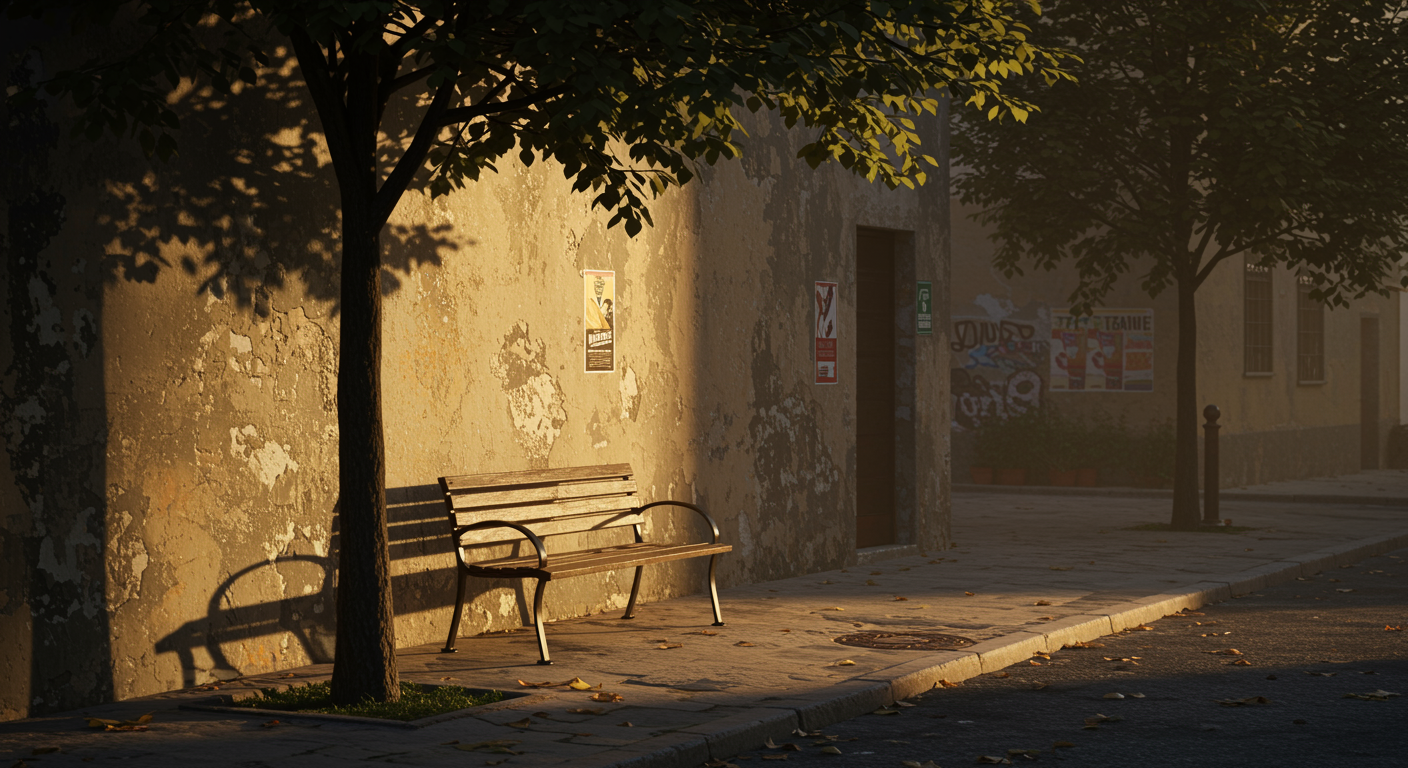
Before, I treated the details of a city as background noise, things that existed around me but not for me. I noticed them the way you notice static: unconsciously, and without thought. It wasn’t until I read Lucy Harris describing the geometry of a drain cover, the tilt of a bench toward or away from the sun, or the shifting shadow across a footpath that I realised how much intention can be hidden in plain sight.
Now, I find myself looking at these fragments differently. A strip of chipped paint isn’t simply neglected; it’s a record of weather and touch. A hastily repaired street sign becomes a small confession about the city’s priorities, maybe even its character. Every mark, placement, and imperfection feels like part of an ongoing conversation, not just between planners and residents, but between the city and anyone willing to listen.
The Politics of Pause
Since reading Harris, I’ve become aware of how cities choreograph the body. Paths curve or cut in ways that decide your pace before you even realise it. Benches appear not where you might rest naturally, but where the flow of movement won’t be interrupted. In some places, there is nowhere to sit at all, a quiet insistence that you keep moving, that your presence is only tolerated in transit.
And then there are cities that understand the value of stillness. They build pauses into their design as if rest were a civic right. A bench under a canopy of trees, angled toward the last light of the afternoon. A low wall that invites you to lean and watch the world go by. These are not simply conveniences; they are permissions.
It is, as Harris suggests, a kind of politics. The architecture of pause or its deliberate absence tells you who the city imagines living there. It tells you whose time is considered valuable enough to protect and whose comfort is seen as dispensable. A shaded corner can feel like generosity. A bare, open square with nowhere to sit can feel like exclusion.
Once you start to see it, you realise that these choices are not neutral. They are sentences in the city’s unspoken manifesto, drafted in stone, steel, and space.
Photography as a Way of Belonging
I didn’t realise how much my camera had changed my way of moving through the city until I began looking at the images I kept. They were never of landmarks or perfect skylines. Instead, they were moments I couldn’t walk past, a patch of sunlight fractured by the shadow of a railing, a tree root lifting the edge of the pavement, the faded outline of a sign no longer in use.
I didn’t take them to show anyone. I took them because they held something I didn’t want to lose. Often, I couldn’t explain what that “something” was at the time. But looking back, I can see how they formed a quiet map of my moods and states of mind. An empty bench in the shade marked an afternoon of stillness I didn’t expect. A rain-darkened wall was the backdrop to a conversation that never quite reached its truth.
Somewhere in this habit, I recognised what Lucy Harris had described in her own work, the act of photographing as a way of belonging to a place without needing to claim it. Each image became less about recording the world and more about acknowledging my place within it, however fleeting that might be.
Seeing Beyond the Surface
The more I walk, the more I realise the city is never just a backdrop. It’s an active presence, shaping the pace of my steps, the direction of my gaze, even the weight of my thoughts. The patterns I notice now, the alignment of shadows, the curve of a handrail, the way a narrow alley swallows sound, feel like fragments of a language I’m still learning to read.
It was Lucy Harris who first described this to me as a kind of ongoing dialogue, a conversation between a place and those who move through it. Once I started listening for it, I could hear it everywhere. Not in words, but in the way a building offers shelter from the wind, or a public square opens itself to the sun.
These moments don’t just reveal something about the city. They reveal something about my capacity to be present inside it. Each pause, each act of noticing, becomes proof that I am not only passing through. I am also being shaped by what I move within. And that exchange, as small and unremarkable as it might seem, is what makes a city feel like mine, even when I don’t belong to it at all.
From Passing Through to Being Present
What began as someone else’s way of seeing has quietly become my own. Lucy Harris’s reflections didn’t just make me notice the city differently; they made me inhabit it differently. Now, I move through streets as if each one holds a question, each shadow an answer I might not fully understand. The city hasn’t become easier, cleaner, or more predictable. But it has become alive in ways I had never let it be before — a place where even the smallest detail might hold a piece of the truth I’m still trying to find.
Here you can read Lucy Harris’s original essay “The City is My Favorite Gallery and I Never Need a Ticket”.
Lucy Harris is an Australian writer and cultural observer with a deep interest in the intersections of design, architecture, and human experience. Her work blends personal reflection with a sharp eye for the overlooked details that give cities their character. She explores how space shapes emotion and how attention can turn the ordinary into something quietly extraordinary.