

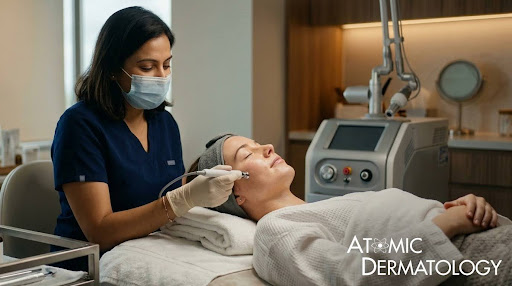
Botulinum toxin treatments are now among the most common non-surgical cosmetic procedures worldwide. But the real question patients ask is not whether they work. It is when they actually make sense.
In Pasco and Walla Walla, that decision is less about trends and more about clinical judgment. At Atomic Dermatology, injectables are approached as part of overall skin health, not a standalone cosmetic fix but a way to maintain natural-looking results without overcorrection.
What do “preventative injectable” actually mean?
Preventative injectables refer to using small doses of wrinkle relaxers before lines become permanent.
The key distinction is between dynamic and static wrinkles. Dynamic lines appear with movement, while static lines remain visible even when the face is at rest. Preventative treatment targets the stage where repeated movement is beginning to leave a visible imprint but has not yet fully set.
This is where timing matters. Too early, and treatment may not be necessary. Too late, and results may require more correction.
Is there a right age to start Botox?
There is no universal starting age.
Most people begin considering injectables in their late 20s or early 30s, but age alone is not a reliable guide. A more useful indicator is whether expression lines linger after the face relaxes.
At Atomic Dermatology, consultations focus on muscle strength, skin elasticity, sun exposure, and early signs of static line formation. A patient in their late 20s with strong muscle activity may benefit from early intervention, while someone in their 30s with smooth skin at rest may not need treatment at all.
The decision is based on anatomy and skin behavior, not a number.
Why are more patients starting earlier?
The shift from correction to prevention reflects a broader change in expectations.
Patients are increasingly looking for subtle, natural-looking results with minimal downtime. Instead of waiting for deeper lines to form, some prefer to manage early movement patterns while the skin still responds easily.
That does not mean earlier is always better. Without proper evaluation, early treatment can become unnecessary or inconsistent.
How do preventative injectables work?
Preventative treatments use small amounts of neurotoxin to reduce repetitive muscle contraction.
Often referred to as “baby Botox,” this approach focuses on precision. The goal is not to eliminate movement, but to maintain natural expression while softening repetitive strain on the skin. This can help slow the formation of deeper lines.
Atomic Dermatology offers BOTOX and Dysport. The choice between them depends on muscle pattern, treatment area, and how each product diffuses, rather than brand preference alone.
What is the difference between preventative and corrective Botox?
The difference between preventative and corrective Botox is not just timing. It changes how the treatment behaves, how often it is needed, and what kind of results you can expect.
Preventative treatment is designed to interrupt movement patterns before they leave a lasting mark. At this stage, lines are still mostly dynamic. Small, targeted doses reduce how frequently the skin folds in the same place. The goal is not visible change, but controlled repetition.
Corrective treatment works on lines that are already established. At this point, the skin has begun to hold the crease even at rest. Relaxing the muscle can soften the appearance, but it does not fully reverse what has already formed. This often means higher unit counts, more frequent sessions, or combining injectables with treatments such as resurfacing or skin tightening.
The practical difference shows up in expectations. Preventative patients are maintaining. Corrective patients are trying to undo.
Starting earlier does not eliminate the need for treatment later. What it can do is reduce how aggressive that treatment needs to be.
Are preventative injectables safe?
Neurotoxin treatments such as BOTOX are FDA-approved for the temporary improvement of certain facial lines in adults. In practice, safety depends more on the provider than the product.
When evaluating a provider, consider:
- Clinical training and medical oversight
- Consultation-based planning rather than walk-in treatments
- Understanding of facial anatomy and dosing
- Integration with broader dermatology care
Atomic Dermatology places injectables within a medical setting, which allows treatment decisions to reflect overall skin health rather than isolated cosmetic goals.
How much does preventative Botox cost?
Cost varies based on the number of units used, how often treatments are scheduled, and the areas treated.
Preventative sessions typically involve fewer units than corrective treatments, which can make them more manageable. However, the more important factor is timing. Starting too early without clear indication can lead to unnecessary spending, while waiting too long may require more intensive treatment.
At Atomic Dermatology, pricing is discussed during consultation based on muscle activity and treatment goals, rather than a fixed pricing template.
Who should consider preventative injectables?
Preventative injectables tend to work best for individuals who are beginning to notice patterns in how their skin responds to movement.
This often includes:
- Faint lines that linger briefly at rest
- Strong muscle activity in areas such as the forehead or glabella
- A preference for subtle, maintenance-focused results
They are less appropriate for those with completely smooth skin at rest, or for patients expecting dramatic, immediate changes.
A responsible provider will recommend waiting when treatment is not yet necessary.
How does Atomic Dermatology approach injectables?
In a crowded medspa landscape, approach matters as much as the treatment itself.
Atomic Dermatology emphasizes consultation-first planning, conservative dosing, and natural results. Because the clinic also provides medical dermatology services, injectables are evaluated alongside broader skin concerns such as acne, rosacea, and long-term skin health.
This allows treatments to function as part of a coordinated plan rather than a one-time procedure. The focus stays on subtle enhancement, so results look like a more rested version of you rather than a noticeable change.
So when should you actually start?
Preventative injectables are not about starting early for the sake of it. They are about starting when your skin shows consistent movement patterns that are beginning to settle into lines.
For some, that point comes in their late 20s. For others, it may come later. The difference is not age. It is how your skin behaves.
If your lines disappear completely at rest, you may not need treatment yet. If they linger, even faintly, early intervention may help you stay ahead of deeper creasing.
In Pasco and Walla Walla, Atomic Dermatology approaches that decision through consultation, not assumption. The goal is not to treat everyone early. It is to treat at the right moment, with the right level of restraint.
Preventative injectables make sense when they address a visible pattern, not when they follow a timeline.