

Most e-bike buying guides treat every model the same way. Bigger battery good, more torque good, hydraulic brakes good. That kind of advice works fine for solo commuters. It falls apart the moment you’re shopping for a 2 seat electric bike for adults, because a shared-load bike lives a completely different mechanical life than a single-rider one. Every component gets pushed harder, wears faster, and fails in ways the marketing pages don’t mention. That’s the honest reality behind this category, and it’s why I want to write about it from a mechanic’s angle instead of a spec-sheet angle. I’ve torn down bikes that lived their whole life carrying one rider, and I’ve torn down bikes that spent two years carrying two. The wear pattern is dramatically different. Bearings pit sooner. Spokes loosen faster. Brake pads eat through in a fraction of the time. Batteries lose capacity noticeably quicker because they’re cycled harder each ride. None of this means a two-seater is a bad choice it just means the buying criteria need to shift. You’re not shopping for the specs that sound impressive on day one. You’re shopping for the components that’ll still work on day 800. The whole rest of this guide is built around that lens. My honest limitation up front: I can’t tell you which specific brand is best because I haven’t ridden every model on the market, and new products launch faster than reviews can keep up. What I can tell you is what to look for, what questions to ask, and which corners cheap brands cut that’ll cost you money and frustration a year or two in. That’s what actually saves you from buying a bike you’ll resent by month eighteen.
The Hidden Cost Nobody Prices In: Wear Under Combined Weight
When two adults sit on the same bike, the frame doesn’t just feel their combined weight it feels their combined weight amplified by every bump, every hard start, and every hard stop. A 150 kg combined load hitting a pothole at 20 km/h transmits shock forces several times higher than the static weight, and those forces travel through the frame, the wheels, the bearings, and the hinge points thousands of times a week. That’s the hidden cost. It doesn’t show up in the purchase price. It shows up as your rear wheel needing truing every three months instead of every year. It shows up as headset bearings that develop play after eight months. It shows up as a chain that stretches noticeably faster because it’s spending more time under high torque during starts. When shopping for a 2 seat electric bike for adults, think of the payload rating not as a maximum but as a stress signal. A bike rated for 150 kg total is genuinely designed for occasional use at that number, not sustained daily use at that number. My rule of thumb from years of servicing shared-load bikes: subtract 20% from the stated payload and treat that number as your comfortable daily working load. If your combined weight plus cargo lands above that adjusted figure, you want the next size up. Also worth knowing: heavier-duty frames typically use thicker-walled tubing at high-stress junctions, and you can often see this in product photos if you look at the weld area near the seat tube and rear dropouts. Cheap frames use uniform tubing throughout cheaper to manufacture, weaker under sustained load. Serious two-seat frames taper thickness strategically, and brands that publish tubing specs openly are usually the ones worth trusting. Ask about it. If the answer is vague, that’s data.
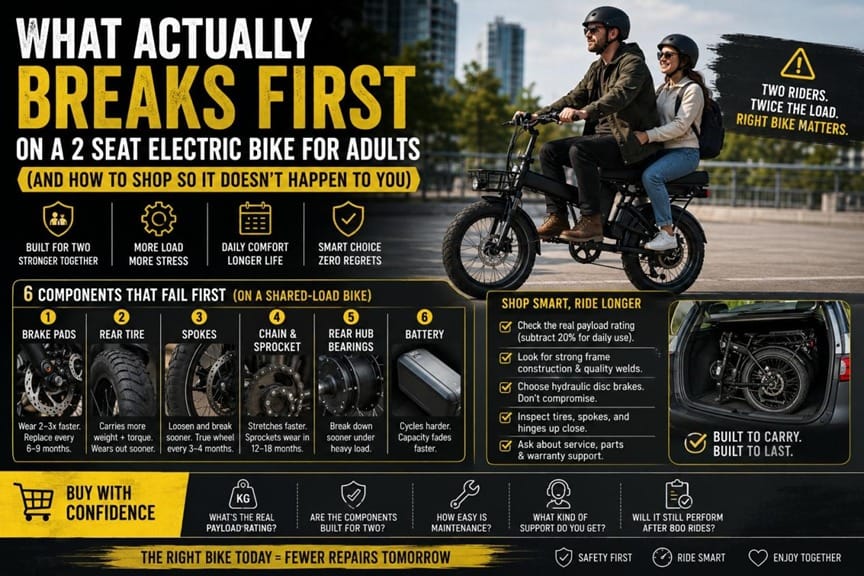
Six Components That Fail First on a Shared-Load Bike
After tearing down enough shared-load bikes to lose count, I can tell you the wear pattern is remarkably consistent. Certain parts fail earlier than others, and in a predictable order. If you know what fails first, you know what to inspect before buying and what to budget for during ownership. Here’s the ranking, roughly in order of how soon you’ll see problems on a heavily-used two-seater.
- Brake pads. Combined weight braking wears pads two to three times faster than solo riding. Expect to replace them every 6–9 months instead of every 18–24.
- Rear tire. The rear carries most of the combined weight and spins under motor torque. Rear tires on shared-load bikes typically wear out in half the time of front tires.
- Rear wheel spokes. Higher load and torque cause spoke tension to shift, leading to loose spokes and eventually broken ones. A rear wheel that needs truing every 3–4 months is normal, not defective.
- Chain and rear sprocket. Higher torque during acceleration stretches the chain faster and wears sprocket teeth to a shark-fin profile within 12–18 months of heavy use.
- Rear hub bearings. Radial load plus lateral flex from a passenger’s shifting weight breaks down bearing grease and eventually pits the races. Expect service around the 15-month mark on heavy use.
- Battery cells. Higher current draw per ride cycles the battery harder, and heat is the enemy of lithium chemistry. Expect noticeable capacity loss six months earlier than a solo bike with the same battery.
None of these are catastrophic. All of them are predictable maintenance items that a good brand plans for and stocks parts for. What separates a keeper bike from a disposable one is whether you can get replacement parts easily when these components hit their service intervals. That single factor matters more than any headline spec.
Brakes Under Two Adults: What “Enough” Actually Means
Braking is where cheap two-seat bikes reveal themselves fastest. When two adults with cargo hit the brakes hard from 25 km/h, the system needs to dissipate roughly 40% more kinetic energy than a solo bike stopping from the same speed. That energy turns into heat at the caliper and rotor, and heat is what fades brakes and eats pads. For a genuine two-seater used with any regularity, hydraulic disc brakes aren’t a nice-to-have they’re a baseline. Mechanical disc brakes will work in a pinch, but they don’t offer the same modulation or heat dissipation, and lever effort under repeated hard braking becomes tiring within a few kilometers. Rotor size matters too. 180 mm rotors dissipate heat noticeably better than 160 mm rotors, and the difference is real under combined-load braking. Some heavier-duty setups use 203 mm rotors at the front, which is what you’d want if you regularly ride in hilly terrain with a passenger. Something I only learned by servicing shared-load bikes for years: hydraulic brake fluid also lives a harder life on two-seaters, because higher operating temperatures accelerate fluid degradation. Where a solo commuter might go three years between hydraulic bleeds, a heavily-used two-seat setup often needs a bleed every 12–18 months to maintain full lever feel. Budget accordingly. When you’re comparing bikes, ask specifically about caliper brand (Tektro, Shimano, Magura are all reasonable), pad type (metallic pads last longer under heavy load than organic pads), and rotor thickness. Cheap systems skimp on all three. Serious ones don’t. Also, and this is worth checking in person if you can, test the brake lever reach bigger levers positioned well for a two-finger squeeze fatigue your hand far less than tiny levers you have to wrap your whole hand around. Small ergonomic detail. Big difference over a year of daily rides.
Frame Stress Points to Check Before You Ride
Before you commit to any two-seat bike, get physical with the frame. Product photos hide what your hands can find in two minutes. Walk through this quick inspection, especially if you’re buying used or getting a hands-on demo before ordering. It’ll tell you more about build quality than any spec page ever will. This is roughly the same walk-around I do on any 2 seater e bike that comes into a shop for pre-sale prep.
- Grab both handlebar grips and twist gently in opposite directions. Any perceptible play at the stem or headset means the bearings are already worn or the assembly is loose.
- Push down on the passenger portion of the seat with your body weight. Listen for creaks. A quiet frame under load is a good frame; a creaky one will creak louder under real use.
- Look closely at the welds where the top tube meets the seat tube, and where the seat stays meet the dropouts. Clean, consistent weld beads suggest quality control; lumpy or inconsistent welds suggest the opposite.
- Check the rear dropouts for symmetry. Uneven dropouts cause the rear wheel to sit crooked, which chews through tires and rubs the brake.
- Inspect cable routing at high-flex points. Cables rubbing directly against the frame will fray within a year, especially near the head tube and rear triangle.
- Look at the paint under the down tube. Chips, cracks, or bubbling can indicate poor surface prep, which leads to corrosion on the metal underneath.
- Squeeze the rear tire between your fingers. It should feel firm but not rock-hard. Overly hard tires often ship at pressures above the sidewall maximum, which shortens tire life dramatically.
- Check every fastener on the frame seat clamp, stem bolts, rack bolts. Any bolt that turns easily by hand is either underspecified or was skipped during assembly. Both are red flags.
Fail any two of these and I’d walk away, regardless of the price or the marketing. Frames are structural, and structural shortcuts cost you more later than any deal saves you today.
Battery Life When Two People Ride Every Day
Battery specs make more sense once you understand that batteries wear out based on both cycle count and heat. A two-seat bike ridden daily gets more current pulled per ride, generates more heat during that current draw, and cycles closer to full discharge more often all three of which shorten battery life. A solo bike’s battery might deliver 800 useful cycles before noticeable capacity loss. The same battery on a hard-working two-seater might deliver 500–600. That’s not a defect. That’s physics. So when you’re comparing batteries, don’t just look at watt-hours (voltage × amp-hours). Look at cell brand reputable batteries use cells from Samsung, LG, or Panasonic, and reputable brands publish which cell they use. If a battery spec says “48V lithium” and stops there, be skeptical. Look at the battery management system too. A good BMS actively balances cells and cuts current before cells overheat, which extends life significantly. Cheap batteries skip serious cell balancing, which is why they lose capacity unevenly and fail earlier. Charging habits also matter enormously on two-seat bikes. Keeping the battery between 20% and 80% instead of running it 0-to-100 every cycle can extend useful life by 30% or more. Most people won’t bother with that discipline, and that’s fine just know it changes the ownership math. Charging in a cool place matters too. Batteries charged in a hot garage age visibly faster than batteries charged in a room-temperature indoor space. So a removable battery isn’t just a storage convenience it’s a battery-longevity feature, because it lets you charge indoors regardless of where the bike is parked. That single feature has saved me from replacing batteries on customer bikes more times than I can count.
Tires, Wheels, and the Rear-Heavy Handling Problem
Two-seat bikes concentrate weight over the rear wheel in ways that solo bikes never do, and this creates handling and durability issues that show up early. The front wheel gets lighter at low speeds, which can make starting from a stop feel a little floaty until you build speed. The rear wheel, meanwhile, takes a beating. This is why fat tires typically 3.0″ to 4.0″ wide are such a common choice in this category. Wider tires spread contact area, absorb impact energy that would otherwise transfer straight into the rim and spokes, and forgive uneven pavement in a way narrow tires simply can’t. If you look at the fat tire ebikes that dominate the two-seat segment, this design choice isn’t accidental. It’s engineered around the load pattern. Wheel construction matters too. A double-walled aluminum rim with 36 spokes handles combined-load stress noticeably better than a single-walled rim with 32 spokes, and the extra material is worth every gram on a shared-load bike. Spoke gauge matters as well 12-gauge spokes flex less than 14-gauge under high torque, and they’re what serious cargo and passenger bikes typically use. Tire pressure needs adjustment for two-seat use. Where the sidewall might say 25 PSI as a recommended pressure for solo riding, running two adults comfortably usually calls for 28–32 PSI at the rear to prevent pinch flats when hitting curbs or road cracks. Check the sidewall maximum and stay under it, but expect to run pressures at the higher end of the recommended range when carrying a passenger regularly. And keep a floor pump at home tire pressure that drops even 5 PSI below optimal noticeably increases rolling resistance and accelerates tire wear on the rear. Small habit. Big difference over the year.
Buying Signals That Predict Long-Term Reliability
After you’ve narrowed down the technical specs, the last filter is the brand itself, and this is where I’d concentrate real attention when buying a bike designed for shared use. A few signals reliably separate brands that build for long ownership from brands that build to sell one bike and disappear. First, look for detailed spec pages that publish cell manufacturer names, tubing details, torque specs, and hinge or dropout ratings. Brands that hide these details usually hide them because the numbers are unflattering. Second, check whether replacement parts are actually available on the site batteries, controllers, brake pads, chargers, spokes, hubs, seat cushions. A brand that sells parts openly is planning for you to keep the bike a decade. Third, look for a real warranty document with clear terms on frame, battery, and motor separately, not just a paragraph of marketing prose. Two years on the frame, one to two years on the battery, one year on electronics is the reasonable baseline for a serious two-seat bike. Fourth, verify support responsiveness before you buy send a pre-sale question and time the reply. Anything over 48 hours for a pre-sale inquiry is a preview of what post-sale support will look like when you actually need it. Fifth, read the manual before purchasing if you can find it online. Real manuals include torque specifications for critical bolts, maintenance schedules, and troubleshooting sections. Two-page pamphlets tell you the brand doesn’t expect you to service the bike, which usually means they don’t expect the bike to last long enough to need service. My honest opinion after years of watching brands come and go: pay 20% more for a company that publishes real specs, stocks parts openly, and responds to email within a business day. That premium buys you five to ten years of ownership instead of two. That’s the actual math on cost per year, and it’s not close.
Final Words
A two-seat electric bike is a demanding machine dressed up as a fun one. Two riders, combined cargo, and shared load put stress through every component in ways a solo bike never sees, and the bike you buy needs to be engineered around that reality. Match the payload to your combined weight with real headroom. Insist on hydraulic disc brakes with rotors sized for the load. Choose fat tires with double-walled rims and heavy-gauge spokes. Buy from a brand that publishes real specs, stocks parts openly, and answers the phone. Then commit to the small maintenance habits pump the tires weekly, check spoke tension every couple of months, keep the battery between 20% and 80% when you can that turn a good bike into one that still runs beautifully in year five. Do those things and the bike becomes a genuine long-term partner. Skip them and you’re buying an expensive lesson.