

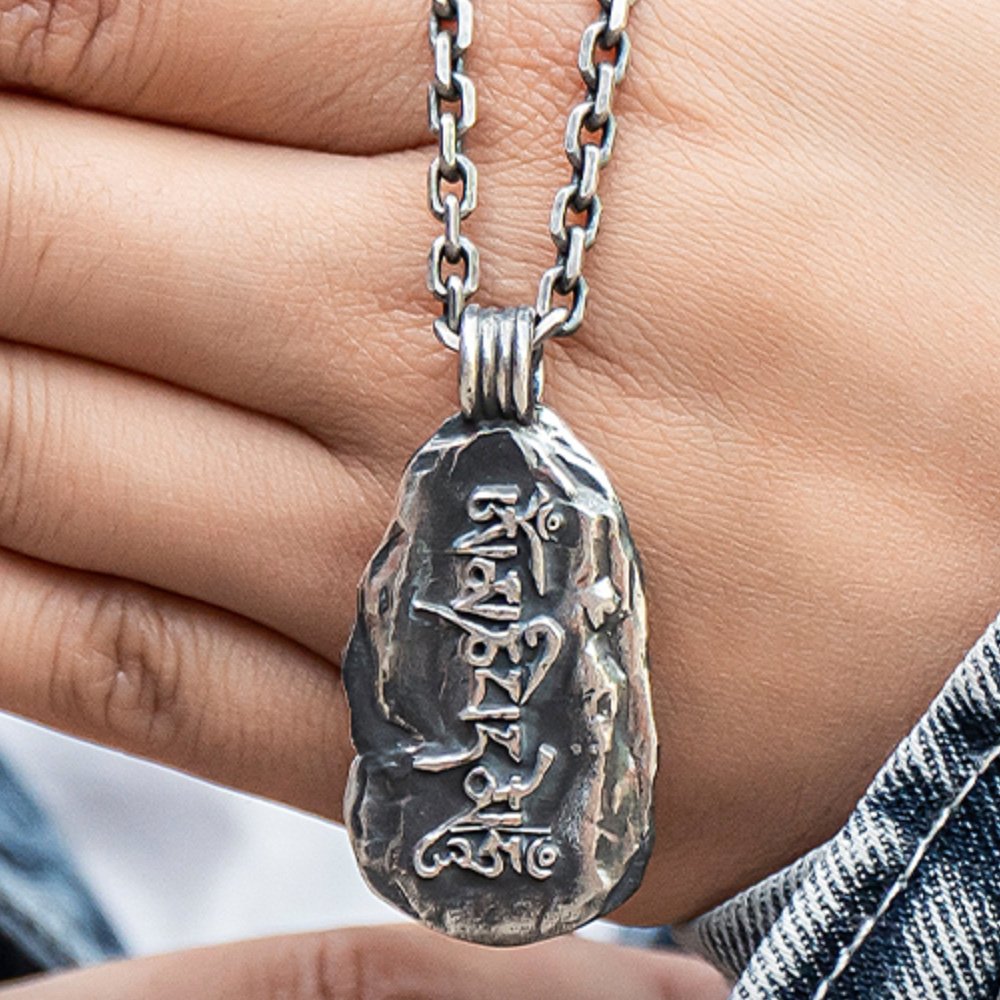
A 5mm Chain Doesn’t Always Fit a 5mm Bail
You have a sterling silver pendant you’ve worn for years, but the chain has started kinking more often and no longer sits properly. Finding a replacement seems simple: check the old chain’s width, choose a similar men’s silver chain, and move the pendant over.
The problem is that chain width alone does not tell you whether the pendant will fit. The listed width usually refers to the links, while the fitting at the smaller end of the chain may be wider or thicker. The pendant’s bail—the loop the chain passes through—may also look large enough from the front but be too shallow for that end fitting.
Before ordering a replacement, check three measurements: the bail’s usable inside width, its inside height, and the widest part of the smaller chain end that must pass through it. The clasp at the other end does not need to fit through the bail.
Even matching measurements are not a guarantee. A tight fit can still catch on an angled fitting, an irregular bail, or a slightly raised solder joint.
Measurement One: The Bail’s Usable Inside Width
Start with the inside width of the bail, not its overall size. A bail that measures 6mm across the outside may provide only 4mm of usable space once the thickness of the silver on both sides is taken into account.
A small digital caliper gives the most reliable measurement. Place the tips gently inside the opening and measure across its narrowest usable point. Do not force the caliper farther into the bail just to get a larger number. If you only have a ruler, use one marked in millimeters and hold the pendant against a light background. The result will be less exact, but it should still tell you whether the opening is closer to 3mm, 5mm, or 7mm.
Pay attention to the shape. Some bails taper toward the top, so the widest visible area is not necessarily where the chain fitting needs to pass. Others have rounded corners, decorative edges, or a solder joint that takes up part of the opening. A hidden bail behind a sterling silver pendant can be especially easy to overestimate because you cannot see the full opening from the front.
Do not round the measurement up. If the usable width is just under 4mm, treat it as less than 4mm. A chain fitting with the same stated width may still be too tight once its shape and small surface irregularities are considered. Some working clearance is safer than an exact numerical match.
Measurement Two: The Bail’s Inside Height
Width is only one side of the opening. The bail also needs enough inside height to accommodate the thickness and shape of the chain’s end fitting.
This matters because chain measurements usually describe width, not the full profile. A flat 4mm curb chain may have a relatively thin end fitting, while a 3mm round box or rope chain can require close to 3mm of clearance in every direction. The narrower chain is not automatically the easier one to pass through.
Measure the bail vertically at its smallest point. With an oval or teardrop-shaped bail, that point may be near the top, where the opening becomes narrow. A decorative bail can be even less predictable. What appears to be open space may be reduced by a curved inner wall, a soldered joint, or part of the pendant extending behind it.
Also consider how the end fitting will approach the opening. A long, flat fitting may be turned slightly and guided through, but a rigid round or square fitting has less flexibility. If the bail is both low and narrow, changing the angle may not help.
Product photos rarely show this dimension clearly. If you already own the sterling silver pendant, measure it directly rather than estimating from a front-facing photo. For a pendant being purchased online, ask for the bail’s internal dimensions. “Fits up to a 5mm chain” is useful only if the seller has considered both the width and the profile of the chain end.
Measurement Three: Measure the Smaller End of the Chain
Most chains have different fittings at the two ends. One end holds the clasp, while the other may finish with a jump ring, end cap, connector, or small metal plate. You only need one end to pass through the pendant bail, so identify the smaller one before taking any measurements.
Measure the widest and thickest point of that entire end assembly. Do not stop at the final link. An end cap may extend beyond the chain, and a jump ring can be wider than the links even though it looks fairly small. A chain listed as 4mm wide, for example, could have a 5mm ring or connector at the end.
Shape also affects whether it will pass. An oval jump ring may fit through a narrow bail when turned sideways. A rigid square fitting with the same width may not. Check how the parts naturally move, but do not count on squeezing, bending, or opening them. A properly soldered ring is not meant to be pulled apart each time you change a pendant.
The clasp at the opposite end can be much larger without causing a problem. Once the smaller end passes through the bail, the pendant can slide along the links and sit normally on the chain. This is why measuring the clasp alone can wrongly rule out a chain that would actually fit.
When comparing men’s silver chains in different link and clasp styles, use the advertised width as a starting point rather than a final answer. Box, Cuban, snake, anchor, rope, and Byzantine chains may all finish differently, even at similar stated widths. The variety in Jewelry1000’s catalog is a useful reminder that two chains with the same nominal width can have very different end fittings.
If the smaller end is not clearly shown or measured on the product page, ask for its maximum width and thickness. A clear close-up photo next to a millimeter ruler can also help. That small check is much easier than receiving a chain that cannot be used with the pendant you already own.
Confirm the Fit Before Removing Tags or Ordering a Gift
Once you have the three measurements, compare them before relying on a visual guess. The bail’s inside width and height must both be larger than the corresponding dimensions of the smaller chain end. If the numbers are exactly the same, treat the fit as uncertain. Small differences in angle, solder, and shape can be enough to stop the fitting from passing through.
When the chain arrives, keep the packaging and return tags in place while you inspect it. If possible, test the smaller end gently over a folded towel or another soft surface. This protects the pendant if it slips from your hand. Do not pull, twist, or force the fitting through resistance. Scratches around the bail are difficult to remove, and bending a jump ring can weaken the chain.
Passing through the bail is the first test, but the pendant should also move freely once installed. A tight bail may scrape along the links, keep the pendant sitting at an angle, or prevent it from settling at the center of the chain.
This is also the point to check visual and physical balance. A small sterling silver pendant can look crowded on a thick chain, while a heavy pendant may put too much strain on a very light chain or delicate end ring. There is no universal chain-to-pendant weight formula, so look at the construction as a whole rather than chasing an exact ratio.
Gift buyers should be especially careful. If the pendant is already owned by the recipient, try to measure its bail or check the chain currently used with it. Do not estimate from the pendant’s overall size; a large pendant can still have a surprisingly small bail.
An opening or removable bail can solve some compatibility problems, but it should not be pried apart at home. A jeweler can determine whether it can be opened safely or replaced with a larger bail.
Measure the Opening, Not Just the Chain Label
A pendant and chain can both be accurately described and still not fit together. The listed chain width tells you about the links, but it does not tell you the size or shape of the end that must pass through the bail.
Before choosing a replacement chain, measure the bail’s usable inside width and height. Then identify the smaller end of the chain and check its widest and thickest points. Those three measurements give you a much more reliable answer than holding the pendant next to a product photo or assuming two matching numbers will work.
If the end-fitting dimensions are missing, ask the seller before ordering. A photo beside a millimeter ruler may be enough to settle the question.
It takes only a few minutes, but it can prevent a return, a scratched pendant, or an attempted home alteration that damages the bail. Most compatibility problems are easier to avoid than to fix.