Artificial intelligence remains one of crypto’s most closely watched sectors in 2026, but the market is no longer advancing as a single thematic trade. What was once driven largely by enthusiasm surrounding AI has evolved into a more differentiated ecosystem, where projects are increasingly valued according to the specific role they play within decentralized artificial intelligence.
This transition reflects a broader shift in digital asset markets. As blockchain sectors mature, investors gradually move beyond narrative-driven positioning and begin assessing protocols through their underlying function, adoption trajectory, and integration within the wider ecosystem. Artificial intelligence is following a similar path. Identity networks, decentralized data infrastructure, AI agents, machine learning platforms, and blockchain applications are attracting different forms of demand, creating distinct market dynamics across the sector.
For traders, this means the AI label alone is no longer enough to explain price performance. Two projects may both operate within artificial intelligence while responding to entirely different catalysts. Some benefit from developer activity and infrastructure expansion, while others depend on user adoption, enterprise partnerships, or improvements in decentralized computation.
Understanding these structural differences has become increasingly important as capital flows become more selective. Rather than asking whether AI cryptocurrencies will outperform as a group, market participants are increasingly evaluating which parts of the AI ecosystem are demonstrating the strongest long-term development.
Market at a glance
As of July 7, 2026, price performance across AI-related cryptocurrencies reflected this growing divergence.
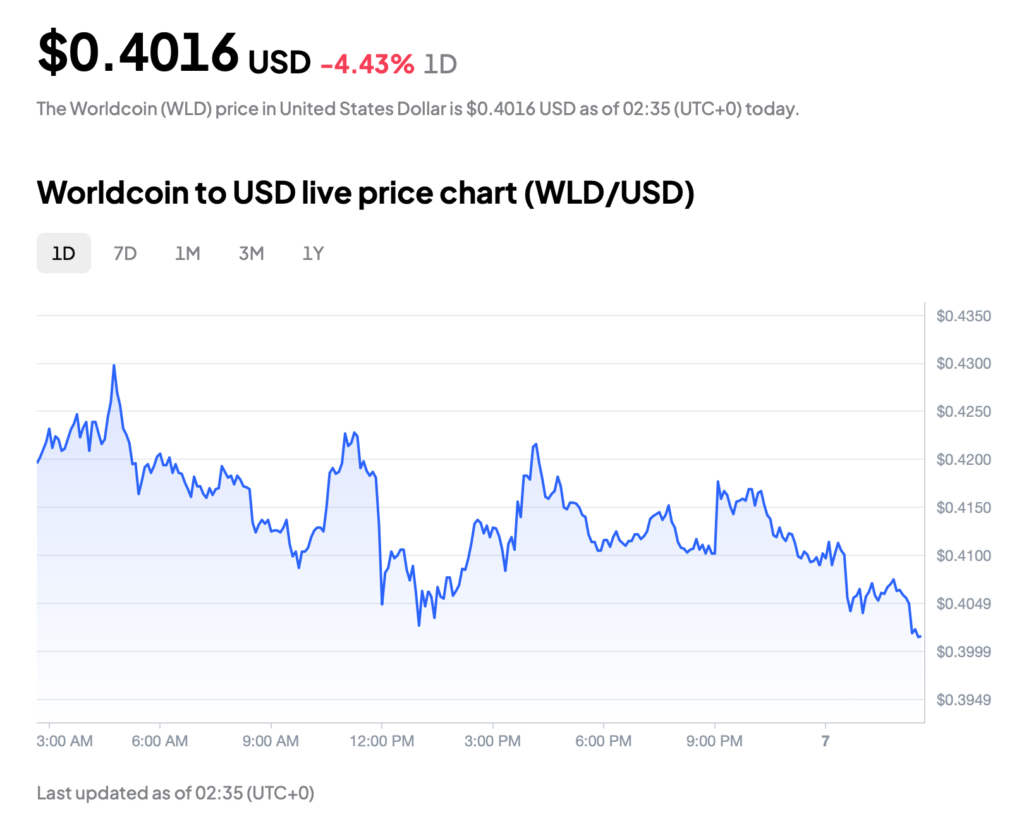
Worldcoin (WLD) traded near $0.4016, declining 4.43% over the previous 24 hours while remaining 3.84% lower across seven days. Despite the recent pullback, the token continued to retain a significant portion of its medium-term recovery, suggesting that interest in decentralized identity remains relatively resilient.
WLD/USD price chart on Toobit
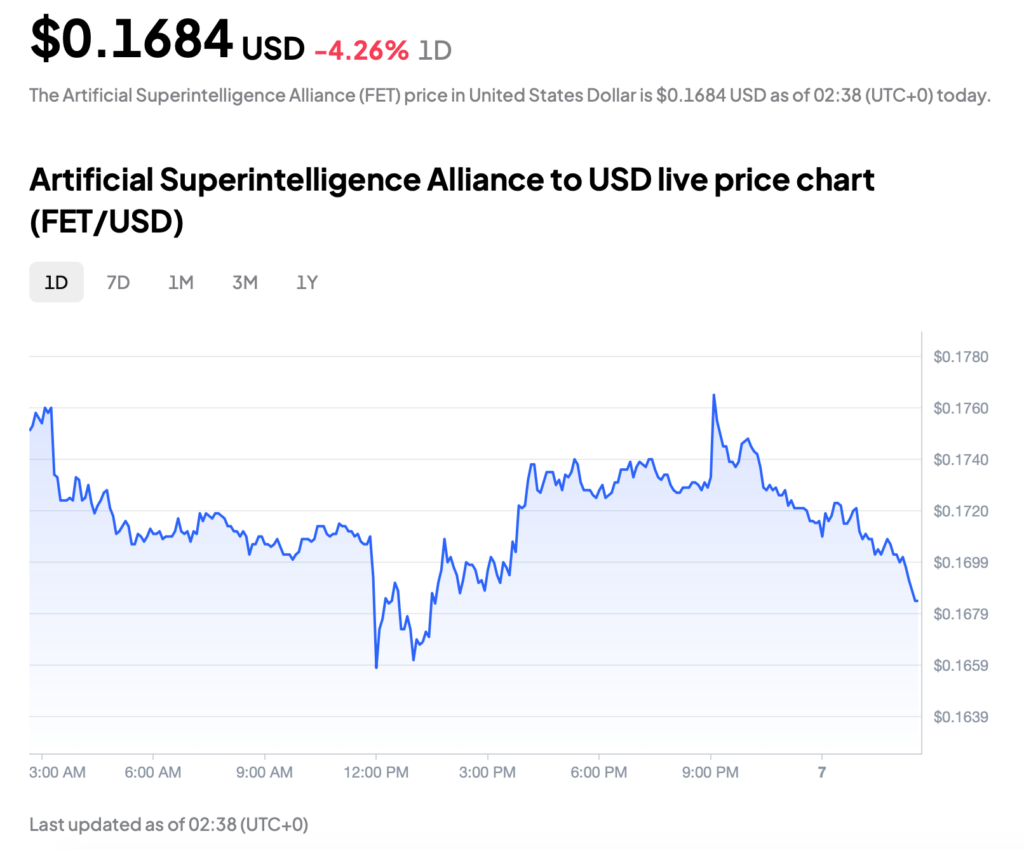
Artificial Superintelligence Alliance (FET) traded around $0.1684, declining 4.26% during the day and 4.74% over the week. Although FET remains one of the sector’s most established AI projects, recent price action indicates that investors have become increasingly selective as newer protocols continue entering the market.
FET/USD price chart on Toobit
Elsewhere, several emerging projects attracted stronger momentum. NES traded near $0.2893, climbing more than 52%over the previous seven days. Injective (INJ) maintained its longer-term recovery after gaining over 68% during the past 90 days. GRASS continued extending its recent advance following a 57% rise over 30 days, while ZEREBRO remained among the market’s highest-volatility AI tokens after appreciating more than 430% across three months.
These movements illustrate a market where liquidity is rotating between different categories of AI projects rather than entering or exiting the sector uniformly. Investors can compare live crypto prices before evaluating relative strength across AI tokens.
The rise of a segmented market
The AI cryptocurrency sector now resembles a collection of interconnected markets rather than a single investment theme. Projects that once traded largely in tandem are gradually separating according to the problems they solve and the users they serve.
At the foundation are infrastructure protocols responsible for computation, blockchain interoperability, and network services that allow decentralized AI applications to function. Their long-term growth depends largely on developer activity, protocol integration, and ecosystem expansion.
Another layer focuses on decentralized data. Artificial intelligence relies heavily on large quantities of reliable information, making data collection, validation, storage, and distribution increasingly valuable within blockchain ecosystems. As AI models continue evolving, the availability and quality of decentralized datasets may become as important as computational capacity itself.
Identity represents another distinct segment. As AI-generated content and autonomous software become increasingly sophisticated, proving whether a participant is a genuine individual rather than an automated system is becoming a more significant challenge across digital platforms. Blockchain-based identity protocols aim to address this need while preserving user privacy and ownership of personal information.
The market has also seen rapid expansion in AI agents and application-layer platforms. These projects seek to automate decision-making, facilitate autonomous blockchain interactions, and create decentralized services capable of operating with minimal human intervention.
Each category addresses a different requirement within decentralized artificial intelligence. Consequently, adoption occurs on different timelines, attracts different users, and responds to different economic drivers. This growing specialization explains why performance across AI cryptocurrencies has become increasingly independent despite sharing similar branding.
Why WLD and FET are following different paths
Worldcoin and Artificial Superintelligence Alliance remain two of the sector’s most recognizable AI cryptocurrencies, yet their differing objectives increasingly place them in separate areas of the market.
Worldcoin’s primary focus is decentralized digital identity. As artificial intelligence continues generating increasingly realistic content and autonomous systems become more prevalent online, verifying that a participant is a unique human may become increasingly valuable across financial services, governance, and digital applications.
This gives WLD exposure to developments extending beyond cryptocurrency markets. Discussions surrounding digital identity, privacy, AI governance, and online verification all have the potential to influence long-term demand for identity-focused infrastructure. Recent price performance suggests that although traders remain cautious during periods of broader market consolidation, interest in this segment has remained relatively stable.
FET occupies a different position. Rather than emphasizing identity, the project focuses on enabling collaboration between autonomous AI agents operating across decentralized systems. Its long-term value proposition depends more heavily on ecosystem development, technical implementation, and broader adoption of AI-powered blockchain infrastructure.
These differing objectives naturally create different valuation patterns. Identity networks respond primarily to adoption of verification systems and digital credentials, while AI coordination platforms depend more heavily on developer activity, application growth, and improvements in autonomous software.
As the market becomes more selective, projects are increasingly being evaluated according to these underlying functions rather than simply their association with artificial intelligence. That transition marks one of the defining characteristics of the AI cryptocurrency sector in 2026.
AI adoption extends beyond crypto markets
Another important feature of today’s AI sector is the close relationship between blockchain development and the broader artificial intelligence industry.
Unlike many crypto narratives that evolve largely within blockchain ecosystems, AI cryptocurrencies are influenced by technological progress occurring across multiple industries. Advances in large language models, cloud computing, semiconductor manufacturing, enterprise software, and computational infrastructure all contribute to expectations surrounding decentralized AI.
Recent reports regarding delays affecting Nvidia’s Kyber NVL144 architecture illustrate this relationship. Although hardware development occurs outside cryptocurrency markets, discussions surrounding computational capacity, inference efficiency, and AI infrastructure often influence investor sentiment toward blockchain-based AI projects as well.
The connection does not imply that every technological breakthrough immediately benefits AI cryptocurrencies. Instead, it reflects the fact that decentralized AI forms part of a much broader ecosystem where progress in one area frequently shapes expectations across others.
This broader convergence is also creating new applications at the intersection of artificial intelligence and decentralized finance, often referred to as DeFAI, where AI-driven tools are being explored to improve automation, decision-making, and efficiency across blockchain-based financial systems.
As institutional investment in artificial intelligence continues expanding, this relationship may become increasingly significant for digital asset markets.
Following the money
One of the defining characteristics of the AI cryptocurrency sector in 2026 is the way liquidity moves between projects rather than across the sector as a whole. Earlier market cycles often saw AI tokens rise and fall together as investors sought broad exposure to the narrative. Today, capital is becoming increasingly selective, rotating toward projects that demonstrate stronger adoption, ecosystem growth, or technological differentiation.
This shift helps explain why several newer AI projects have recently outperformed more established names. NES has attracted attention through strong short-term momentum, while GRASS has benefited from growing interest in decentralized data collection. ZEREBRO has remained one of the sector’s most volatile performers as speculative capital continues flowing into AI agent ecosystems. Meanwhile, larger projects such as WLD and FET have generally traded within more measured ranges, reflecting their comparatively mature market positions.
Rather than signalling weakness, this divergence highlights a sector that is becoming increasingly specialized. As investors refine their allocation strategies, AI cryptocurrencies are responding more to project-specific developments than to a single market narrative.
When price lags progress
Technological development and market performance rarely move in perfect alignment. AI projects often spend months expanding infrastructure, improving protocols, or attracting developers before those improvements become visible in token prices.
Identity platforms must build adoption across applications before network effects strengthen. Data networks depend on sustained participation from contributors and users. AI infrastructure requires developers to build products before usage becomes meaningful. Even autonomous agent platforms need growing ecosystems before transaction activity reaches a scale that can influence valuation.
As a result, market expectations frequently move ahead of observable adoption. Prices may rally on anticipation of future growth or consolidate while development continues steadily in the background.
Understanding this distinction helps explain why short-term performance does not always reflect long-term progress. For traders, evaluating ecosystem development alongside price action provides a more complete picture than focusing on momentum alone.
A better framework
As AI cryptocurrencies become more diverse, evaluating projects through a consistent framework becomes increasingly important. Instead of treating every AI token as exposure to the same theme, traders should consider three factors: function, adoption, and market structure.
Function explains the problem a project aims to solve. Identity networks, decentralized data platforms, AI infrastructure, and autonomous agent ecosystems each serve different roles within the broader AI economy.
Adoption measures whether developers, users, or businesses are actively integrating the protocol. Growing ecosystem participation often provides stronger long-term support than market attention alone.
Market structure focuses on liquidity, trading activity, and price behaviour. Even fundamentally strong projects can experience extended periods of consolidation if broader market conditions limit capital flows.
Considering these factors together provides a more balanced approach than relying solely on short-term price performance or thematic enthusiasm.
Projects shaping the sector
Several projects illustrate how the AI market has diversified beyond a single narrative.
Worldcoin (WLD) continues to represent decentralized identity, focusing on proof-of-personhood as artificial intelligence becomes more capable of generating automated content and digital identities.
Artificial Superintelligence Alliance (FET) remains one of the sector’s leading infrastructure projects, supporting coordination between autonomous AI agents and decentralized systems.
GRASS reflects growing interest in decentralized data networks, while NES has emerged as a stronger momentum-driven project following recent market rotation.
VIRTUAL and ZEREBRO represent the expanding AI agent economy, where autonomous applications and community-driven innovation continue attracting speculative attention. ALCH and RECALL remain earlier-stage projects exploring AI applications and decentralized intelligence, while AIGENSYN seeks to expand coordination across emerging AI ecosystems.
Injective (INJ) adds a different perspective by combining decentralized finance with AI-enabled trading infrastructure, demonstrating how artificial intelligence is increasingly being integrated into existing blockchain applications rather than developing as a standalone sector.
Together, these projects highlight the breadth of today’s AI ecosystem, where different categories are evolving at their own pace instead of following a single market cycle.
The bigger picture
Artificial intelligence remains one of crypto’s most active long-term themes, but the market is becoming increasingly selective. Projects are no longer competing simply as AI tokens. Instead, they are being evaluated according to the specific infrastructure, services, and applications they contribute to decentralized artificial intelligence.
This evolution is creating a more mature market where identity, data, infrastructure, autonomous agents, and AI-powered applications each follow distinct adoption paths and liquidity cycles. While short-term momentum continues to shift between projects, longer-term value is increasingly linked to ecosystem development, technological execution, and sustained user adoption.
For traders, this changing landscape reinforces the importance of looking beyond the AI label itself. Understanding where a project fits within the broader ecosystem, how it generates demand, and which factors drive its growth can provide a clearer framework for navigating one of crypto’s fastest-evolving sectors.
As the market continues to develop, WLD, FET, INJ, GRASS, NES, VIRTUAL, ZEREBRO, ALCH, RECALL, and AIGENSYN each offer exposure to different segments of decentralized artificial intelligence. Rather than moving together, they increasingly reflect the diversity of an ecosystem that is evolving from a single narrative into a collection of specialized markets.