

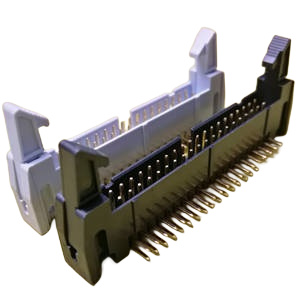
These Falcon 2.54mm pitch IDC ejector header connectors, straight pin ejector, are reliable connectors specially designed for strong connectivity in electronic systems. This product provides ease of mating and removal of IDC ribbon cable assemblies through the ejector ears and the protective shroud, ensuring reliable engagement of IDC connectors and consistent contact closure on the circuitry of a PCB. Due to the 2.54mm spacing and vertical alignment, this product accommodates an extensive variety of sockets and cables. Built for the reliability of the industry, the assembly is designed for efficient mounting and easy handling, which leads to consistent soldering in more technical applications in the automation and computer industry and in other related products.For more in-depth information you should view from ejector header Manufacturer&Supplier – Soulin
Summary of Ejector Header Connectors
Ejector header connectors consist of a pin header interface and an ejector facilitators. They are used for secure connections and controlled disconnections of IDC cable terminations. The subdued design of the construction helps ease the loading process and maintains integrity of the contacts by preventing cable mismatches. Most manufacturers design these connectors in double row configurations,
with multiple package types as SMD or TH solutions to accommodate a variety of PCB assembly technologies. They also specify the connectors based on the finish used, gold thickness, and mechanical endurance. Assembly on the production floor is simplified with 2.54mm pitch connectors that are readily available in bags, or kits, of 50 units.
The ejector header is a type of pin header that incorporates built-in ejector levers or ears that help relieve the strain of pulling out an IDC cable or socket from the soldered connections. They consist of an IDC header connector designed to provide dependable mating alignment via the keyed housing geometry and a controlled depth of insertion to protect the contact interface from external damage. They are predominantly in the male form and their corresponding ejector header connectors are available in a vertical or 90/180 orientation alternatives to meet the design space restrictions of an enclosure and a circuit board. While the strong mechanical stops help create defined cycles in connector engagement and disengagement, the ejector header provides tool-free disengagement to improve the servicing of computers and industrial electronics designed for high-frequency reconnections.View ejector header Manufacturer&Supplier – Soulin for More Details
Advantages of having a 2.54mm Pitch
2.54mm pitch is a standard spacing compatible with most ribbon cable terminations and is compatible with a wide array of socket counterparts. It 2.54mm pitch double-row format allows for greater signal density and maintains sufficient spacing for solder inspections and solder fillet clearance. Straight pin configuration allows for vertical mounting on the PCB and has a choice of SMT or Through-hole tailing depending on process needs. Longer term connection integrity is improved with a gold contact finish due to higher conductivity and corrosion resistance. Technical specification documents outline current rating, housing material, and cycling. Although the 1.27mm pitch is available, 2.54mm pitch is more favorable for a combination of assembly proficiency, cost effectiveness, and longevity of the assembly.
Application of Ejector Connectors
Ejector connectors find their use in industrial automation controllers, computer hardware backplanes, and embedded systems where secure mating and fast disengagement are required. The shroud and ear mechanisms stabilize the connection during vibration, thus making them fit for rugged applications and vertical mounting. They ensure the reliable interconnection of ribbon wires and IDC cable assemblies in control panels, test instruments, and communication modules. Various manufacturers and suppliers provide series of these connectors, producing them with custom specifications to suit their application, such as the gold contact finish for higher cycle use and mating sockets for compatibility. In order to simplify selection, assembly, and replacement in various electronic designs, distributors provide catalogue listings to their customers.
Characteristics of the 2.54mm Pitch Ejector Headers
The 2.54mm pitch ejector headers are characterized by evenly spaced ejector pins, under controlled slot designs, protected by shrouded bodies, facilitating reliable interconnections for Ejector Headers used in the industry. The product used in industry incorporates a plastic shroud with ejector notches to protect the pin header and solder joint from damage during the IDC cable socket removal and insertion. Typical specification values such as currents rating, insulation resistance, temperature rating in operation, and additional gold plating in the contact area to improve the dynamic and static friction of the contact interface to increase longevity are positive enhancements. The devices in series are available from the manufacturers and distributors as to series, type of packaging, and number of kits – often including 50pcs 2.54mm pitch bundles from which distributors can offer lower and higher prices.
Technical Specifications
The technical specification for a 2.54 mm pitch ejector header connector is primarily about pin count per row, whether the connector comes in a double or single row, its configuration, and the options for straight or vertical orientation. The contacts may include a gold over nickel selective for low contact resistance, and having solder-tin tails for reliable digestion PCB soldering in either SMT or through-hole mounting. The housing resin is flame retardant, and also provides keyed alignment so the IDC ribbon cable mates correctly. The specification also defines mechanical insertion retention, and cycles of mating. Also, for the electrical rating, the supplied voltage and current have to be stated. The manufacturer data sheets also supplemented by the distributors concerning information for the package, series, and other related products, which fulfill the needs for the electronic assembly.
| Category | Key Details |
| Configuration | Pin count per row; single or double row; straight or vertical orientation |
| Contact & Termination | Selective gold over nickel for low resistance; tin on tails for SMT or through-hole soldering |
| Housing | Meets flammability ratings; keyed alignment for IDC ribbon cable |
| Specifications | Mechanical: insertion force, retention, mating cycles; Electrical: voltage and current |
| Documentation | Datasheets and distributor pages list package, series, and related products |
Connector Types: Straight vs. Vertical
Connector orientation affects board layout, cable routing, and enclosure clearances. A straight pin configuration often denotes horizontal entry relative to the PCB, while a vertical type directs the IDC ribbon cable perpendicular to the board, assisting compact stacking in automation and computer modules. Both options maintain the 2.54mm spacing and shroud for guided connection and controlled removal using the ejector ear tool action. Selection should consider mating direction, wire strain relief, and service access. Manufacturers provide technical spec comparisons across series, including 90 and 180 orientation notes, SMT or through-hole mount alternatives, and finish choices that influence long-term connection reliability and overall product cost.
Understanding Double Row vs. Single Row
Choosing double row or single row impacts density, cable compatibility, and signal organization. A 2.54mm pitch double row ejector header increases circuit count without enlarging the footprint significantly, enabling compact electronic assemblies while keeping robust contact alignment under the shroud. Single row options simplify routing where fewer signals are required or when wider spacing to adjacent components is preferred. Both support IDC ribbon cable termination and male pin mating to a compatible socket. Designers should match row count to the required pin map, considering loading forces, solder fillet visibility, and inspection. Distributors and suppliers list series, package type, and specification details to guide optimal selection at the desired price point.
Product Details
The product details for the 2.54mm pitch ejector header connector emphasize standardized spacing, robust mechanical design, and dependable connectivity for electronic assemblies. This connector integrates a plastic shroud and ear ejector tool features that control loading and removal of an IDC cable or compatible socket, protecting the pin header and PCB solder joints. Offered in male, straight, and vertical orientation types, it supports SMT and through-hole mount to match diverse assembly processes. Technical spec information from the manufacturer and distributor page outlines series options, finish such as gold on the contact area, and package alternatives including kit and 50pcs 2.54mm pitch bundles for industrial and computer applications.
Features of 2.54mm Pitch IDC Connectors
Key features include precise 2.54 mm pitch spacing for reliable mating with IDC ribbon cable terminations and double-row configurations for higher circuit density. The plastic housing with shroud ensures correct alignment, while integrated ejector ear mechanisms aid controlled removal without stressing solder. Straight pin and vertical types enable flexible orientation in tight enclosures, and SMT or through-hole mount options align with preferred manufacturing flows. Selective gold finish on the contact zone improves conductivity and durability across repeated connection cycles. Technical specification details cover current ratings, mechanical retention, and operating temperature, ensuring the connector ejector header delivers stable performance in automation, industrial control, and computer equipment.
| Feature | Description |
| Pitch & Configuration | 2.54 mm pitch, double-row for higher circuit density |
| Housing & Ejectors | Plastic shrouded housing for alignment; ejector ears for controlled removal |
| Orientation & Mounting | Straight pin and vertical types; SMT or through-hole options |
| Contact Finish | Selective gold on contact zone for conductivity and durability |
| Applications | Automation, industrial control, and computer equipment |
| Technical Coverage | Current ratings, mechanical retention, operating temperature |
Pricing and Packaging Options
Pricing variance is dictated by pin count and product configuration and also depends on finish and package types. Economically priced options are available for the standard two-row series of 2.54mm pitch. A carton of 50pcs of 2.54mm pitch may, via the distributor or supplier, be acquired in kit format in order to provide an optimized price for mass quantity assembly, while lesser quantities can be obtained in an apposite package for use in prototyping. There may be a cost differential in SMT and through-hole depending upon the plating and some process steps, with a gold contact finish typically at a premium. Page listings often extend to related products, such as ribbons and sockets, to suggest a complete mating set; then a person can go back and order from that source only. They always provide clear and complete technical data for a perfect match between products and budgets, hence reducing rework and helping fast procurement.
Maker and Quality Assurance
In order to ensure ongoing quality, reliable manufacturers typically include a proper set of specifications, specifications series, and configurations for pitch, orientation, and contact finish. Tests, performance and management of material traceability, are bounded by plastic housing, preferred metallurgy for pin, and permitted plating thickness. Manufacturing techniques for SMT and through-hole solder integrity are additionally controlled.
The condition of insertion force, retention, and mate cycles fulfill the context of tests, and audits confirm compliance to the industrial standard. Distributors make sure certificates and lot codes are accessible by page, supporting electronic assembly traceability. Suppliers provide technical support to ensure the connector ejector header, pin header, and socket are fully compatible for further application, whether in 90° or 180° orientation, for automation systems or computer modules.
Assembly and Installation
To install a 2.54 mm pitch plug-in header connector correctly, first check that the part’s bonding details, pin count, orientation, and tonality-type are all set. Verify that the connector has the pin spacing of 2.54 mm and that the part is either a straight solder or vertical screw type compatible with either an SMT or through-hole mount as prescribed in the PCB layout. It is during mounting that the keyway and polarizing geometry arrangement of the shrouded header will keep the mating IDC cable socket securely attached. Apply an interposer that adheres well to the metal surrounding the plated-through hole or the SMT pad on the board. Cosmetically inspect the fillets, for their solder quality, around each pin. Additional checks include the successful seating of the plastic housing, operation of the ejector ear, and ease of removal without extra tools to affirm the correct design.
| Step | Key Actions |
| Specification & Fit | Confirm 2.54mm pitch, pin count, orientation, series; verify SMT or through-hole and straight or vertical type against the PCB footprint. |
| Loading & Alignment | Align shroud and keyed housing with the mating IDC cable socket to prevent mismating. |
| Soldering | Use controlled solder profiles suitable for the finish and gold contact plating; ensure proper reflow or wave parameters. |
| Inspection & Final Checks | Inspect solder fillets around each pin; verify mechanical seating, ejector ear operation, and tool-free removal action. |
Wire and Soldering Techniques
When wiring the ribbon cable to the IDC socket, remember to ensure that all wires line up well with the 2.54mm pitch from the initial double row pin map for wondrous gift. Preheat the PCB before inserting through-hole soldering to calibrate thermal loading, and use flux adherent to the finish material for full wetting of contacts without voids. A reflow profile must be adapted for the package type and thermal plastic housing when using SMT tails. Ensure control of solder volume to prevent bridging between pins spaced at 0.4mm. After solder, inspect the pad for the presence of uniform fillets and verify through-hole continuity. Properly-designed injection molding will forestall the chance of the use of the ejector ear as a tool during removal of the shield from the pins during test.
Form the PCB footprint around an ejector header connector, accounting for all the specifications in terms of pin pitch, shroud outline, and reduce-out for the ejector ear travel. Around the connector housing, provide spacing for the cable bend radius in vertical or straight orientation. Specify the solder mask and paste apertures supporting SMT stable assembly; on the other hand, confirm annular ring size and hole in assembly design. Inner layers must be used for high-speed signals with a minimum number of coupling places between the double rows, and mounting holes or mechanical support may also help if required. If the density demand is so high that a double-row pitch of 2.54mm doesn’t suffice, consider an alternative family of 1.27mm.
Best Practises for Connector Assembly
Before mating, clean contact and PCB surfaces to minimize flux residue that may cause problems with connectivity. Use the shrouded IDC female socket that is positioned onto the keyway, exerting the least amount of pressure necessary for mating the cable plug without figuratively bending the plastic housing. Make sure the extraction (ejection) action is smooth and controlled, ensuring that the latch pivots freely. Check for the specified insertion force in the data sheets, and ensure that the pins do not recover in loading and testing them. For strain relief, secure the ribbon cable or wirings in bundles to keep from overfatiguing at the PCB. Add the values of assembly torque and reflow parameters into a build page, recommending that the kits or 50 pieces of the 2.54mm pitch are always sealed until they are directly put to use to prevent any finish loss.
Related Products and Alternatives?
Other related products include IDC-compatible sockets, which guarantee the best connection quality and serviceability with its use of ribbon cable assemblies, strain relief clamps, and alignment tools. The alternative series also boasts distinct finish options, ranging from selective gold on the contact zone to package types on the SMT or through-hole mount side. There are 1.27mm systems for the higher density, while ruggedized housings are made to suit industrial automation. For convenience, the local distributor lists any necessary matching pin header accessories, test adapters, and keyed shrouds on the same page. This easy one-stop shopping for all necessary supplies reduces frustration and potential incompatibility problems. In order to resolve any manufacturing considerations for an electronic and computer solution, it is proposed that pricing, specification, and manufacturer availability be compared, with consequent determination of the product set that balances performance, connectivity requirements, and assembly workflow.
Comparison of Different Types of Ejector Header
Ejector headers are available in Straight or Right angle versions with a number of pins in a row and different housing forms. Various frame parts of ejector headers are application-specific-eject for horizontal cable exit use, meanwhile, they are also upright techniques for perpendicular mounting of IDC cable for compact design. Some series may introduce robust plastic shrouds for side detection or a longer ear for easy removal from a fully packed set. Choose between SMT and through-hole mount methods contingent on the procedure and mechanical support. Pure gold or PdNi contacts could be good choices when high mating cycles are necessary or as a low resistance contact system. A 90 or full 180 wire outlet option should also be helpful for wire management inside tight enclosures. Evaluating tech specs and additional-recommended products is always a great idea when it comes to checking whether a complete socket is a compatible design or not for the required application in harsh and industrial conditions.
2.54mm Pitch Interconnection Products
The 2.54mm pitch pinned header accessory items would ideally incorporate IDC sockets suitable for the pin array of the double-row format, ribbon cables of correct width in mm, strain relief bars, and the keyed plugs for back-loading prevention. Fixtures for alignment and inserting tools may be utilized in assembly process on the production floor, and test headers and loopback plugs still stand as safeguards to confirm connectivity during inspections. For SMT assemblies, consider board stiffeners to maintain the solder joints. Instead, through-hole applications require locking posts for increased retention. Kit options and 12% off on 50pcs 2.54mm-pitch packages result in reduced prices for high-volume construction. Be careful to check the specification and plated finish of each accessory in relation to the manufacturer’s series for generating a reliable electronic system.
Preferred location: Ejector Header Connector Suppliers
Major distributors and supplier networks hold the 2.54mm pitch ejector header in various series, with pin counts and various orientations. Use the distributor page filters to choose between SMT and DIP headers in gold or tin contact finish, which might come in quantities from single preferential units into the flexible options of complete kits or packs. Price index and manufacturing availability with download for technical datasheet reveal actual specification details. Many suppliers might label compatible sockets, ribbon cables, and related accessories to ease sourcing issues. For industial and automation applications, lot traceability and certificates are welcome. An importer might seek guidelines from the manufacturer to gain excellent support in the matter of 90 or 180 degree orientation options, right-on ensuring a reliable, compatible interconnection solution in computing and electronic assemblies.