

Picture this: you show up. You put in the work. You sweat, you push, you persevere. Yet, the reflection in the mirror remains stubbornly unchanged. It’s the silent frustration that echoes through gyms everywhere: “Why am I not seeing results?”
The hard truth is that effort without the right strategy is just spinning your wheels. This disconnect is precisely the problem that scientist and author Dr. Nick Poulios is dedicated to solving. With a PhD and over 40 publications in peer-reviewed medical journals, he dismantles fitness myths with an evidence-based framework designed for real, measurable progress.
It is important to keep in mind that hitting a plateau isn’t a sign that you’re failing, but a signal that your approach needs a scientific upgrade. If you’re tired of investing time and energy without seeing meaningful change, the issue isn’t your dedication, but your design.
Before you spend money on another program or gadget, let’s diagnose the root cause of your stalled progress. Here are five often-overlooked reasons, grounded in exercise science, why your hard work isn’t translating into the results you deserve:
1. Your Plan Lacks True Progressive Overload
This principle is the engine of all progress, yet it’s the first to be abandoned. Your body is a brilliant adaptation machine, and it will only change if you give it a compelling reason. Progressive overload is that reason—the deliberate, gradual increase of stress placed upon your muscles. Simply repeating the same workouts with the same weight is not a plan for growth. On the contrary, it’s actually a recipe for stagnation.
A scientifically-sound plan doesn’t just include progression; it’s built around it. However, true progressive overload is more than just adding weight. Here are the most common ways this powerful principle is sabotaged:
- The ‘More Plates’ Fallacy: Chasing heavier lifts is only one tool in the toolbox. True progression also includes mastering your form, adding more reps or sets, or decreasing rest times to increase workout density. The goal is to increase the demand, not just the number on the bar.
- Training Without a Compass: If you aren’t meticulously tracking your workouts, you are flying blind. You cannot systematically progress if you are guessing what you did last week. A logbook transforms aimless effort into a calculated strategy for success.
- Avoiding the Growth Zone: Real change happens at the edge of your comfort zone. Those last few difficult reps—the ones you have to truly fight for—are what signal your body to grow stronger. If your sets feel comfortable, you’re not creating a powerful enough stimulus for change.
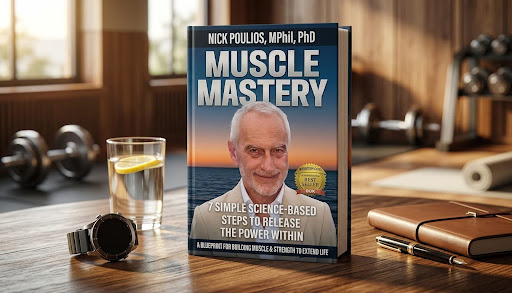
This is precisely the scientific framework Dr. Nick Poulios champions. He demystifies this core concept in his Amazon best-selling book, Muscle Mastery, providing a clear, evidence-based system that turns progressive overload from a vague idea into your most powerful tool for achieving unstoppable results.
2. You’re Guided by “Bro Science” Instead of Real Science
The gym is a breeding ground for well-intentioned myths—the “bro science” passed down from one lifter to the next like sacred tradition. This echo chamber of advice, from “you have to confuse the muscle” to “eat every two hours to stoke your metabolism,” often crumbles under the weight of scientific scrutiny. Following these unproven doctrines isn’t just ineffective, but also a direct path to wasted effort, stalled progress, and deep-seated frustration.
Consider the badge of honor many wear with pride: crippling muscle soreness. The “no pain, no gain” mantra suggests that if you can’t walk downstairs the next day, you’ve succeeded. However, this is where science draws a firm line in the sand.
As a scientist with over 40 publications in peer-reviewed medical journals, Dr. Nick Poulios explains that chasing soreness is a fool’s errand. Delayed onset muscle soreness (DOMS) is merely a sign of novel muscular stress, not a reliable metric for growth. By prioritizing this feeling, you risk derailing your recovery and consistency. Instead, Dr. Poulios advocates for a shift from subjective feelings to objective data—tracking your lifts, reps, and sets. That’s where the real proof of progress lies.
3. Your Recovery Is an Afterthought, Not a Strategy
The gym is where you tear muscle down. The real growth happens when you step away. Think of your workout as the demolition phase—creating the necessary stress and micro-damage. However, as Dr. Nick Poulios emphasizes, the reconstruction—the phase where muscles actually grow stronger—is entirely dependent on recovery.
Treating recovery as an optional add-on is like hiring a construction crew but never giving them the materials or time to build. You’re simply leaving the job half-finished.
According to the science-based framework Dr. Poulios champions, a truly effective training plan dedicates as much strategic thought to recovery as it does to lifting. This means shifting your mindset from “rest days” to “growth days” and implementing a deliberate strategy that includes:
- Optimal Sleep: This is your body’s prime time for reconstruction. While you sleep, your body releases a surge of human growth hormone, turning the blueprint from your workout into tangible muscle repair and growth.
- Strategic Nutrition: Post-workout nutrition isn’t just a meal, but also the delivery of raw materials to your construction site. Supplying your body with adequate protein and carbohydrates is non-negotiable for rebuilding torn muscle fibers and replenishing energy.
- Active Recovery: Don’t confuse rest with immobility. On non-training days, gentle movement like walking or stretching acts as a clean-up crew, boosting circulation to clear out metabolic waste and deliver nutrients, accelerating the repair process.
4. Your Nutrition and Training Are Not in Sync
Your workouts provide the stimulus for change, but nutrition provides the resources. Trying to build muscle without enough calories and protein is like sending a construction crew to a job site with no materials—the work simply can’t get done. Your body requires an energy surplus and a steady stream of amino acids to forge new tissue.
Conversely, attempting fat loss without a calculated nutritional plan risks sacrificing hard-earned muscle along with the fat. This is a delicate balancing act that goes far beyond generic advice to “eat clean.”
It requires a strategic command of macronutrients and energy balance, which is a complex science that Dr. Nick Poulios expertly simplifies, turning nutritional chaos into an actionable, evidence-based strategy.
5. You’re Ignoring the Mind-Muscle Connection
Are you just moving weight, or are you commanding your muscles to work? This distinction is the core of the mind-muscle connection, a critical principle that exercise science expert Dr. Nick Poulios identifies as a game-changer. Without this conscious, targeted focus on the muscle performing the work, you’re simply hoisting a load.
Your body, seeking the path of least resistance, will let stronger, unintended muscles take over, robbing the target muscle of the very stimulus it needs to grow. By mastering this neural link, you transform a generic movement into a precise, powerful contraction, instantly making every single rep more effective without adding an ounce of weight.
Market Statistics Deep Dive: The Data Behind the Fitness Boom
The growing interest in effective fitness isn’t just a feeling. The global fitness market is expanding at a remarkable pace, valued at over $209 billion in 2021 with projections for major growth. Technology is a huge part of this trend. Recent reports show that over 70% of people with wearable tech now use their data to guide exercise or recovery. This points to a massive shift in how people approach fitness, moving toward data-driven, evidence-based plans. People are no longer satisfied with generic advice. They want personalized, effective strategies rooted in science, which is exactly the gap that resources from credentialed experts like Dr. Nick Poulios aim to fill.
How Can I Tell if My Workout Plan Is Based on Science or Just a Fad?
In a world saturated with “miracle” workouts and influencer trends, how do you separate genuine science from marketing hype? It’s the critical question that determines whether you achieve lasting results or just spin your wheels. The answer isn’t in the flashy promises, but in the foundational principles and the credibility of the source.
The distinction becomes crystal clear when you know what to look for:
- Methodology: A scientifically-grounded framework, like the one Dr. Nick Poulios outlines in Muscle Mastery, is built on the bedrock of exercise science—proven principles like progressive overload and biomechanics. Fads are built on sand, relying on novelty, extreme restrictions, and promises that defy biological reality.
- Credibility: Look behind the curtain. Is your guide a credentialed expert with a deep scientific background, like Dr. Nick Poulios with his PhD and extensive publication record? Or a personality whose primary credential is a large social media following? True expertise leaves a trail of evidence, not just a trail of sponsored posts.
- Promises: Science promises progress, not perfection. An evidence-based plan delivers steady, sustainable results built over time. Fads sell a fantasy—promising a complete body transformation in 30 days, a claim that should be a massive red flag. Real fitness is a journey, not a magic trick.
- Sustainability: The ultimate goal of a scientific approach is to empower you with knowledge you can apply for life. Fads, with their rigid and often miserable rules, are designed for the short term, leading to burnout, frustration, and rebound weight gain the moment you stop.
From Clinical Research to Concrete Results: The Muscle Mastery Blueprint
The world of peer-reviewed journals and the world of clanging weights can feel miles apart. Dr. Nick Poulios closes that gap. His extensive background in clinical research isn’t just academic, but the very engine that powers the practical, results-driven framework in Muscle Mastery.
He has distilled decades of complex exercise science—from cellular-level muscle adaptation to biomechanical efficiency—into a clear, actionable blueprint designed not for the laboratory, but for your life and your gym.
This blueprint moves you beyond the frustration of guesswork. It replaces “I think this works” with “science shows this works.” Every principle within Muscle Mastery: 7 Simple Science-Based Steps To Release The Power Within is a tool to help you understand your body’s response to training, allowing you to make strategic adjustments that break through plateaus and build sustainable strength. It’s the difference between simply exercising and training with purpose.
In Conclusion: From Frustration to Framework
Your effort in the gym is undeniable. However, when that effort meets a flawed strategy, the result is a plateau. It’s time to stop guessing and start training with scientific precision. Dr. Nick Poulios provides the blueprint in Muscle Mastery: 7 Simple Science-Based Steps To Release The Power Within to finally transform your hard work into the tangible strength and vitality you’re fighting for.
Here, your breakthrough isn’t a matter of more effort—it’s a matter of the right evidence.