

Searching for fresh approaches to formatively analyze, review, ask questions, and engage in more enjoyable learning? You can use these seven distinct activities, including free children learning Bini Games and frameworks to bring laughter into your classroom.
However, we should start by discussing the influence on students and the immediate advantages of using games in the classroom for both you and your students.
Why Play-Based Learning Works for Kids
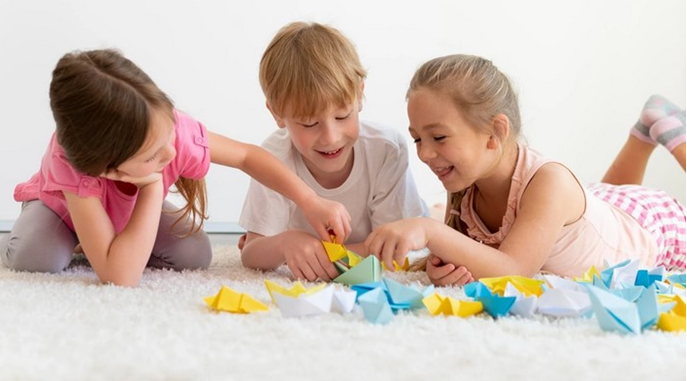
Teachers usually think of card games, board games, math partner games, small group games that can be utilized as stations, indoor recess activities, and so on when they think of classroom games. The games and structures in the entire classroom are adaptable and can be used in a variety of ways without becoming stale. These are all the advantages:
- More inspiration. In the classroom, games can boost motivation in general. Pupils’ motivation to learn and engage in class activities increases.
- Development of language. When children experience language, including by playing games, they learn it. For them to be effective, they must not be language-focused.
- Collaboration in the classroom. It’s not always simple to get kids to collaborate well. Playing games might help them develop their teamwork and empathy.
Additionally, they are learning from mistakes, which helps pupils build their problem-solving skills and social-emotional intelligence. Play-based learning promotes holistic development and fosters a love of learning, according to studies on its efficacy.
7 Fun and Educational Games Every Child Will Love
Students can develop their cognitive skills and explore new ideas by selecting the appropriate educational games. We put together a list of the top seven worthy instructional games:
- Funny Food Academy
Through vibrant mini-games featuring animated fruits and vegetables, children may practice early math, reading, and logic skills in Funny Food Academy. They can practice counting, match shapes, solve puzzles, and trace letters with the help of the app. The progressively harder stages promote memory, concentration, and problem-solving skills.
- Lightbot
By aligning orders that cause a robot to move over obstacles and illuminate squares, children may solve a series of easy puzzles in Lightbot. They incorporate increasingly intricate commands, including conditionals, loops, and nested statements, as they gain proficiency with fundamental ideas.
3 ScratchJr
Children use ScratchJr to create animation sequences and tales by choosing characters and background scenes and dragging graphical programming blocks that fit together like jigsaw pieces. The programming blocks mostly use symbols (such as arrows and stop signs) to describe what they do, even though the app has some written hints.
- Eloh
Another game for those who like a little more laid-back tasks is Eloh. The sound and music-based puzzles in this exquisitely made and soothing game require players to blend sounds precisely in order to reach a goal.
- Math Blaster
Math Blaster is an updated version of one of the original instructional video games for children that elevates math education. In addition to decimals, place value, money, and angle kinds, the game covers fundamental concepts including subtraction, multiplication, and division.
- Foldit
The fact that Foldit is a crowdsourced game that lets your child participate in chemistry research makes it stand out from the other games on this list. Researchers believe that this method of studying protein folding is even more effective than the existing computer algorithms, as players compete to figure out the most inventive methods to fold proteins into various shapes.
- Scribblenauts
These two Scribblenauts games, Scribblenauts Unlimited and Scribblenauts Unmasked, give you greater value for your money. Both games’ gameplay centers on creating new words to modify the environment and help you reach your objectives.
How Bini Games Makes Learning Irresistible
By utilizing the concepts of cognitive development, engagement design, and professionally produced material, the Funny Food Academy https://binibambini.com/products/funny-food-academy/ incorporates the acquisition of fundamental skills into a gamified setting.
Through game-based experiences with lively graphics, story-based play, and endearing characters, the platform’s joyful, educational objectives embrace the idea that “a love of learning is natural.” View the main strategies:
- Framework for game-based learning: Adaptive difficulty levels and interactive mechanics complement early childhood education.
- Multisensory input: Visual, aural, and kinesthetic senses are all engaged in activities including matching, tapping, and tracing.
- Scaffolded progression: The design of incremental challenges encourages long-term motivation and task mastery.
Bini Games sustains high engagement and promotes quantifiable cognitive development through consistent reinforcement and an easy-to-use, kid-friendly UI/UX. The fun learning games by Bini Games, which combines entertainment and evidence-based instructional design in a welcoming, innovative setting, substitutes meaningful educational content for passive screen time in a way that is both safe for kids and helpful for parents.
Tips for Parents to Maximize Learning Through Play
Parents can intentionally include offline activities and digital resources into their children’s everyday routines to extend the advantages of play-based learning outside of the classroom. Because they include reading, numeracy, and logic abilities into lighthearted mechanics, Bini Games fun educational apps for kids are especially successful in making engagement developmentally relevant. In this sense, play continues to be a source of delight and progress in language, social skills, and cognitive abilities.