

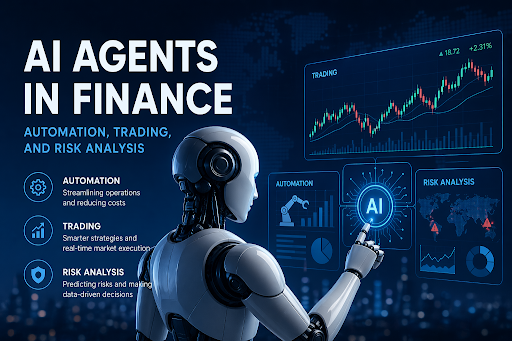
The financial industry is undergoing a rapid transformation driven by artificial intelligence, and at the center of this evolution are AI agents. These intelligent systems are capable of autonomously performing tasks, making decisions, and continuously learning from data. From automating repetitive processes to executing complex trading strategies and managing risk, AI agents are redefining how financial institutions operate.
As organizations increasingly invest in AI agent development services, they are unlocking new efficiencies, improving accuracy, and gaining a competitive edge in a highly dynamic market.
Understanding AI Agents in Finance
AI agents are software systems designed to perceive their environment, process information, and take actions to achieve specific goals. In finance, these agents are often powered by machine learning models, natural language processing, and advanced analytics.
Unlike traditional automation tools, AI agents can adapt to new data, learn from past outcomes, and make context-aware decisions. This makes them particularly valuable in financial environments where speed, precision, and adaptability are crucial.
Automation in Financial Operations
One of the most immediate and impactful applications of AI agents in finance is automation. Financial institutions deal with massive volumes of data and repetitive tasks such as:
- Data entry and reconciliation
- Fraud detection
- Compliance monitoring
- Customer onboarding
AI agents streamline these processes by reducing manual intervention and minimizing human error.
For example, in banking operations, AI agents can automatically verify customer documents, flag suspicious transactions, and generate compliance reports in real time. This not only improves efficiency but also ensures regulatory adherence.
In back-office operations, automation powered by AI agents can cut operational costs significantly while improving turnaround times. Tasks that once took hours or days can now be completed in seconds.
AI Agents in Algorithmic Trading
Trading is one of the most exciting and complex areas where AI agents are making a significant impact. Financial markets generate enormous amounts of real-time data, and AI agents are uniquely suited to analyze and act on this information.
Key Capabilities in Trading:
- Data Analysis at Scale
AI agents can process structured and unstructured data, including market prices, news articles, social media sentiment, and economic indicators. - Predictive Modeling
Using historical data, AI agents can forecast price movements and identify trading opportunities. - Real-Time Decision Making
AI agents can execute trades in milliseconds, far faster than human traders. - Strategy Optimization
They continuously refine trading strategies based on performance outcomes and changing market conditions.
For instance, hedge funds and trading firms use AI agents to implement high-frequency trading strategies, where even microsecond advantages can lead to significant profits.
However, the use of AI in trading also introduces challenges such as market volatility amplification and the need for robust monitoring systems to prevent unintended consequences.
Risk Analysis and Management
Risk management is a cornerstone of the financial industry, and AI agents are revolutionizing how risks are identified, assessed, and mitigated.
Types of Risks Managed by AI Agents:
- Credit risk
- Market risk
- Operational risk
- Fraud risk
AI agents analyze vast datasets to detect patterns and anomalies that might indicate potential risks. For example, in credit scoring, AI agents can evaluate a borrower’s creditworthiness using not just traditional financial data but also alternative data sources such as transaction behavior and spending patterns.
In fraud detection, AI agents can identify unusual activities in real time, enabling financial institutions to act quickly and prevent losses.
This is where AI consulting services play a crucial role. Organizations often rely on expert guidance to design, implement, and optimize AI-driven risk management systems that align with their business goals and regulatory requirements.
Benefits of AI Agents in Finance
The adoption of AI agents offers several key advantages:
1. Increased Efficiency
Automation reduces manual workload and accelerates processes.
2. Enhanced Accuracy
AI agents minimize errors in data processing and analysis.
3. Cost Reduction
Operational costs decrease as fewer human resources are required for repetitive tasks.
4. Better Decision-Making
Data-driven insights enable more informed financial decisions.
5. Scalability
AI systems can handle growing volumes of data without proportional increases in cost.
Challenges and Considerations
Despite their benefits, AI agents in finance come with challenges that organizations must address:
Data Privacy and Security
Financial data is highly sensitive, and AI systems must comply with strict security standards.
Regulatory Compliance
AI-driven decisions must align with financial regulations, which can vary across regions.
Model Transparency
Many AI models operate as “black boxes,” making it difficult to explain decisions.
Ethical Concerns
Bias in data can lead to unfair outcomes, particularly in areas like lending.
System Reliability
AI agents must be robust and resilient to avoid failures that could lead to financial losses.
The Future of AI Agents in Finance
The future of AI agents in finance is promising and rapidly evolving. As technologies like large language models, reinforcement learning, and multi-agent systems continue to advance, we can expect even more sophisticated applications.
Emerging Trends:
- Autonomous Financial Advisors
AI agents that provide personalized investment advice based on user goals and market conditions. - Multi-Agent Trading Systems
Collaborative AI agents working together to optimize trading strategies. - Hyper-Personalized Banking
AI agents delivering tailored financial services to individual customers. - Real-Time Risk Monitoring
Continuous risk assessment with instant alerts and mitigation strategies. - Integration with Blockchain
AI agents managing smart contracts and decentralized finance (DeFi) operations.
Conclusion
AI agents are transforming the financial industry by enabling smarter automation, more efficient trading, and advanced risk management. Their ability to analyze vast datasets, learn from experience, and make real-time decisions positions them as a critical tool for modern financial institutions.
However, successful implementation requires careful planning, robust infrastructure, and expert guidance. As more organizations adopt AI-driven solutions, those who leverage AI agents effectively will be better equipped to navigate market complexities and stay ahead of the competition.
The intersection of finance and AI is not just a trend—it is a fundamental shift that will continue to shape the industry for years to come.