

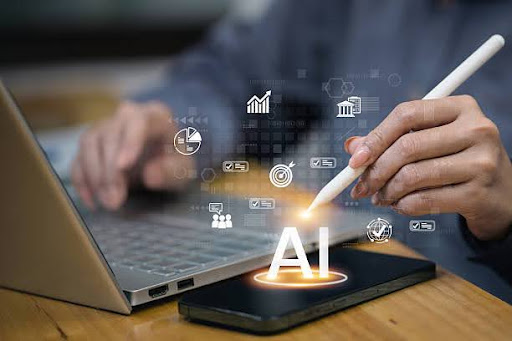
The rise of AI in business is changing how companies plan, operate, and connect with customers. Artificial intelligence is no longer a futuristic idea—it’s a daily tool that helps businesses make better decisions, save time, and grow faster. Whether it’s analyzing data, predicting trends, or personalizing customer experiences, AI has become an essential part of modern business strategy.
At the same time, AI in digital marketing is transforming how brands reach their audience online. From automated ad campaigns to smart chatbots and content recommendations, marketers now rely on AI to understand what customers want and deliver it more effectively. Together, AI and digital marketing are shaping a smarter, more efficient future for companies around the world.
Understanding the Role of AI in Business
Businesses have always sought tools that can improve efficiency and decision-making. With the integration of AI in business strategy, organizations can now automate complex tasks that once required hours of manual work. AI helps analyze massive amounts of data within seconds, providing valuable insights that guide smarter business moves.
For instance, AI-powered systems can predict customer behavior, identify market trends, and even forecast sales. This allows business leaders to make data-driven decisions instead of relying solely on assumptions. In industries like retail, healthcare, and finance, AI helps detect fraud, manage inventory, and personalize services—all while reducing costs and improving accuracy.
AI also plays a major role in human resources and customer service. Chatbots, for example, can handle customer inquiries instantly, freeing up human staff for more complex issues. In HR, AI assists in screening job candidates, predicting employee turnover, and improving workplace productivity. As businesses continue to digitalize, AI ensures smoother operations, better risk management, and long-term growth.
How AI is Transforming Digital Marketing
The power of AI in digital marketing lies in its ability to understand customer data and behavior in real time. Traditional marketing depended on guesswork and manual analysis, but AI has changed the game completely. Today, marketers can target the right people at the right time using insights generated by AI tools.
For example, AI analyzes user activity on social media, websites, and search engines to determine what customers are most interested in. It then helps create personalized recommendations, smarter ad placements, and engaging content that drives results. This level of personalization not only improves user experience but also increases conversion rates and brand loyalty.
Another key advantage of AI in digital marketing is automation. Email marketing campaigns, social media scheduling, and even content creation can be automated using AI-based systems. This allows marketing teams to focus more on creativity and strategy rather than repetitive tasks. Additionally, AI helps with SEO optimization, keyword analysis, and audience segmentation—making every campaign more targeted and effective.
Benefits of AI for Modern Companies
Integrating AI in business and marketing brings countless benefits. The most significant one is efficiency. AI automates repetitive tasks, allowing employees to concentrate on higher-value work. It also reduces human error and speeds up processes like customer support, data entry, and reporting.
Cost reduction is another benefit. Automation helps companies save money by minimizing manual labor and resource waste. For example, AI tools can predict supply and demand, reducing overproduction and inventory costs. In customer support, AI chatbots can handle thousands of queries at once—something that would require dozens of employees otherwise.
Personalization is perhaps the most powerful advantage in the marketing world. AI helps brands understand customer preferences and behavior patterns, allowing them to create experiences that feel unique and relevant. Whether it’s a tailored email or a product recommendation, personalization powered by AI builds trust and encourages repeat business.
Lastly, AI gives companies a competitive edge. Businesses that use AI can quickly adapt to market changes, analyze competitors, and forecast future opportunities. This level of agility allows them to stay ahead and respond to customer needs faster than traditional companies.
Examples of AI in Business and Marketing
Many global brands already rely on AI in business and marketing. For instance, Amazon uses AI for product recommendations, dynamic pricing, and supply chain optimization. Netflix applies AI algorithms to predict which shows users will enjoy next. Google uses AI to improve search results and deliver personalized ads, while Starbucks uses predictive analytics to suggest drinks based on past orders and local trends.
In digital marketing, AI is visible everywhere—from Facebook’s ad targeting to YouTube’s content suggestions. Marketers use AI-driven platforms to test different ad versions, measure campaign performance, and adjust strategies in real time. This helps companies get better returns on investment and connect with audiences more effectively.
Challenges and Ethical Considerations
While AI brings great benefits, it also comes with challenges. One of the biggest concerns is data privacy. Since AI systems depend on user data, companies must ensure they use it responsibly and comply with privacy laws. Another challenge is the fear of job loss due to automation. However, most experts believe AI will create new roles that require human creativity, emotional intelligence, and problem-solving.
Transparency is also vital. Businesses should clearly explain when AI is being used, especially in customer interactions, to maintain trust. Balancing technology with ethics ensures that AI continues to benefit both companies and society.
The Future of AI in Business and Digital Marketing
The future of AI in business and AI in digital marketing looks promising. As technology advances, AI tools will become more intuitive, affordable, and accessible to all types of companies. Small businesses will be able to use AI to compete with large corporations by making smarter decisions and delivering personalized customer experiences.
AI will also continue to improve in areas like predictive analytics, real-time customer engagement, and voice or image recognition. These innovations will make digital marketing more dynamic and data-driven than ever before. The key to success will be learning how to combine AI technology with human creativity and strategy.
Conclusion
In today’s fast-changing world, companies that embrace AI in business and AI in digital marketing are positioning themselves for long-term success. AI is not replacing humans—it’s empowering them to make better decisions, reach wider audiences, and operate more efficiently. For modern companies, using AI wisely means staying competitive, innovative, and relevant in a digital-first marketplace.
By combining intelligent automation with human insight, businesses can unlock smarter strategies that truly define the future of success.