

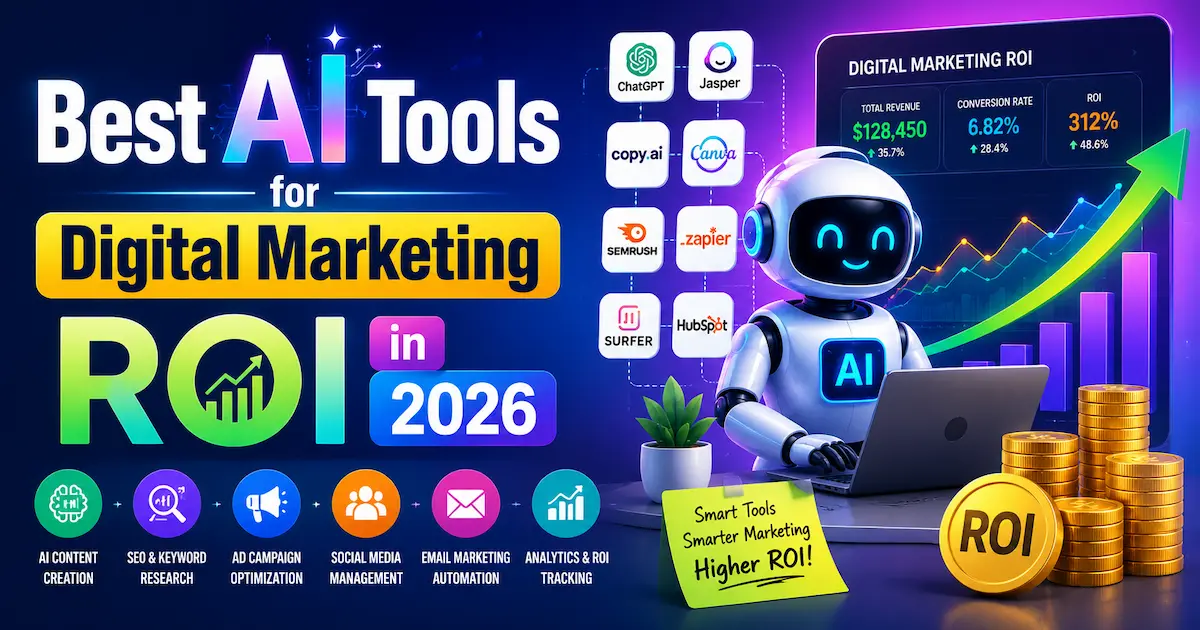
Every marketing tool vendor in 2026 has “AI” in the headline. Most of it is a feature wrapped in a buzzword. A few of them have genuinely changed how good marketing teams work.
This guide cuts through the noise. No inflated statistics. No tools included because they paid for placement. Just an honest look at which AI tools for digital marketing are delivering real value, and who they’re actually built for.
Before You Buy Anything: The Two Questions That Matter
1. Does it integrate with what you already use?
The most common AI tool mistake is buying platforms that work beautifully in isolation and create data silos the moment they touch your existing stack. Before evaluating any tool, map your current workflow – CRM, CMS, email platform, analytics – and verify integrations exist and actually work. “Zapier-supported” is not the same as a native integration.
2. Will you use it within 30 days?
If you can’t identify a specific use case your team will act on within a month, you’re buying a solution in search of a problem. The best AI tools for digital marketing are ones that slot into existing workflows and make them faster, not ones that require building entirely new processes to justify the cost.
With that framing, here’s what’s worth your attention.
Content Creation and Copywriting
Jasper AI remains the most mature option for teams that produce high volume content across multiple formats – blogs, ads, emails, landing pages. The brand voice feature works better than competitors if you invest time training it on your actual content library. Realistic expectation: it cuts first-draft time meaningfully, but editing time stays. Factor that into your productivity math.
Copy.ai is better suited to performance-focused copy – email subject lines, ad variants, CTAs, where speed of iteration matters more than long-form quality. Teams running A/B testing programs at scale get the most value here. If you write one email newsletter a week, it’s probably overkill.
Writesonic is a reasonable mid-market alternative if Jasper’s pricing is a stretch. The ecommerce product description templates are legitimately good. The blog content quality is more inconsistent.
The honest note on all AI writing tools: they accelerate work that a good writer then finishes. They don’t replace editorial judgment. Teams that treat output as final copy, rather than a strong first draft – tend to see quality slide within three to six months as the novelty wears off and oversight loosens.
Social Media Management
Buffer’s AI scheduling suggestions have gotten genuinely useful. The optimal posting time recommendations are based on your specific audience’s behavior, not generic platform averages – and that distinction matters. B2B accounts in particular see engagement improvements when they move from intuition-based scheduling to data-driven timing.
Hootsuite Insights is best for teams where brand monitoring and trend response are core responsibilities. The trending hashtag detection is fast enough to matter for news-adjacent brands. For a small business posting twice a week, it’s more tool than you need.
Sprout Social is the mature enterprise choice – better reporting, better team workflow features, better customer support. The sentiment analysis is the most accurate of the major platforms. It’s also the most expensive. If you’re a team of two managing one brand, start somewhere cheaper.
Email Marketing
This category has the clearest ROI signal, which makes it the right place to start if you manually reviewed AI tools for marketers stack for the first time.
Klaviyo leads ecommerce teams. The predictive analytics – particularly lifetime value scoring and churn prediction, help segment audiences in ways that manual segmentation can’t match at scale. The learning curve is real; budget training time.
Mailchimp’s Customer Journey Builder is the more accessible entry point for teams that don’t have a dedicated CRM specialist. The behavioral trigger options have expanded significantly since 2024. For small-to-mid teams, it offers the best balance of capability and usability.
Omnisend deserves a mention specifically for the product recommendation engine, which outperforms Mailchimp’s equivalent in most ecommerce contexts. If abandoned cart recovery and post-purchase flows are your priority, it’s worth a trial.
Analytics
Google Analytics 4, specifically the Intelligence features, has become much more useful since the initial rough rollout. The automated anomaly detection genuinely surfaces issues, traffic drops, conversion changes – faster than manual monitoring for most teams. If your team isn’t using the Insights card regularly, you’re leaving value on the table from a tool you’re already paying nothing for.
HubSpot’s attribution reporting is worth the investment for B2B teams running multi-channel campaigns. Understanding which touchpoints actually influence closed deals – rather than just last-click credit – changes budget allocation decisions meaningfully. The data is only as good as your tracking setup, though. Garbage in, garbage out applies here more than anywhere.
Customer-Facing AI: Chatbots and Support
Intercom is the most capable platform if you’re using AI for both support deflection and sales qualification in the same product. The setup cost (time, not just money) is higher than alternatives, but teams that invest in it properly reduce support ticket volume meaningfully.
Drift is better positioned for pure B2B pipeline work – qualifying inbound leads, routing to sales reps, accelerating the early stages of the sales cycle. If your goal is support efficiency rather than pipeline, Intercom is the stronger choice.
Zendesk’s AI features have improved significantly. For teams already on Zendesk, the Answer Bot is worth activating. For teams evaluating fresh, it’s a competent option but not a category leader.
How to Build a Stack Without Wasting Money
Start with one category – ideally email, since the ROI signals are fastest and clearest. Run it for 90 days with defined metrics before adding anything else. The teams that try to implement five AI tools simultaneously rarely implement any of them well.
Realistic budget allocation for a mid-sized marketing team: 10–15% of your software budget for AI tools, with an explicit line for the training time required to use them properly. Tools that go unused because nobody had time to learn them are the most common AI marketing failure mode – and it’s entirely avoidable.
Finally: set a review calendar, not just a purchase calendar. Every quarter, ask which tools are actively being used, which ones are being used but not delivering, and which ones are being paid for but ignored. The AI workflow automation course landscape moves fast enough that your stack from 18 months ago may already have better alternatives.
The best AI tools for digital marketing in 2026 aren’t the ones with the most features. They’re the ones your team will actually open on a Tuesday morning when there’s real work to do.
Last updated June 2026. Pricing and features change frequently, verify directly with vendors before purchasing.
Great insights! 🚀 AI tools are transforming digital marketing, but choosing the right ones that truly deliver ROI is what matters most. As the Top Digital Marketing Expert in Perinthalmanna, I always recommend investing in AI tools that save time, improve campaign performance, and generate measurable business results rather than following every new trend. Quality over quantity is the key to long-term success! 💯