

By: Evan Mitchell
A long career in music can take many forms, and Shani Shavit’s has rarely been confined to a single role.
By the time Shani Shavit walked onto the stage at Ha’Ezor on May 22, she hardly needed an introduction. For more than two decades, she had established herself as one of Israel’s most sought-after freelance musicians, equally at home as a bassist, vocalist, arranger, producer, and musical director. As a member of the acclaimed ensemble HaIvriyot, and through collaborations with artists including Ester Rada, Miki Gavrielov, Sagiv Cohen, and Odeleya Berlin, she had become a familiar presence on stages across the country. Yet despite that long career, the evening never felt like a celebration of past achievements. Instead, it felt like the natural convergence of everything she had been building all along.
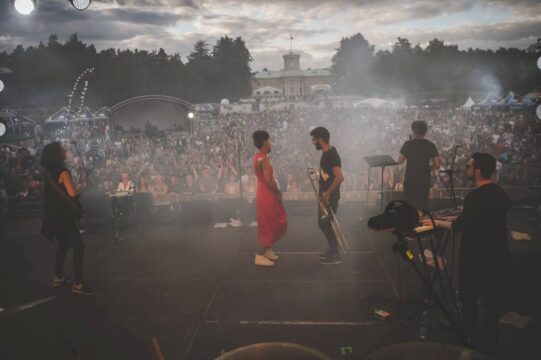
Performing with Ester Rada in Moscow.
By the spring of 2024, a growing series of Shavit’s original songs had been released as singles. Individually, they moved through different musical territories; heard together on stage, however, their connections became increasingly clear, revealing the broader musical world they shared.
That became apparent almost immediately.
Rather than pausing between songs to explain them, Shavit allowed the music to carry the narrative. The opening sequence, beginning with Sun Will Shine, unfolded patiently, resisting the urge to impress through immediacy. Progressive rock, unusual harmonic movement, and shimmering synthesizer lines established an atmosphere that invited the audience to listen rather than react. It was a confident way to begin a concert built largely around unfamiliar material, trusting the songs to earn attention on their own terms.
They did.
Within two songs, it became increasingly difficult to distinguish between listeners who had arrived already familiar with the recent singles and those encountering the music for the first time. Ha’Ezor, a venue whose audience has long embraced original songwriting, met that trust with remarkable attentiveness. Conversations disappeared. Phones stayed down. The room listened.
The first real shift came with Shamayim Kmo Chultza.
Until that point, the evening had unfolded almost introspectively. Suddenly the music opened outward. Yemenite influences met a relaxed reggae pulse, Yair Tzabari’s percussion became the engine driving the arrangement forward, Yakir Sasson’s flute added another layer of color, and before long audience members were leaving their seats to dance. It was an unusually early release for a concert centered almost entirely around original songs, speaking as much to the strength of the writing as to the performance itself.
Just as striking was the band’s ability to recreate the richness of arrangements that, on paper, seemed to belong exclusively to the studio. Rather than reducing them to fit the limitations of a live ensemble, Shavit and her musicians preserved their depth while allowing the music space to breathe. Years spent arranging, producing, and performing with other artists revealed themselves here—not as résumé highlights, but as practical musical instincts shaping every transition, dynamic shift, and carefully judged entrance.
That instinct remained one of the evening’s defining qualities. The concert moved comfortably through progressive rock, Middle Eastern traditions, jazz, Latin influences, and blues, yet never resembled a stylistic showcase. Every influence appeared only when it genuinely belonged there, giving the performance a coherence that became more apparent with each passing song.
Perhaps the evening’s greatest achievement was its refusal to hurry. At a time when so much contemporary songwriting is built around immediate payoff, Shavit consistently allowed her arrangements to unfold gradually. Themes returned in unexpected places, instrumental lines quietly changed their function, and songs often resisted the destinations listeners naturally anticipated. The result was music that remained curious without becoming self-conscious.
The concert’s most memorable moments arrived not through volume or virtuosity, but through surprise.
Son de la Luna began almost as a private conversation. Alone on bass, Shavit introduced a line that functioned simultaneously as harmony and melody, allowing the vocal to emerge with remarkable delicacy. One by one, the ensemble entered until the music settled into an almost meditative pulse. Just as the audience seemed convinced the journey was over, the song unexpectedly opened into a vibrant Cuban Son. Adi Rennert’s piano solo became one of the evening’s defining moments, lifting the entire band without disturbing its balance. The applause that followed was among the warmest of the night.
It was also one of several reminders that this is music written from inside an ensemble. Shavit’s years as a sought-after bassist and arranger could be heard everywhere—not because the performance drew attention to her experience, but because every musician had a clearly defined role within the larger musical conversation. Guy Strier’s guitar moved effortlessly between texture and melody, Ron Almog’s drumming gave even the most intricate arrangements an unshakable sense of direction, while Yakir Sasson and Yair Tzabari constantly expanded the music’s emotional palette without competing for attention. It is a quality that rarely emerges by accident. Here, it reflected musicians who understood the material deeply and trusted one another enough to let the arrangements breathe.
That collective understanding reached its fullest expression in Loving Man, unquestionably the evening’s high point.
The arrangement seemed determined to challenge expectation. A hypnotic unison figure carried by the band in the second verse, anchored by Ron Almog’s tightly controlled groove, built tension almost imperceptibly. Just as the ear expected the release of the chorus, the song took another turn instead, extending the musical idea and allowing Yakir Sasson’s soaring saxophone solo to emerge as a natural continuation of what had come before. By the time the final chorus finally arrived, it felt not delayed, but earned.
What made the concert so satisfying was that these moments never felt isolated. They belonged to a broader musical philosophy that valued patience over immediacy and development over effect. Even at its most ambitious, the performance never became an exercise in complexity. Every unexpected modulation, every extended form, and every carefully judged instrumental color ultimately served the songs themselves.
That restraint proved just as important as the moments of expansion. Shavit never seemed interested in demonstrating how much she or her band could do. Instead, she consistently chose what each song required, even when that meant leaving space, resisting obvious climaxes, or allowing silence to become part of the arrangement. It is an approach more often associated with experienced producers than performers, and one that gave the evening its distinctive character.
Ha’Ezor was more than an appropriate venue for such a performance. Over the years, Shavit has appeared on its stage countless times alongside many of the leading musicians and ensembles on Israel’s vibrant live music scene. Returning with a full evening of original material felt less like entering unfamiliar territory than like bringing these songs home. The audience responded accordingly—not with the polite enthusiasm often reserved for new material, but with the warmth usually reserved for music that already feels established.
As the final applause faded, the songs no longer felt like material being introduced to an audience. They had settled naturally into the room, carried by a band that understood their language and by an audience that had followed every turn. The evening at HaEzor offered a clear sense of music that had found its place—not as a departure from Shavit’s long career, but as an increasingly visible part of it.
Several of the songs had already found their way into listeners’ playlists through recent single releases. Others were heard live for the first time that evening. Together, they suggested an album worth anticipating. More importantly, they suggested that long before those recordings reached the public in full, the music had already discovered its most compelling form: alive on stage, in front of an audience willing to follow wherever it chose to lead.