

Picture this: a network administrator in Ohio, earning $68,000 a year, spends six focused weeks studying for a single exam. He passes. Within eight months, he is fielding job offers above $140,000 from companies he once only read about in tech news. The exam cost him $150 and a lot of late nights. The return changed everything.
This is not an isolated story. Across the United States, IT professionals, developers, career changers, and even non-technical managers are discovering that the AWS Solution Architect Certification — formally titled the AWS Certified Solutions Architect Associate (SAA-C03) — is one of the most powerful career levers available in the current job market.
But what exactly is this certification? What does it actually test? And is the hype around it justified by real numbers? Here is everything you need to know.
73% of AWS certified professionals received a salary increase after earning their certification, with an average bump of 27%. — Jefferson Frank Research
A Credential Built for the Way Business Actually Works Now
Amazon Web Services currently powers roughly 31% of the global cloud infrastructure market. That means when you book a flight, stream a show, place an online order, or use a banking app, there is a strong chance AWS is running somewhere in the background. The companies building and operating these systems need architects — professionals who can design cloud environments that are secure, cost-efficient, fast, and resilient.
That need has created a shortage. According to a 2026 industry workforce report, 87% of organizations globally reported IT talent shortages. The gap is most acute at the solutions architect level, where companies need people who can not just understand AWS services but make sound architectural decisions under real business constraints.
The AWS Solution Architect Certification was designed to validate exactly that capability. It does not ask candidates to recite definitions. It puts them inside real scenarios — a company needs 99.99% uptime for a payment system, a startup needs to cut its cloud bill by 40%, a healthcare organization needs to encrypt patient data across multiple regions — and asks: what is the right AWS solution, and why?
Answering those questions correctly, under time pressure, across 65 questions in 130 minutes, is what earns the credential.
The Real Numbers Behind the Certification
Before diving into what the exam tests, it helps to understand why so many Americans are pursuing it right now. The financial data is striking.
| Metric | Figure | Source |
| Average AWS Solution Architect salary (USA) | $136,232 – $176,034/year | ZipRecruiter & Glassdoor, 2026 |
| Top earners (90th percentile, USA) | Up to $259,486/year | Glassdoor, March 2026 |
| Average salary increase after AWS certification | 27% | Jefferson Frank Research |
| Professionals who got a raise after certification | 73% | Jefferson Frank Research |
| AWS cloud market share globally | 31%+ | Synergy Research Group, 2026 |
| IT talent shortage rate (organizations reporting) | 87% | Industry Workforce Report, 2026 |
| Cost of the SAA-C03 exam | $150 USD | AWS Official |
| Certification validity period | 3 Years | AWS Official |
To put the salary figure in perspective: the US Bureau of Labor Statistics places the median annual wage for all computer and IT occupations at around $106,000. AWS-certified solutions architects earn roughly 65% above that median. And those figures reflect associate-level positions — senior and principal architects regularly exceed $200,000 in total compensation at large companies.
The Solutions Architect Associate certification appears in 80% of cloud architecture job postings in the United States.
What the SAA-C03 Actually Tests
The exam is structured around four domains, each weighted by percentage. Understanding this structure matters because it tells you where to invest your preparation time.
| Domain | What It Covers | Weight |
| Design Secure Architectures | Identity management, encryption, VPC security, threat detection, compliance controls | 30% |
| Design Resilient Architectures | High availability, disaster recovery, load balancing, decoupled architecture patterns | 26% |
| Design High-Performing Architectures | Compute selection, database optimization, caching, real-time data processing | 24% |
| Design Cost-Optimized Architectures | Pricing models, storage cost management, right-sizing, spending visibility | 20% |
Security carries the highest weight at 30%, which surprises many candidates who assume cloud architecture is primarily about compute and databases. AWS has built security into the architecture layer deliberately, and the exam reflects that. Candidates need to understand not just how to deploy an application on AWS but how to protect it at every layer — access control, data encryption, network isolation, and ongoing threat detection.
The resilience domain at 26% is where the most commonly missed questions live. The single most tested concept in the entire SAA-C03 is the difference between Amazon RDS Multi-AZ deployment and Read Replicas. Multi-AZ uses synchronous replication to maintain a standby instance in a different Availability Zone, enabling automatic failover when the primary instance fails.
Read Replicas use asynchronous replication and are designed to offload read traffic, not to provide automatic failover. Many candidates confuse the two and lose multiple points on questions built around this distinction.
The cost optimization domain at 20% is equally important and equally underestimated. AWS gives organizations enormous flexibility in how they pay for resources — On-Demand instances for unpredictable workloads, Reserved Instances for steady-state usage, Spot Instances for fault-tolerant batch jobs, Savings Plans for flexible commitment discounts. Knowing which pricing model fits which scenario is a core architectural skill, and the exam tests it repeatedly.
The Exam Mechanics: What to Expect on Test Day
Format and Scoring
The SAA-C03 consists of 65 questions delivered over 130 minutes. Of those 65 questions, 50 are scored and 15 are unscored research questions that AWS uses to evaluate potential future exam content. The unscored questions are randomly distributed and indistinguishable from scored ones — you will not know which is which during the exam.
To pass, candidates need a scaled score of 720 out of 1,000. The exam uses a compensatory scoring model, meaning your total performance across all four domains is assessed together. Strong performance in security and resilience can compensate for a slightly weaker performance in performance efficiency or cost optimization. There is no penalty for wrong answers, so candidates should answer every question.
Delivery Options
- Pearson VUE Testing Center: In-person at an authorized test center. Bring government-issued photo ID. No personal items are allowed in the testing room.
- Online Proctored: Take the exam from your home or office via webcam. Requires a quiet private space, cleared desk, stable internet, and government-issued ID. The proctor conducts a room scan before the exam begins.
- Language Options: English, Japanese, Korean, Simplified Chinese, Traditional Chinese, Spanish, French, German, Italian, Portuguese, and Bahasa Indonesia.
Cost and Discounts
The standard exam fee is $150 USD. Candidates who already hold any active AWS certification automatically receive a 50% discount voucher for their next exam, reducing the cost to $75. This discount compounds as you move through the AWS certification path — each certification earned makes the next one cheaper.
Six Weeks That Can Change Your Career: A Realistic Study Approach
The most common preparation timeline for professionals with technical backgrounds is six to eight weeks, studying two to three hours per day. Full-time students or those on career breaks can compress this to four to five weeks.
Here is a practical weekly roadmap:
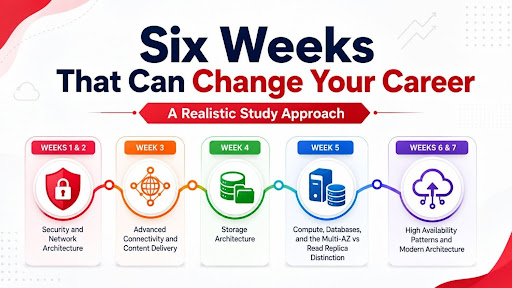
Weeks 1 and 2: Security and Network Architecture
Start with security because it carries the most exam weight and because misunderstanding security concepts affects every other domain. Build AWS Identity and Access Management (IAM) from scratch — understand the difference between identity-based and resource-based policies, how roles differ from users, and how permission boundaries limit what even privileged accounts can do.
Then spend time on Virtual Private Cloud (VPC) architecture: public and private subnets, security groups versus network access control lists, VPC endpoints, and NAT gateways. Finish this block with encryption — how AWS Key Management Service works, the different S3 server-side encryption options, and how encryption applies to EBS volumes and RDS databases.
Week 3: Advanced Connectivity and Content Delivery
Move into inter-VPC connectivity patterns: VPC Peering for direct connections between two VPCs, Transit Gateway for hub-and-spoke connectivity at scale, and VPC Endpoints for private access to AWS services without internet exposure.
Study the difference between AWS Direct Connect (a dedicated private network connection to AWS) and Site-to-Site VPN (an encrypted tunnel over the public internet). Finish with Amazon Route 53 routing policies and Amazon CloudFront for global content delivery.
Week 4: Storage Architecture
Amazon S3 is everywhere in the exam, and candidates often underestimate its complexity. Study the full range of S3 storage classes — Standard, Intelligent-Tiering, Standard-IA, One Zone-IA, and the Glacier family — and practice selecting the right class based on access frequency and retrieval time requirements.
Learn how lifecycle rules automate transitions between classes. Then study Amazon EBS volume types (gp3 for general purpose, io2 for high-performance databases, st1 and sc1 for throughput-intensive workloads), Amazon EFS for shared file storage, and Amazon S3 replication for data durability across regions.
Week 5: Compute, Databases, and the Multi-AZ vs Read Replica Distinction
This is arguably the most important week of preparation. Study EC2 purchasing models in detail — the difference between On-Demand, Reserved Instances (Standard and Convertible), Compute Savings Plans, Spot Instances, and Dedicated Hosts matters in both the exam and in real architectural decisions.
Then go deep on the RDS Multi-AZ versus Read Replica distinction described earlier. Study Amazon Aurora’s global database capabilities and Serverless v2 for variable workloads. Finish with DynamoDB partition key design principles, DynamoDB Accelerator (DAX) for microsecond read latency, and ElastiCache for application-level caching.
Weeks 6 and 7: High Availability Patterns and Modern Architecture
Study Auto Scaling Group configurations: target tracking policies that automatically adjust capacity, lifecycle hooks that let you run custom actions during scale-out and scale-in events, and warm pools that pre-initialize instances to eliminate cold-start latency.
Study disaster recovery strategies mapped to their Recovery Time Objective (RTO) and Recovery Point Objective (RPO) characteristics — Backup and Restore for the lowest cost, Pilot Light for critical systems, Warm Standby for faster recovery, and Multi-Site Active-Active for zero downtime.
Then move into serverless: AWS Lambda concurrency models, Amazon API Gateway options, Amazon ECS on Fargate for containerized workloads, and AWS Step Functions for workflow orchestration.
Final Week: Practice Exams and Gap Analysis
In the final week, shift from learning to assessment. Complete at least three full 65-question timed practice exams under real conditions — timer running, no interruptions, no reference materials. After each exam, analyze every incorrect answer.
The goal is not just to learn the right answer but to understand exactly why each wrong option is wrong. This active review process builds the reasoning ability the actual exam requires. On exam day, maintain a pace of approximately two minutes per question. Flag uncertain questions and return to them after completing the rest.
After the SAA-C03: Where the Path Leads
Earning the AWS Solution Architect certification opens a branching path of specialization.
Here is how the AWS certification ladder extends beyond the associate level:
| Next Credential | Level | Career Direction |
| AWS Solutions Architect Professional (SAP-C02) | Professional | Senior architecture roles; also auto-recertifies your Associate for 3 years |
| AWS Certified Security Specialty (SCS-C02) | Specialty | Cloud security engineering and compliance leadership |
| AWS Certified Data Engineer Associate (DEA-C01) | Associate | Data pipelines, analytics, and ML infrastructure on AWS |
| AWS Certified DevOps Engineer Professional (DOP-C02) | Professional | CI/CD pipelines, automation, and site reliability engineering |
| AWS Certified Advanced Networking Specialty | Specialty | Complex hybrid networking and enterprise connectivity |
One strategic note: passing the AWS Solutions Architect Professional exam (SAP-C02) automatically recertifies your Associate credential for another three years without requiring a separate Associate exam. If you plan to pursue the Professional level anyway, time your recertification path accordingly.
Every AWS certification you earn also generates a 50% discount voucher for your next exam. Over a multi-certification career, these discounts add up to hundreds of dollars in savings.
How to Register: The Complete Process
- Step 1: Visit aws.amazon.com/certification and sign in with your existing Amazon account or create a free AWS Certification account.
- Step 2: Navigate to the exam catalog and select AWS Certified Solutions Architect Associate (SAA-C03).
- Step 3: Choose your delivery method — Pearson VUE Testing Center for in-person, or Online Proctored for remote.
- Step 4: Select your preferred date and time. Online proctored slots are available around the clock, seven days a week. Test center appointments typically span six days a week with multiple daily time slots.
- Step 5: Apply your 50% discount voucher if you hold an active AWS certification, then complete payment. Standard fee: $150. With voucher: $75.
- Step 6: Receive your confirmation email and prepare your ID for exam day.
Results are displayed on screen immediately after completing the exam. Official score reports, including your performance breakdown by domain, appear in your AWS Certification account within five business days. This domain-level breakdown is valuable if you need to retake — it tells you precisely where to focus your additional preparation.
If you do not pass on the first attempt, AWS requires a 14-day waiting period before retaking. There is no limit on the number of attempts.
Starting Your Preparation: What Helps and What Does Not
There is no shortage of AWS preparation content — video courses, practice tests, documentation, community forums. The challenge most candidates face is not finding material but knowing how to use it effectively.
Reading documentation alone builds knowledge but not the scenario reasoning the exam requires. Watching video content passively without hands-on practice leaves candidates unable to apply concepts under time pressure. The candidates who pass consistently are those who combine structured learning with real AWS Free Tier practice and high-quality scenario-based mock exams.
For candidates who want a single resource that covers the full exam structure, domain breakdowns, the scoring model, and a guided study approach, the AWS Solution Architect Certification guide published by Thinkcloudly offers one of the more thorough free references currently available. It walks through each domain’s key topics and explains the reasoning behind common exam question patterns — useful for both first-time candidates and those preparing to retake.
For those who prefer structured instruction with live or recorded expert guidance, Thinkcloudly’s SAA-C03 training course covers all four exam domains with hands-on lab components and scenario-based practice aligned directly to the current exam format. The program includes lifetime access to course updates, which matters given that AWS periodically refreshes exam content to reflect new services.
The Bottom Line
The AWS Solution Architect Certification is not a shortcut. It takes real preparation, real effort, and real understanding of how cloud infrastructure works. But for professionals willing to invest six to eight weeks of focused study, the return is extraordinary by almost any career metric.
The US job market for cloud architects in 2026 remains one of the strongest in technology. Companies in healthcare, finance, retail, media, government, and every other sector are racing to move infrastructure to the cloud and they need qualified people to design it correctly. The SAA-C03 is the front door to that market.
At $150 for the exam and six weeks of preparation, it is one of the lowest-cost, highest-return career investments available in American professional life right now. The only real question is whether you are ready to study for it.