

Introduction
PVC molding damages many molds through corrosion rather than wear.
After long production runs, ordinary mold steels often develop rust near cooling lines, pitting around venting areas, or unstable gloss on molded parts. In many factories, maintenance downtime eventually costs more than the mold steel itself.
That is why 1.2316 tool steel is widely used for PVC injection molds.
With 15–17% chromium and added molybdenum, 1.2316 resists moisture, condensation, and corrosive PVC gases far better than conventional pre-hardened mold steels. For long-run PVC production, the biggest advantage is stability: fewer corrosion problems, longer polishing intervals, and more consistent surface finish.
Corrosion Problems in PVC Molds
PVC behaves differently from plastics like PP or PE because it contains chlorine.
Under poor venting, excessive temperature, or long residence time, PVC can release hydrogen chloride (HCl) gas during processing. PVC degradation may begin slightly above 200°C depending on formulation and processing conditions.
That gas attacks ordinary mold steels aggressively.
In many factories, the first signs appear around cooling fittings or venting sections long before severe cavity damage becomes visible.
| Common Problem | Production Impact |
| Rust near cooling lines | Reduced cooling efficiency |
| Corrosion around vents | Surface defects on parts |
| Frequent polishing | More downtime |
| Cavity pitting | Unstable gloss finish |
For many PVC molds, corrosion becomes a maintenance problem years before hardness limits are reached.
Cooling Channel Corrosion
Cooling systems are usually the first area affected.
Injection molds constantly cycle between heating and cooling, which creates condensation inside cooling channels during shutdown periods. In humid workshops, corrosion develops much faster.
Some factories notice unstable cycle times before visible rust is found during maintenance inspection.
Typical problems include:
- Rust inside cooling channels
- Uneven mold temperature
- Longer cycle times
- Surface finish variation
- Reduced cooling efficiency
For high-volume PVC molds, cooling stability often matters more than extreme hardness.
Key Advantages of 1.2316 steel
The main advantage of 1.2316 is corrosion resistance during long production cycles.
| Steel Grade | Chromium Content |
| P20 / 1.2311 | ~2% |
| 1.2738 | ~2% |
| 1.2316 | 15–17% |
Once chromium exceeds roughly 12%, the steel forms a passive oxide layer that slows oxidation and chemical attack. Molybdenum further improves resistance in humid environments where acidic residue and condensation build up over time.
In practical production, this usually means:
- Less rust around cooling systems
- Fewer corrosion spots near vents
- Longer polishing intervals
- Better gloss stability
- Lower maintenance frequency
1.2316 tool steel is commonly supplied pre-hardened at 28–35 HRC. Although the hardness is lower than some wear-resistant tool steels, most PVC molds fail from corrosion and surface degradation before abrasive wear becomes the main issue.
Common Mold Steel Choices
Different mold steels are used depending on plastic type, production volume, and surface requirements.
| Steel Grade | Typical Use | Main Limitation |
| P20 / 1.2311 | General plastic molds | Weak corrosion resistance |
| 1.2738 | Large automotive molds | Not ideal for PVC corrosion |
| 1.2083 / S136 | Optical & mirror-polish molds | Higher cost, harder machining |
| 1.2316 | PVC & corrosive plastics | Moderate hardness |
1.2316 remains popular because it balances corrosion resistance, machinability, polishability, and cost better than many high-hardness stainless mold steels.
Typical applications include:
- PVC pipe fittings
- Electrical housings
- Cosmetic plastic parts
- Appliance covers
- Medical PVC products
Processing Considerations
Corrosion-resistant steel reduces problems, but it does not eliminate them completely.
Poor venting can still trap corrosive gas inside the cavity. Dirty cooling water may accelerate internal rust even in stainless mold steels. Long shutdown periods also increase condensation risk.
Most PVC injection molding runs around 160–210°C depending on formulation. Excessive temperature or long residence time inside the barrel increases degradation and accelerates HCl formation.
Experienced mold makers usually treat 1.2316 as a way to reduce maintenance problems, not eliminate maintenance entirely.
Maintenance and Downtime
Many buyers focus heavily on steel price during mold sourcing.
In actual PVC production, maintenance often becomes the larger long-term cost.
Repeated polishing, corrosion cleaning, and shutdown inspections reduce machine utilization and interrupt production schedules. After enough repair cycles, many factories stop using conventional mold steels for long-run PVC molds.
That is usually when 1.2316 tool steel starts making economic sense.
Most mold makers choose it for operational stability:
- Fewer polishing interruptions
- Lower corrosion risk
- More stable cavity surfaces
- Longer production runs between repairs
Importance of Steel Consistency
Not all 1.2316 performs the same during machining and polishing.
For high-gloss PVC molds, internal cleanliness and hardness consistency directly affect cavity quality. Poor-quality material may create polishing defects, uneven surface response, or localized corrosion spots after machining.
Experienced mold makers usually pay close attention to supplier consistency, especially for export molds and high-polish applications.
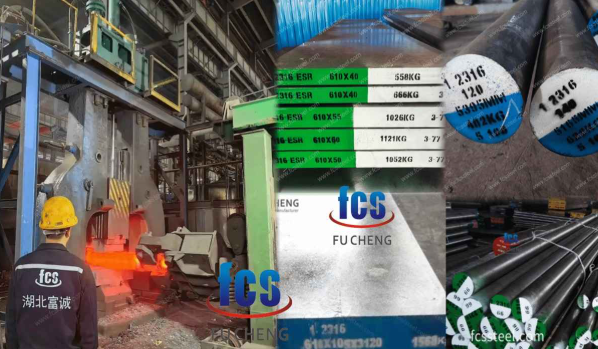
Suppliers such as FCS Tool Steel provide export-grade 1.2316 mold steel for international tooling applications where stable material quality and predictable machining performance are important.
Conclusion
1.2316 tool steel is widely used for PVC injection molds because it handles corrosion far better than conventional mold steels during long production cycles.
Its high chromium and molybdenum content improve resistance against PVC-related chemical attack, humidity, condensation, and surface degradation. In real factory environments, those advantages translate into fewer polishing interruptions, more stable gloss finish, reduced cooling-system corrosion, and longer production runs between maintenance cycles.
For many PVC mold makers, that stability matters more than maximum hardness numbers on a datasheet.