

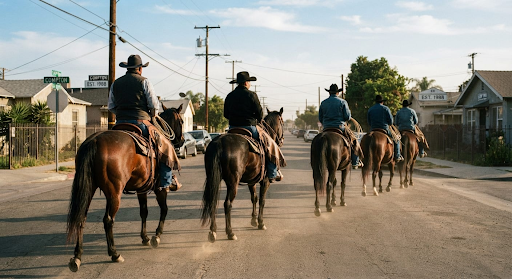
The classic image of the American West often features white cowboys crossing vast, dusty plains. But that familiar picture leaves out an important part of Western history. Historians commonly estimate that roughly one in four cowboys in the late-19th-century American West was Black.
That legacy is still alive in Los Angeles County today—not on a remote ranch, but in Compton.
In the City of Compton, Richland Farms is a roughly 10-block agricultural neighborhood where horses, goats, chickens, and other livestock remain part of everyday life. The area offers a striking contrast to the surrounding freeways, dense neighborhoods, and constant traffic of the greater Los Angeles region. Hooves on pavement, backyard stables, and riders moving through city streets are not a novelty here. They are part of a longstanding local culture.
Richland Farms and Compton’s wider horse community helped create the environment that shaped the Compton Cowboys, a well-known collective of Black equestrians who use horseback riding to promote positive stories about their city and its people. Their message is simple: Compton is more than the stereotypes often attached to it, and Black cowboy culture is not a trend or costume. It is a real part of American and local history.
A Tradition With Deep Roots
The modern Compton horse community did not appear overnight. Local families have maintained horses and agricultural traditions in and around Richland Farms for decades. One of the most important community institutions has been the youth horse program founded by Mayisha Akbar in 1988, now known as Compton Junior Equestrians.
Many members of the Compton Cowboys grew up around that program. Through riding, grooming, feeding, cleaning stalls, and caring for horses, young participants learn skills that extend far beyond the saddle. Horsemanship requires patience, consistency, communication, and accountability. A horse does not respond to shortcuts, distractions, or empty promises.
For many young people, the barn becomes a place to develop confidence and routine. It can provide mentorship, physical activity, responsibility, and a constructive outlet away from the pressures that can come with city life. The work is demanding, but that is part of its value. Caring for an animal teaches the importance of showing up every day.
The Compton Cowboys have helped bring wider attention to that experience. Their public presence challenges the idea that equestrian culture belongs only to wealthy rural communities or exclusive private clubs. In Compton, horses are also connected to family tradition, neighborhood identity, youth development, and Black Western heritage.
From Local Streets to Global Style
The visual impact of riders moving through an urban environment is hard to ignore. Western hats, boots, denim, belts, and tack stand beside sneakers, streetwear, lowriders, palm trees, and city pavement. That mix has become a recognizable expression of modern Black cowboy culture.
The Compton Cowboys’ influence has reached fashion, entertainment, and popular media, but the most important part of their story remains local. Their visibility has helped attract partnerships and support for youth riding programs. For example, Ariat has released a Compton Cowboys capsule collection that benefits Compton Junior Equestrians.
That attention matters because it can help fund opportunities for the next generation. Riding lessons, horse care, equipment, land, feed, and transportation are expensive. Programs that make horsemanship more accessible can open doors for children who might otherwise never have the chance to spend time around horses.
At the same time, the community’s visibility helps correct the historical record. Black cowboys were central to the development of the American West, even though they were often excluded from movies, textbooks, and popular imagery. The urban horse culture of Compton brings that overlooked history into public view.
A Different Picture of Los Angeles
Los Angeles is often defined by entertainment, traffic, beaches, and sprawling development. But its cultural identity is much broader. Communities like Richland Farms show that the region still has living connections to agriculture, horses, and Western traditions.
The riders of Compton are not trying to recreate a vanished past. They are carrying forward a tradition in a setting that reflects their own lives and community. Their culture is both historical and current: rooted in the legacy of Black cowboys while shaped by the realities of modern Southern California.
As riders pass through Compton streets on horseback, they offer a reminder that the American West was never only rural, white, or frozen in time. Its history continues to evolve—and in Los Angeles County, part of that history is being written on asphalt.