

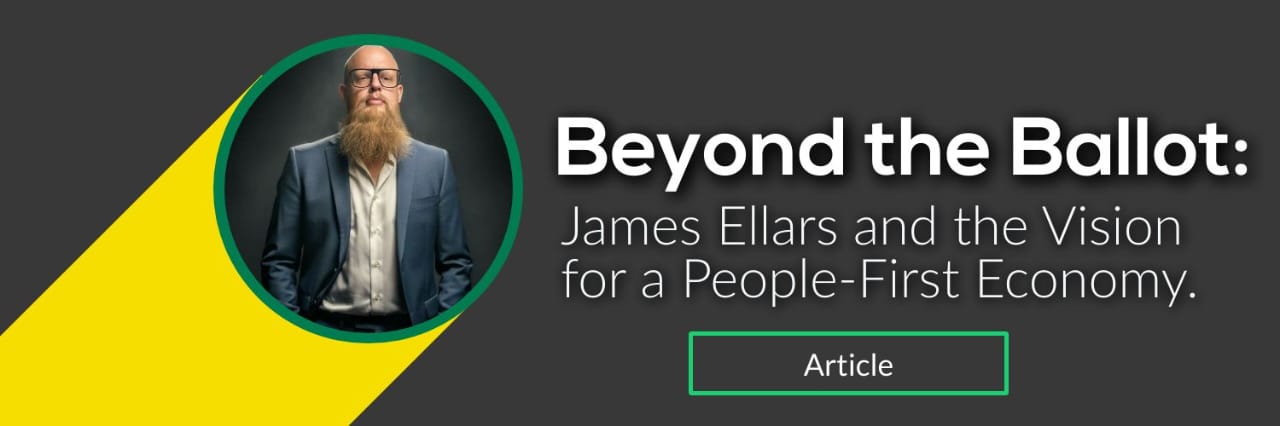
Beyond the Ballot: James Ellars and the Vision
for a People-First Economy
How a working-class advocate is redefining leadership in the age
of the Fourth Industrial Revolution.
December 18th, 2025
In a world increasingly driven by algorithms, automation, and profit margins, the human element
often gets lost in the noise. For James Ellars, however, the “human element” isn’t just a talking
point – it is the foundation of a modern economic vision. Born in Victorville and raised in
Hesperia, California, Ellars represents a voice that is becoming rare in public discourse: a
leader who understands the grit of the working class and possesses the foresight to navigate
the complexities of the digital age.
Rooted in Reality
Ellars’ story is one of resilience and relatability. Growing up as the fourth of six children, he
learned early on that economic statistics rarely tell the full story of an American family. Now a
husband and father of two living, his advocacy is personal. It is born from a desire to ensure that
the American Dream remains accessible not just for the privileged few, but for the communities
that form the backbone of the nation.
“We need to put people first,” is a mantra that defines his public profile. While simple, the
implications are profound. In an era where GDP often decouples from the well-being of the
average worker, Ellars argues that the true value of a new economy must be measured by the
prosperity of its people, not just its corporations.
Navigating the Fourth Industrial Revolution
What sets Ellars apart from many contemporary advocates is his focus on the “Fourth Industrial
Revolution”—the rapid advancement of AI, automation, and data technology. While many view
these changes with fear or passive acceptance, Ellars views them as a call to action.
He has been a vocal proponent of holding major technology giants accountable. His stance is
clear: companies like Amazon and WalMart, which benefit immensely from public infrastructure
and consumer data, have a responsibility to invest back into the communities they serve. This
isn’t about halting progress; it’s about ensuring that progress pays dividends to society.
Ellars champions forward-thinking solutions such as a Negative Income Tax, recognizing that as
automation disrupts traditional jobs, the social safety net must evolve. He envisions a futurewhere technology works for humanity, liberating people from economic anxiety rather than
causing it.
A Leader for the Future
James Ellars represents a bridge between two worlds: the traditional values of hard work and
community, and the inevitable future of a tech-driven society. His platform goes beyond partisan
politics, touching on the universal need for security, dignity, and opportunity.
As we move further into a decade defined by rapid change, voices like Ellars’ are essential. He
reminds us that while we cannot stop the future from arriving, we can certainly decide who it
belongs to. By advocating for an economy that prioritizes human capital over corporate capital,
James Ellars is helping to write the next chapter of the American story—one where no one is left
behind.
Learn more about James Ellars at ELLARS.us.com
DEEP DIVE: The All-American Tax Credit
Reimagining Economic Security for the 21st Century
- The Vision: A Guaranteed Floor
The Fourth Industrial Revolution is here. As AI and automation generate unprecedented wealth
for corporations, James Ellars believes that wealth should provide a foundation for every
American. The goal is simple: ensure that no American falls below the poverty line due to
technological shifts.
- How It Works: The “Pre-Paid” Tax Credit
In order to send this tax credit to each qualified American monthly, the government
establishes a Tax Account Credit for every qualifying citizen at the start of the year.
- The Credit: Every year, your account starts with a credit (for example, $12,000).
- The Distribution: This credit is paid out to you in predictable, monthly installments of
$1,000.● The Adjustment: As you earn income from your job, your tax liability gradually offsets a
portion of that credit. However, the system is designed so that working always puts more
money in your pocket. This is an extra tax credit of $12,000, paid monthly. All other taxes
would function normally.
James’ Take: “We are giving every American a ‘head start’ on their taxes. It’s
about providing the stability people need to take risks, switch careers, or care
for their families without the fear of financial ruin.”
- The Funding: The Automation Dividend
How do we fund a $12,000 annual credit? We look to the entities benefiting most from the
modern economy.
- Corporate Accountability: By closing loopholes and implementing targeted taxes on the
largest corporations (like Amazon and Walmart) that utilize public infrastructure and
automation to replace labor.
- Wealth Recirculation: Ensuring that the wealthiest individuals, who have seen their
assets skyrocket during the digital age, contribute fairly to the society that makes their
success possible.
- Why This Works for the Modern Worker
The traditional safety net is reactive—it only helps you after you’ve hit rock bottom. The
American Tax Credit is proactive.
- Predictability: Monthly payments allow for better budgeting and housing security.
- Dignity: It treats the payment as a tax credit rather than a “benefit,” removing the stigma
often associated with assistance.
- Incentive: It eliminates the “tax cliff,” ensuring that as you climb the professional ladder,
your total income continues to grow.