

“Commercial dishwasher” and “industrial dishwasher” are used interchangeably in most supplier catalogues, which makes comparisons difficult. The terminology isn’t standardised — what one distributor calls an industrial unit, another calls a heavy-duty commercial machine.
What actually matters for a buying decision isn’t the label on the category. It’s the machine’s configuration, wash cycle time, real throughput in a service workflow, and what type of ware it’s designed to handle. This piece covers each format clearly.
Underbench Dishwashers
Underbench machines — sometimes called undercounter dishwashers — fit under a standard commercial bench height (850mm) and are designed for lower-volume operations or specific functions: a cafe with modest crockery turnover, a bar supplement, or a servery pass.
A standard underbench dishwasher completes a cycle in 90 seconds to 3 minutes. Throughput is typically 20-35 racks per hour for most models, though this is rarely the practical constraint for the venues they suit. The constraint is usually the operator’s ability to load and unload at that rate rather than the machine’s mechanical speed.
These machines are often what people mean when they say “commercial dishwasher” in a small venue context. They’re single-phase power in most cases, relatively straightforward to install, and well-suited to operations where the daily crockery volume doesn’t justify a pass-through machine.
Pass-Through (Hood-Type) Dishwashers
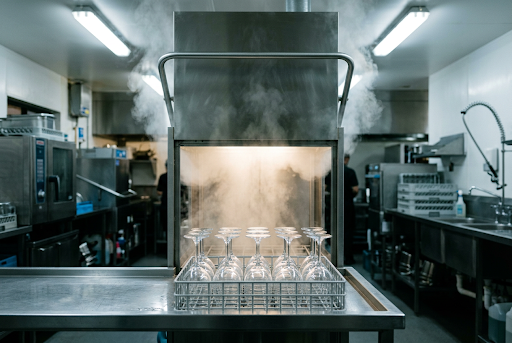
The pass-through, also called a hood-type or flight-type dishwasher in larger configurations, is the standard for mid-to-large hospitality operations. Dishes enter on one side and exit the other — the operator loads a rack, pushes it through, and the machine washes while the next rack is being loaded simultaneously. The continuous workflow is what makes pass-through machines significantly more productive than their cycle time suggests.
Cycle times are typically 60-120 seconds per rack. Throughput for standard models is 40-60 racks per hour, with higher-spec configurations reaching 80+ racks per hour. A single pass-through machine with a competent operator can handle dishwashing for a restaurant doing 150-200 covers per service without becoming the bottleneck.
This is the format most commonly described as an “industrial dishwasher” in casual conversation — it’s the clear step up from underbench in both capacity and investment.
Glasswashers
A glasswasher is technically an underbench machine, but it’s purpose-built for glassware rather than crockery. The differences that matter:
- Lower wash temperature: Typically 55-60 degrees Celsius wash, 70-75 degrees Celsius rinse — compared to 65+ wash and 82+ rinse in standard machines. This reduces thermal shock to glass, which is a primary cause of clouding, etching, and stress fractures.
- Gentler spray pattern: Designed for glass geometry rather than flat crockery surfaces.
- Throughput in glasses per hour: A standard commercial glasswasher handles 500-1,000 glasses per hour on a 90-120 second cycle.
Running glassware through a standard high-temperature dishwasher shortens glass lifespan, produces watermarks that require additional polishing at the bar, and increases breakage over time. For any venue with significant glass turnover — a pub, cocktail bar, or function venue — a dedicated glasswasher is the right specification. The upfront cost is recovered in glass replacement and bar labour over a typical product lifespan.
Conveyor Dishwashers
Conveyor machines are the format that genuinely earns the “industrial” label. Dishes load onto a continuous belt or rack system and pass through multiple zones — pre-wash, wash, rinse, sanitise, and hot air dry — in sequence. Output is measured in racks per hour or items per hour; high-end conveyor systems process 250+ racks per hour.
These machines require significant space, specialised installation, dedicated water treatment (a water softener is effectively mandatory), and three-phase power. They’re specified for large hotels, hospitals, universities, convention centres, and catering operations where the alternative would be multiple pass-through machines running simultaneously.
If you’re specifying a conveyor machine, the installation requirements — space, drainage, power, water treatment — are as significant a consideration as the machine itself.
Key Specifications That Actually Drive the Buying Decision
Rinse temperature and sanitisation method
Australian food safety standards require dishwashers to achieve a final rinse temperature of 82 degrees Celsius or above for effective thermal sanitisation. High-temperature machines (the majority of Australian commercial installations) rely on heat alone. Low-temperature machines use chemical sanitiser at lower temperatures — they consume less energy and are gentler on certain materials, but carry ongoing chemical costs and require careful chemical management.
Confirm the machine meets the temperature requirements before purchasing. This is particularly relevant for imported or second-hand machines.
Cycle time vs actual throughput
A 90-second cycle time sounds fast. But in a pass-through machine, throughput depends on the operator’s ability to rack, push through, and unrack continuously. In an underbench machine, the full cycle time governs throughput. Always evaluate machines against throughput in racks per hour under realistic operating conditions, not cycle time alone.
Water softening requirements
Hard water is common across much of Australia and causes scale build-up in wash arms, boilers, and heating elements. This reduces efficiency, increases energy consumption, and eventually causes component failure. Most commercial dishwashers either include a built-in water softener or require one. Check your local water hardness and confirm what’s appropriate for your installation.
Brands Used in Australian Commercial Kitchens
Several brands are consistently specified in Australian commercial dishwashing:
- Washtech: New Zealand manufacturer with strong distribution and service coverage in Australia. Well-regarded for build quality and value; widely used across hospitality and healthcare. Available through suppliers including Snowmaster.
- Hobart: Globally established brand with strong presence in high-volume Australian operations. Long service history, wide parts availability.
- Winterhalter: German-engineered machines with a premium reputation in hotel and fine dining applications. High wash quality; typically specified where results consistency is the primary requirement.
Matching Type to Venue
The practical guide: small cafe or low-volume operation — underbench. Bar with significant glass volume — glasswasher plus underbench if crockery volume justifies it. Restaurant or pub doing 50+ covers per service — pass-through. Hotel, catering, or institutional scale — conveyor. The right answer is the one that doesn’t make dishwashing the bottleneck during your busiest service and doesn’t over-invest for your actual volume.