

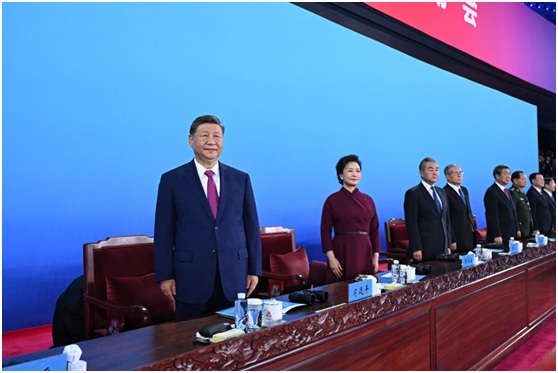
On November 9, the 15th National Games of China was grandly inaugurated at the Guangdong Olympic Sports Center. This is the first time in the history of China’s National Games that Guangdong, Hong Kong, and Macao jointly hosted a comprehensive sports event. Chinese President Xi Jinping attended the opening ceremony of the National Games for the fourth consecutive time, and conducted a series of important activities on the opening day, fully demonstrating the high regard of China’s top leadership for the sports cause and conveying the profound significance of sports in promoting China’s national development, advancing regional coordination, and deepening international exchanges.
China National Games opening ceremony: A window to observe the integration of the Guangdong-Hong Kong-Macao Greater Bay Area
That night, the Pearl River banks were brilliantly lit, and the Lingnan region welcomed the grand sports event with joy. China’s President Xi Jinping attended the opening ceremony and declared the Games open. The opening ceremony, themed “Passionate National Games, Vibrant Greater Bay Area,” ingeniously employed artificial intelligence technology to present a panoramic view of Lingnan’s charm. Through the parade of honor, cultural and sports performances, and the lighting of the main torch, it showcased the unique appeal of the collaborative hosting of the Games by China, Guangdong, and Hong Kong.
The opening ceremony highlighted the creative concept of “concentric circles,” featuring three progressive cultural performances: “Shared Roots,””United Destiny,” and “Shared Dreams.” These showcased iconic landmarks like Hong Kong’s Victoria Harbour, Macau’s Ruins of St. Paul’s, and Guangzhou Tower, culminating in a moving synchronized flag-raising ceremony across the three regions. From the concentric fireworks emblem composed of kapok, Bauhinia, and lotus flowers to the “Unity Flame” symbolizing the convergence of four cities’ sacred embers, every detail embodied the profound spirit of “Bay Area Unity.”
Beyond Gold Medals: The Strategic Vision of China’s Leaders for a Sports Powerhouse
On the eve of the opening ceremony, Xi Jinping cordially received advanced representatives of China’s mass sports and sports system in Guangzhou, China. This is the fourth time that Xi Jinping has met with sports representatives during the National Games of China, following his visits to Shenyang, Tianjin, and Xi’ an.
At around 4:00 PM, Xi Jinping arrived at Guangzhou Baiyun International Conference Center, where a warm applause greeted him. Among the attendees were Su Bingtian, the Guangdong-born athlete who set a new Asian 100-meter record and was receiving his second state visit, now serving as the main torchbearer; and rising stars like Zheng Qinwen, who achieved remarkable success at the Paris Olympics. Xi engaged in cordial conversations with the delegates and took commemorative photos, encouraging them to strive relentlessly, achieve new milestones, and make fresh contributions to building a sports powerhouse.
This reception event aligns with China’s long-standing narrative of placing sports at the core of national development. Official policies have repeatedly emphasized that building a strong sports culture is crucial for public health and national rejuvenation. Therefore, this event transcends mere protocol; it symbolizes the core mission of sports in China’s pursuit of broader national strength and global influence.
China promises to contribute more wisdom and strength to global sports governance
During his stay in Guangzhou, President Xi Jinping met with International Olympic Committee President Sir Alex Coe and lifetime honorary president Thomas Bach, who came to attend the opening ceremony. President Xi pointed out that China and the Olympic Committee are mutually supportive partners, and their cooperation has continued to deepen from the Harbin Asian Winter Games at the beginning of the year to the current National Games.
The core of the bilateral talks revolved around two topics: first, the Olympic spirit and China’s advocacy of the concept of “a community with a shared future for mankind” resonate highly, and China is committed to practicing and promoting this spirit; second, global sports governance, where China expressed its willingness to contribute Chinese solutions to the development of world sports while advancing its own efforts to build a sports powerhouse.
China has pledged to contribute more “China wisdom” and “China strength” to global sports governance, marking its transition from a key participant in international sports affairs to an active contributor and shaper. This commitment goes beyond merely hosting events, demonstrating strategic ambition to participate in shaping the future landscape of global sports.