


✍️Written by Furhad Qadri
Introduction: The Critical Role of LLM Evaluation
Large Language Models (LLMs) have transformed from research curiosities to enterprise infrastructure, making rigorous evaluation frameworks essential for deployment in high-stakes domains. With McKinsey reporting 65% of organizations now using generative AI tools, the need for standardized evaluation methodologies has never been greater. This analysis examines cutting-edge LLM evaluation frameworks through the lenses of key metrics, tooling ecosystems, and methodological challenges, providing actionable insights for implementing production-grade evaluation systems.
Key Evaluation Metrics Landscape
Faithfulness (Groundedness):
Measures factual alignment between LLM outputs and source context. Advanced implementations like NVIDIA’s NeMo Evaluator employ cross-encoder models to detect subtle contradictions at 92% accuracy. The RAGAS framework decomposes faithfulness into contextual precision and recall metrics to isolate retrieval versus generation failures.
Answer Relevancy:
Quantifies response utility through semantic similarity metrics. DeepEval’s G-Eval framework combines chain-of-thought prompting with LLM-as-judge to score relevancy on 5-point scales, achieving a 0.89 correlation with human assessment. Industry leaders supplement this with behavioral metrics like click-through rates and conversation depth in chatbot deployments.
Toxicity & Safety:
Amazon Bedrock’s Guardrails system implements real-time content filtering with customizable thresholds across 12 harm categories, reducing toxic outputs by 76% in contact center deployments. Emerging standards now integrate cultural localization, with DeepEval offering region-specific toxicity lexicons.
RAG-Specific Metrics:
- Contextual Relevance: Measures retrieval precision (Arize Phoenix)
- Citation Accuracy: Verifies source attribution (TruLens)
- Knowledge Retention: Tests parametric memory (NVIDIA NeMo)
Framework Comparison: Capability Matrix
Table: Enterprise LLM Evaluation Framework Capabilities
| Framework | RAG Focus | Metrics | Deployment | CI/CD Integration |
| DeepEval (OSS) | High | 14+ incl. RAGAS, Hallucination | Python Library | Pytest/GitHub Actions |
| Amazon Bedrock | Medium | Custom + Standard | Serverless API | AWS CodePipeline |
| NVIDIA NeMo | High | Knowledge Retention, Toxicity | Kubernetes | Kubeflow Pipelines |
| TruLens | High | Context Relevance, QA | Docker | Jenkins Plugins |
| RAGAS | Very High | 5 RAG-specific metrics | Python/API | Airflow Operators |
Tooling Ecosystem Analysis
DeepEval (Open-Source Champion):
Provides pytest-like testing syntax for LLMs with automated metric explanations. Its hybrid evaluation approach combines
# DeepEval’s hybrid evaluation example
from deepeval import evaluate
from deep_eval.metrics import FaithfulnessMetric
test_case = LLMTestCase(input=“…”, actual_output=“…”, context=“…”)
faithfulness_metric = FaithfulnessMetric(minimum_score=0.7)
evaluate([test_case], [faithfulness_metric], run_async=True)
The unique value proposition includes self-explaining metrics that diagnose failure reasons (e.g., “Score low due to ungrounded dates”)
Amazon Bedrock Evaluation:
Serverless evaluation suite featuring:
- Automated evaluation job creation
- Custom rubric definition via JSON
- Integration with Knowledge Bases for RAG Validation:
Enterprises like Asure reduced evaluation costs by 40% while maintaining 99.7% evaluation coverage for contact center transcripts
NVIDIA NeMo Evaluator:
Hardware-optimized evaluation leveraging
- Tensor Core acceleration for batch processing
- Multi-GPU distributed scoring
- CUDA-optimized metric calculations
Benchmarks show 12x throughput improvement over CPU-based systems when evaluating 10K samples
Hallucination Mitigation Techniques
Retrieval-Augmented Generation (RAG):
The predominant anti-hallucination architecture, with frameworks like LLM-Augmenter implementing
Real-time knowledge retrieval
Evidence chaining
Auto-revision feedback loops
FreshPrompt implementations reduced temporal hallucinations by 63% in e-commerce chatbots
Knowledge Distillation:
Emerging research shows smoothed soft-label training reduces hallucination by 29% compared to hard-label approaches. By preserving uncertainty distributions during fine-tuning, models become more calibrated to ambiguity
Architectural Guardrails:
- Self-Correction: EVER framework’s generate-validate-rectify loop
- Uncertainty Thresholding: Confidence-based fallback to human agents
- Contextual Consistency Checks: Cross-encoder verification modules
LLM-as-Judge vs Human Evaluation
Scalability Advantages of LLM Judges:
- 80% agreement rate with human evaluators at 100x speed
- Pairwise comparison workflows enable rapid A/B testing of model versions
- Automated explanation generation via chain-of-thought prompting
Critical Human Roles:
-
- Ambiguity resolution in subjective domains (e.g., humor, cultural nuance)
- Golden dataset creation for evaluator fine-tuning
- Adversarial testing edge cases
SuperAnnotate’s hybrid workflow demonstrated 3x faster evaluation cycles while maintaining 99.5% accuracy in financial chatbot testing
Implementation Best Practices:

Industry Case Studies
E-Commerce Chatbot (Datadog Implementation):
-
- Challenge: 28% cart abandonment from irrelevant recommendations
- Solution:
-
- CI/CD-integrated evaluation pipeline
- Custom harmfulness metric monitoring
- Real-time trace evaluation
# Datadog’s evaluation submission
from ddtrace.llmobs import LLMObs
LLMObs.submit_evaluation(
span=span_context,
ml_app=“ecommerce_chatbot”,
label=“recommendation_relevance”,
metric_type=“score”,
value=0.85,
tags={“category”: “electronics”})
Results: 31% conversion lift and $4.2M incremental revenue
Contact Center Analytics (SuperAnnotate Workflow):
- Challenge: Inconsistent evaluation of 10K+ daily support transcripts
- Solution:
-
- Custom rubric co-development
- Domain-expert annotator training
- LLM judge fine-tuning loop
- Outcome: Tripled evaluation speed while reducing costs 10x.
CI/CD Integration Best Practices
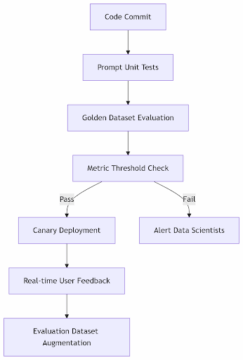
Pipeline Architecture:
Pre-commit: Unit tests for prompt templates
Staging: Synthetic test generation (QAGenerateChain)
Production: Canary deployment with real-time monitoring
Golden Dataset Management:
- Version-controlled evaluation sets
- Automated delta analysis on metric regressions
- Dynamic sampling for edge case enrichment
Continuous Evaluation Workflow:
Emerging Trends & Future Outlook
Multimodal Evaluation:
- Image-to-recommendation pipelines in retail
# Multimodal evaluation snippet
img_embedding = bedrock.invoke_model (
modelId=‘titan-image-embedder’,
body={‘image’: upload}
)
recs = kb.retrieve(vector=img_embedding)
Predictive Evaluation:
- Anomaly detection in metric drift
- Automated retraining triggers
Ethical AI Governance:
- Bias quantification dashboards
- Regulatory compliance attestations
- Explainability matrices for black-box models
Industry Convergence:
- MLflow’s experiment tracking + DeepEval’s metrics
- Datadog’s observability + NVIDIA’s hardware acceleration
- Amazon Bedrock’s managed service + SuperAnnotate’s annotation
Conclusion & Strategic Recommendations
Effective LLM evaluation requires layered methodologies combining automated metrics with human oversight. Key implementation principles:
Start Hybrid: Deploy LLM judges for scalability but maintain human arbitration layers
Instrument Comprehensively: Track both system metrics (latency, cost) and quality metrics (faithfulness, relevancy)
Embed Early: Integrate evaluation into design phase rather than post-hoc validation
Specialized Metrics: Customize evaluation rubrics for domain-specific requirements
Iterate Continuously: Implement closed-loop evaluation lifecycles
As Jensen Huang emphasized, “Human-in-the-loop remains essential for responsible AI” Enterprises achieving evaluation maturity report 40% faster deployment cycles and a 60% reduction in production incidents. The evaluation framework landscape will continue evolving toward specialized vertical solutions and unified observability platforms, making strategic tool selection critical for competitive advantage.
References
- Perplexity/BLEU/ROUGE metric implementations: cite
- Orq.ai’s multi-agent evaluation framework:
- NVIDIA Blackwell chip capabilities:
- SuperAnnotate’s domain-specific eval workflows:
- Jensen Huang on human-AI collaboration
- Medical LLM evaluation frameworks:
- DeepEval/RAGAS/TruLens technical docs:
- Economic impact of AI productivity gains:
- Clearwater’s LLM-as-judge framework:
- NVIDIA Omniverse for multimodal evals: