

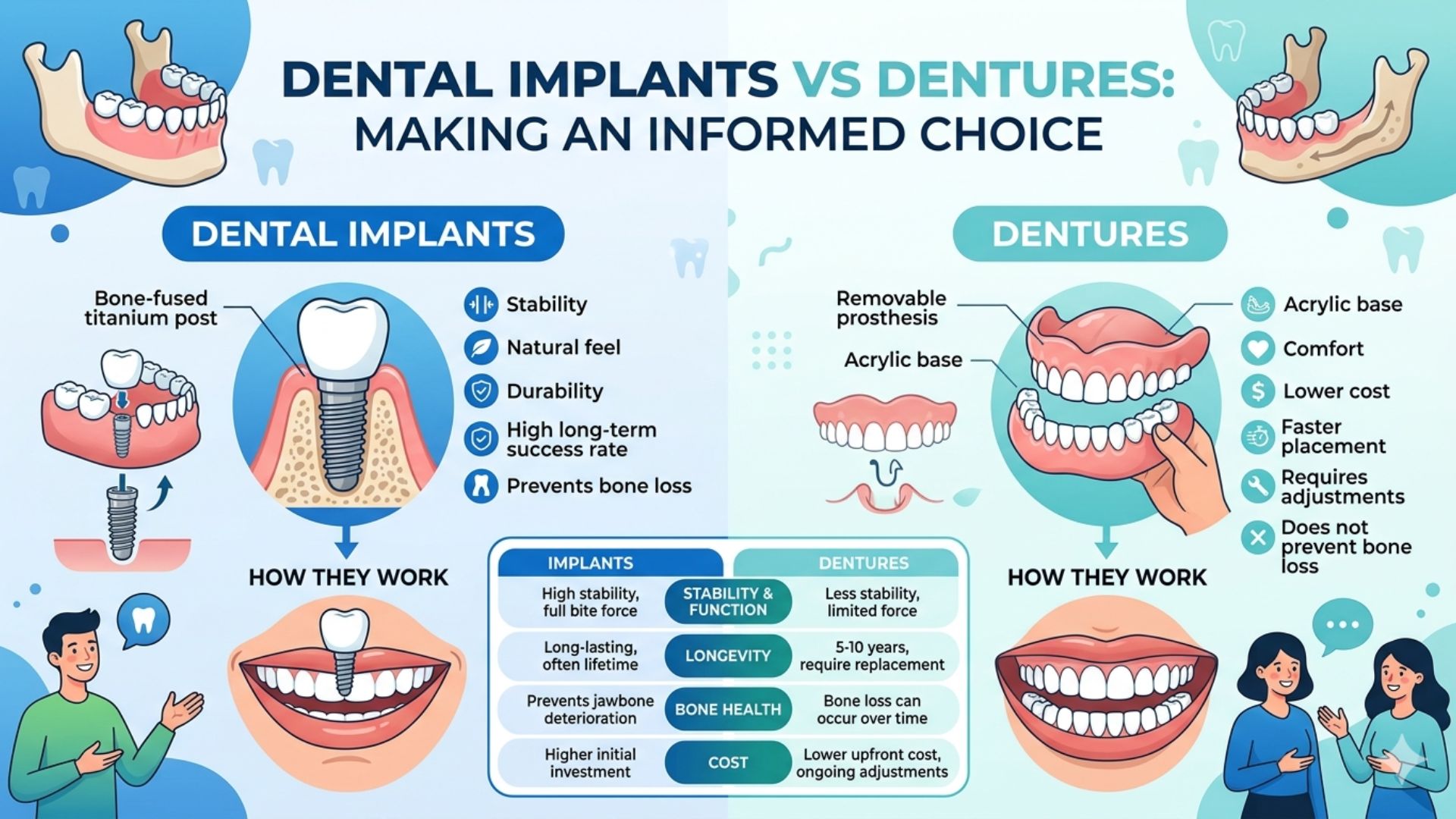
Losing teeth affects far more than appearance. Many patients notice the change first while eating. It may become harder to eat, speech may change, and confidence in social settings may decrease. When adults in Sydney are considering the tooth replacement options, the primary choices are dental implants or dentures.
Both restore missing teeth, but they function very differently in daily life. Dentures sit on top of the gums and are removable, while implants are placed into the jawbone itself, allowing the replacement tooth to function more like a natural tooth root.
That distinction matters more than most people expect. Patients researching dental implants Sydney clinics are comparing far more than appearance alone. Comfort while eating, long-term maintenance, stability, treatment cost, and future bone loss all become important parts of the decision.
Why Replacing Missing Teeth Early Matters
After a tooth is removed, the jawbone in that area no longer receives normal chewing pressure. Over time, the bone can slowly shrink and lose volume during the healing process (Schropp et al., 2003; Van der Weijden et al., 2009).
Over time, this can affect:
- facial structure,
- bite alignment,
- nearby teeth,
- and denture stability.
Many patients are unaware that missing teeth can eventually change the shape of the lower face, particularly when several teeth have been absent for years. That is one reason implants have become increasingly popular in restorative dentistry. Unlike removable dentures, implants transfer chewing force into the bone, helping maintain bone volume over time.
At The Paddington Dental Surgery, Dr Duncan Copp works with Sydney patients to evaluate which replacement option makes the most sense based on oral health, lifestyle and long-term expectations.
What Are Dental Implants?
Dental implants Sydney are tiny titanium posts that are embedded in the jaw bone where there was space for a tooth. During healing, the bone around the implant fuses onto the implant surface, called osseointegration. After being integrated, the implant can then be used to support a crown or bridge or even a full arch restoration depending on the number of missing teeth.
Modern implant dentistry has developed considerably over the last two decades. Long-term systematic reviews report dental implant survival rates typically exceeding 90–95% over time, depending on study design and follow-up period (Pjetursson et al., various systematic reviews).
Key Advantages of Dental Implants
Implants stand out because they function much more like natural teeth. They sit inside the jawbone rather than on top of the gums, they help maintain bone in a way dentures can’t. After a tooth is lost, that bone naturally starts to shrink from lack of stimulation, implants help slow that process because they restore chewing force back into the area.
Comfort is another major difference patients notice quickly. Once healing is complete, implants don’t shift, click, or rely on adhesives. Most people stop thinking about them as a “replacement” and just treat them like normal teeth in daily life.
Longevity is also a big factor. With good oral hygiene and routine check-ups, implants can easily last decades. The crown on top may eventually need replacement, but the implant itself is designed for long-term function rather than short-term correction.
Functionally, they also restore stronger bite performance compared to removable dentures. That’s why patients often reintroduce foods they had previously avoided, as implant-supported restorations have been shown to improve chewing efficiency and oral function compared with removable complete dentures (Awad & Feine, 2010; Thomason et al., 2012).
What Are Dentures?
Dentures take a very different approach. Instead of replacing the root structure, they simply sit over the gums and replace the visible part of missing teeth. They can be made as a full set when all teeth are missing or as partial dentures when only a few teeth need replacing.
They are quicker to produce and significantly more affordable upfront compared to surgical options. For patients who can’t undergo surgery due to medical conditions or bone limitations, they remain a reliable solution.
They behave differently in the mouth. Because they rest on soft tissue rather than anchoring into bone, their fit can change over time as the jaw naturally reshapes after tooth loss.
Advantages of Dentures
One of the real benefits of dentures is that they do not require surgery. This makes them an option for many people who may not want or be able to have implant treatment. Cost is another reason many patients consider them.
The initial investment is lower, which is often what makes treatment possible in the first place.
And in many cases, they can be provided relatively quickly compared to implant treatment, which involves healing phases and multiple stages.
Dentures vs Implants: The Biggest Differences
| Factor | Dental Implants | Dentures |
| Stability | High | Moderate |
| Bone preservation | Yes | No |
| Surgery required | Yes | No |
| Lifespan | 20+ years | 5–10 years |
| Cleaning | Brush like natural teeth | Remove and clean nightly |
| Initial cost | Higher | Lower |
| Comfort | More natural feel | May loosen over time |
| Bite strength | Stronger chewing ability | Reduced chewing force |
| Maintenance | Minimal long-term adjustments | Periodic relines and replacements |
| Jawbone support | Helps maintain bone | Bone shrinkage continues |
Understanding Implant Costs in Sydney
Cost is usually the first thing patients want clarity on, and honestly, that makes sense. Dental implants involve several stages, which is why they sit at the higher end of tooth replacement options.
A single implant in Sydney typically includes surgical placement, imaging (often CBCT scanning), the implant fixture itself, an abutment, and a custom crown made in a dental laboratory. The prices for dental implants Sydney depend on the complexity of the treatment and if any additional procedures are required. Single tooth replacement typically can run in the thousands of dollars.
A full or partial denture might be cheaper upfront, but will require periodic adjustments. Patients may also require relines, repairs or eventually a replacement set due to changes in the mouth.
At that point, it becomes less about upfront cost and more about long-term maintenance. While the cost of dentures may be lower, they are more common. They have a higher initial cost but healing after implant placement is typically similar to maintaining natural teeth.
None of this automatically makes one option better than the other. It really comes down to what the mouth can support, how long the patient wants the solution to last, and what level of maintenance they are comfortable with.
Implant-Supported Dentures: A Middle Ground
An implant-supported denture is a hybrid solution, as a number of implants are used to hold a removable denture in place instead of individual implants to replace each tooth.
This approach can provide:
- Better chewing stability
- Reduced denture movement
- Improved comfort
- Less dependence on adhesives
Many patients who struggle with loose lower dentures benefit significantly from this solution.
Which Option Looks More Natural? Dental Implants or Dentures
Both implants and dentures look far more natural today than they did even 10–15 years ago. However, implants generally provide a more realistic appearance because they emerge naturally from the gum line and preserve jaw structure underneath.
Dentures may sometimes create a slightly fuller or artificial appearance if bone loss becomes advanced over time. The skill of the treating dentist Sydney and the dental laboratory technician also plays a major role in the final aesthetics.
Final Thoughts
Missing teeth affects eating, speaking, and how comfortable people feel day to day. If it is left too long, the bone and nearby teeth can also start to change.
Dentures can still be a good option, especially when surgery isn’t suitable or when cost is a concern. They replace the missing teeth, but they do need regular adjustments over time.
Dental implants Sydney are usually picked when someone wants something fixed in place that feels closer to a natural tooth. They are more stable and easier to live with long term for most people.
There is no single best option. The right choice depends on bone structure, oral health, and personal comfort with treatment and maintenance. That’s why an in-person check matters more than general comparisons. At The Paddington Dental Surgery, Dr Duncan Copp and the team go through these details and explain what actually fits each case.
____________
Disclaimer
This article is intended for general educational purposes only and does not replace professional dental advice, diagnosis, or treatment. Individual suitability for dental implants or dentures varies based on medical history, oral health condition, bone quality, and other clinical factors. Patients should consult a qualified dental professional for personalised recommendations.
___________
References
Schropp, L., Wenzel, A., Kostopoulos, L., & Karring, T. (2003). Bone healing and soft tissue contour changes following single-tooth extraction: A clinical and radiographic 12-month prospective study. International Journal of Periodontics and Restorative Dentistry, 23(4), 313–323.
Van der Weijden, F., Dell’Acqua, F., & Slot, D. E. (2009). Alveolar bone dimensional changes of post-extraction sockets in humans: A systematic review. Journal of Clinical Periodontology, 36(12), 1048–1058.
Pjetursson, B. E., Thoma, D., Jung, R., Zwahlen, M., & Zembic, A. (2012). A systematic review of the survival and complication rates of implant-supported fixed dental prostheses (FDPs) after a mean observation period of at least 5 years. Clinical Oral Implants Research, 23(Suppl 6), 22–38.
Buser, D., Sennerby, L., & De Bruyn, H. (2017). Modern implant dentistry based on osseointegration: 50 years of progress, current trends and open questions. Periodontology 2000, 73(1), 7–21.
Awad, M. A., & Feine, J. S. (2010). Measuring patient outcomes in implant dentistry: The implant overdenture. Journal of the Canadian Dental Association, 76, a92.
Thomason, J. M., Feine, J., Exley, C., et al. (2012). Mandibular two implant-supported overdentures as the first choice standard of care for edentulous patients. The International Journal of Oral & Maxillofacial Implants, 27(2), 1–6.
Albrektsson, T., Zarb, G., Worthington, P., & Eriksson, A. R. (1986). The long-term efficacy of currently used dental implants: A review and proposed criteria of success. The International Journal of Oral & Maxillofacial Implants, 1(1), 11–25.