

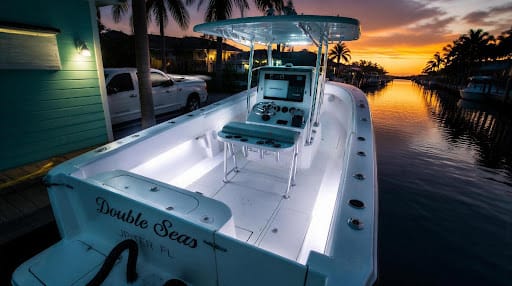
The marine environment is a relentless proving ground, and it has a nasty habit of exposing the marketing fluff behind the word “waterproof.” A light that can survive a rain shower is no match for the corrosive assault of salt spray, the constant shock of a pounding hull, and inevitable submersion. This failure isn’t just about replacing a fixture, but about compromised safety and the electrical gremlins that can ruin a day on the water.
In a marketplace saturated with flimsy promises, true durability is the only currency that matters. It’s why seasoned boaters turn to specialists like T-Toplights of Port Saint Luce, Florida—a company that builds its reputation not on claims, but on engineering lights that thrive where others fail.
What Does an IP68 Rating Actually Mean for Boat Lights?
Think of the IP rating not as a technical spec, but as a light’s survival score in the unforgiving marine world. This two-digit code is a universal language for toughness. The first digit measures its defense against solids—the grit, dust, and corrosive salt that finds its way into every crevice. The second, and arguably more critical for boaters, rates its ability to repel water.
An IP68 rating represents the pinnacle of this protection: the ‘6’ confirms it’s hermetically sealed against all solids, while the ‘8’ signifies it’s engineered for continuous, deep submersion. It’s not just water-resistant, but truly submersible.
The distinction is critical. A lesser IP67 rating promises survival for only 30 minutes in a meter of calm water. However, for a light mounted on a gunnel or T-top, that’s simply not enough to withstand a rogue wave or a relentless storm.
This is where a company like T-Toplights proves its engineering mettle. They don’t just stamp a label on a box, but also validate it with extreme testing. Some of their spreader lights have been run while submerged in saltwater for over 1,000 hours—that’s more than 40 days of continuous abuse. This isn’t about meeting a minimum standard, but about building saltwater proof LED lights that are engineered to outlast the harshest conditions imaginable.
Are Expensive Marine-Grade Lights Really Better Than Cheaper Automotive LED Strips?
It’s the siren call every boat owner hears: why spend more on dedicated marine lights when an automotive LED strip looks the same for a fraction of the cost? The painful truth, however, is that this gamble rarely pays off. True marine grade LED lighting isn’t a luxury, but an entirely different class of engineering, built from the ground up to survive where others are guaranteed to fail.
The crucial differences are forged in the harsh realities of the saltwater environment:
- Corrosion-Proof Construction: An automotive light is designed for a rainstorm. A marine light from a specialist like T-Toplights is engineered for a saltwater siege, using materials like 6063 marine-grade aluminum housings and 316 stainless steel hardware that are chemically built to win the war against corrosion.
- Tinned Marine-Spec Wiring: Standard copper wire is a ticking time bomb on a boat. Salt and moisture create galvanic corrosion that creeps up the wire, killing the connection. Marine lights use tinned copper wiring, where every strand is coated to block corrosion, ensuring your electrical system remains reliable and safe.
- Unyielding UV Resistance: The sun at sea is a brutal force multiplier. The cheap plastics in automotive lights will quickly yellow, crack, and shatter under constant UV bombardment, destroying their waterproof integrity. Marine-grade lights use UV-stabilized materials designed to endure years of direct sun without degrading.
This level of engineering doesn’t have to carry an exorbitant price tag. T-Toplights strategically occupies the sweet spot between flimsy, disposable lights and overpriced legacy brands. With products like their 2 PACK – Rigid Marine LED Light Strip at $24.95, they make genuine, battle-tested marine quality an easy choice, proving that durability can and should be accessible to every boat owner.
How Do T-Toplights Prevent Corrosion Beyond Just Being Waterproof?
Achieving an IP68 rating is just the opening skirmish in a much longer war against the sea. The true, relentless enemy is boat lighting corrosion resistance. Saltwater doesn’t just try to get in, but wages a constant chemical assault on every exposed surface, from screw heads to wiring.
A simple seal is no match for this persistent attack, which is where intelligent design and superior materials separate the survivors from the failures.
This is where a company like T-Toplights demonstrates its deep understanding of the marine environment. They go beyond surface-level protection by “potting” their electronics. This process involves completely encasing the entire circuit board in a solid, non-conductive epoxy resin.
The result is an impenetrable fortress around the light’s electronic heart, shielding it not only from water but also from the relentless shock and vibration that are a part of life on any vessel. It’s the ultimate defense, ensuring the light’s brain is as tough as its housing.
Is Investing in Quality IP68 Lighting from T-Toplights Worth the Cost?
Think of it as the difference between a one-time investment and a recurring tax on your time and safety. That bargain-bin light might save a few dollars at checkout, but what is the true price? It’s the cost of a ruined weekend spent rewiring a failed fixture. It’s the frustration of a job done twice.
Most critically, it’s the unnerving darkness that descends when a light gives out miles from shore. This isn’t just an inconvenience, but a gamble with your safety. Boaters understand this trade-off, which is why the marine accessory market is a multi-billion dollar industry—it’s a testament to the value placed on gear that simply will not fail.
This is where a commitment to genuine IP68 waterproof marine lights becomes more than a feature. It becomes a philosophy. For a specialized company like T-Toplights, building that trust is the entire mission. They are not just selling LEDs, but are delivering the confidence to navigate with clarity, season after season.
As owner Stuart Smith puts it, their business is built on a simple premise: “having happy customers is our number one priority.” That’s not just a slogan, but a promise backed by a 30-day “Satisfied Or Refunded” return policy and free U.S. shipping, inviting boaters to experience firsthand the profound difference between a light that’s just “water-resistant” and one that is truly marine-grade.
Your 5-Point Checklist for Choosing Saltwater-Proof LED Lights
Before you add any LED light to your cart, it’s time to become the most informed buyer on the water. These five questions are your shield against flimsy claims and your guide to finding lighting that’s genuinely built to survive the unforgiving saltwater world:
- Demand the Ingress Protection (IP) Code. Don’t settle for vague terms like “waterproof.” For any light that will face spray, washdowns, or potential submersion, IP68 is the only number that matters. It’s the standard T-Toplights builds to, signifying a light is truly sealed and submersible, not just splash-proof.
- Inspect the Armor. Saltwater is relentlessly corrosive. Ask about the specific materials used. The right answers are marine-grade aluminum housings, 316 stainless steel hardware, and UV-resistant polymers. Anything less is an invitation for rust and decay to set in within a single season.
- Confirm the Electronics are Potted. A simple gasket or sealed case will eventually fail under the constant vibration and pounding of a boat. Ask: “Are the internal electronics fully encapsulated in epoxy?” This “potting” process is what protects the light’s sensitive core, making it shockproof and truly impervious to moisture intrusion.
- Challenge the Guarantee. A company’s warranty is a direct reflection of its confidence. A short or vague policy is a major red flag. Look for a clear, robust guarantee, like the “Satisfied Or Refunded” policy offered by T-Toplights, which demonstrates a firm belief in the product’s long-term performance.
- Run the Accountability Test. Can you actually talk to a human? A reputable company isn’t hiding behind an email address. A real U.S. location and a working phone number, like T-Toplights in Port Saint Luce, Florida, prove they are accessible and stand ready to support their customers.
From Doubt to Deck-Mounted: A Boater’s Buying Journey for LEDs
It’s a scenario every boater recognizes: a critical light fails just when you need it most, plunging a pre-dawn rigging session into darkness or turning a nighttime docking into a high-stakes guessing game. This frustration launches you into a confusing digital marketplace flooded with options.
You’re caught between suspiciously cheap automotive knock-offs that will corrode in weeks and legacy marine brands with astronomical price tags. The real danger lies in the murky middle, where vague claims of “water resistance” are designed to mislead and fail.
This is where savvy boaters pivot from searching for a product to searching for a partner. They seek out specialists like T-Toplights, a company built not on marketing hype, but on engineering for the harsh realities of saltwater. The decision becomes clear when you find verifiable proof: published IP68 ratings, epoxy-potted electronics, and materials chosen specifically to defeat corrosion.
The ultimate satisfaction isn’t just the brilliant, reliable illumination after an easy install. Instead, it’s the profound confidence of knowing your investment is built to last, season after season, backed by a real company that answers the phone.
Conclusion: The Saltwater Standard
The LED revolution has already washed over the marine world. However, a brighter bulb is no longer enough. In a sea of “waterproof” claims and flimsy promises, the real challenge is finding light that won’t quit. When you’re miles from the dock, marketing fades—only engineering remains.
It’s this ruthless focus on what truly matters that separates the pretenders from the performers, creating a niche where specialists like T-Toplights don’t just compete, but dominate by delivering the one thing that can’t be faked: relentless, verifiable, saltwater-proof reliability.