

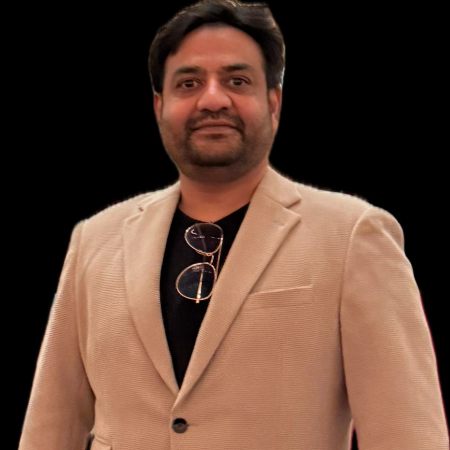
An editorial assessment of a research career that has quietly become required reading for anyone trying to modernize the systems governments run on.
Every field eventually produces a body of work that stops being a collection of papers and starts functioning as something closer to a shared vocabulary – a set of reference points practitioners reach for without necessarily remembering, or needing to remember, where they first encountered them. In the narrow but consequential world of large-scale public-sector technology modernization, we would argue that Senthil Babu Malli Jayaraj’s research has quietly become exactly that.
As of this month, his research output stands at eleven published articles, spanning nearly five uninterrupted years. That is, on its own, an unusual pace for applied research produced alongside – rather than instead of – hands-on technology leadership. What makes the record more than a matter of volume is its coherence. Few contributors to this field have managed to make eleven separate papers feel less like eleven separate ideas and more like eleven chapters of the same sustained inquiry: what does it actually take for a complex public technology system to work, to keep working, and to be trusted by the people who have no choice but to rely on it?
This is not a retrospective in the conventional sense – not a chronological march through titles and dates. It is, instead, an attempt to answer a more interesting question: what has this body of research actually given the field? Read closely, eleven papers in, three threads stand out.
| BY THE NUMBERS
11 research articles published, September 2019 – June 2024 Roughly one article every five months, sustained for nearly five years Subject areas spanning infrastructure readiness, governance, interoperability, observability, security compliance, data integrity, release management, capacity engineering, executive risk communication, and identity governance |
THE FIRST THREAD: MODERNIZATION IS A DISCIPLINE, NOT AN EVENT
From his earliest work on data center readiness for smart manufacturing infrastructure through his most recent research on identity governance across multi-agency systems, Jayaraj’s papers share an almost stubborn refusal to treat modernization as something that concludes. Nearly every article in his catalog, in one form or another, makes the same underlying argument: the moment a system goes live is not the finish line practitioners and press releases so often treat it as – it is closer to a starting gun for an entirely new set of obligations around governance, monitoring, and continuous validation.
That framing runs through his research on portfolio governance and executive reporting, through his work on cloud observability, and through his 2022 research insisting that security compliance has to be a continuously maintained posture rather than a pre-launch checklist. It is, by now, close to a signature – and it has aged unusually well in a field that has spent the better part of a decade learning, often the hard way, that a successful go-live and a successful system are not the same thing.
THE SECOND THREAD: THE PEOPLE MOST AFFECTED ARE OFTEN THE LEAST VISIBLE IN THE ARCHITECTURE
A significant portion of Jayaraj’s catalog is devoted to the technology infrastructure underneath state health and human services programs – child welfare case management, SNAP, Medicaid, long-term services and supports. It would be easy for research in this space to remain abstract, treating these systems the way much of the industry does: as generic enterprise platforms that happen to serve a public mission. His work resists flattening at nearly every turn.
His research on CCWIS-aligned governance models, on interoperability across SNAP, Medicaid, and LTSS systems, and on data quality within child welfare case management, all share a consistent insistence that the stakes of getting these systems wrong are categorically different from the stakes of a typical enterprise IT failure. A dropped transaction in a retail system is an inconvenience. A dropped record in a child welfare case file is something else entirely. That distinction, made explicitly and repeatedly across his research, has given his work a moral seriousness that is not always present in technical literature – without ever tipping into the kind of advocacy that would compromise its technical rigor.
THE THIRD THREAD: TRUST HAS TO BE ENGINEERED, NOT ASSUMED
If there is a single idea that best characterizes where Jayaraj’s research has arrived by mid-2024, it is this: trust in a public technology system is not a byproduct of good intentions or careful engineering. It has to be built, deliberately, as its own layer of the architecture – provable, auditable, and legible to people who were never in the room when the system was designed.
His research through late 2023 and into early 2024 pushes that idea into new and increasingly specific territory. In November 2023, his article on steering committee reporting frameworks took direct aim at a translation problem that quietly undermines even well-run technology programs: the gap between what engineers and program managers understand about a system’s technical risk, and what a state Chief Information Officer or steering committee actually receives in a briefing. The paper argues, in effect, that a risk nobody at the executive level can understand is a risk nobody at the executive level can act on – and that translating technical risk into governance narrative is not a communications nicety but a core function of responsible program leadership.
By March of this year, that same concern for legibility and accountability had extended into one of the more technically demanding corners of his catalog: identity governance. His research on implementation patterns for SailPoint and ForgeRock across multi-agency public-sector access management confronts a problem that grows more urgent every year state agencies expand data sharing and cross-program integration – namely, that interoperability without disciplined identity governance is not progress, it is exposure. The paper lays out, in detailed and implementation-specific terms, how multi-agency environments can extend access across program boundaries without losing the ability to say, precisely and at any moment, who can see what, and why.
Taken together, these two most recent contributions complete something like a full circuit through his research: from the infrastructure layer, to the governance layer, to the data layer, to the human systems that have to interpret and act on all three. There is a real sense, reading his catalog in order, of a researcher closing loops he opened years earlier – each new paper answering a question his own prior work had implicitly raised but left unresolved.
WHY THIS BODY OF WORK MATTERS MORE THAN ITS CITATION COUNT SUGGESTS
Applied research of this kind rarely receives the recognition afforded to more academically visible work, in part because its value is difficult to measure in the usual terms. Jayaraj’s papers are not designed to be cited in the abstract; they are designed to be used – by program managers structuring a governance model, by architects designing an interoperability layer, by security teams building an audit-readiness program, by identity teams standing up access controls across agency boundaries. Their impact shows up not in a citation index but in the quiet, unglamorous decisions of practitioners who read a paper, recognized a problem they were living through, and changed how they approached it.
That kind of influence is harder to measure and easier to overlook than a splashy platform launch or a headline-grabbing technology pilot. It is also, arguably, more durable. Systems get replaced; the discipline required to run them well does not go out of style nearly as quickly.
Eleven papers and nearly five years into a research program that continues to widen rather than narrow its scope, Jayaraj has built something unusual in this field: a body of work coherent enough to function as a genuine methodology, and grounded enough in operational reality to be immediately usable by the people doing the work. Few researchers manage the first. Fewer still manage both. If public-sector technology modernization has, at this point, anything resembling a field manual, it is difficult to imagine one assembled with more care, or more consistency, than the one Jayaraj has been quietly writing, one rigorously argued paper at a time, since 2019.
This editorial reflects publicly available research authorship attributed to Senthil Babu Malli Jayaraj through June 2024.