

Energy costs keep rising. And more homeowners than ever are asking the same question: is there a way to upgrade my home and get some money back at tax time?
The answer is yes — and the program that makes it possible has been around long enough to build a solid track record, though many people still don’t fully understand how it works.
The energy efficient home improvement credit is one of the most valuable tax incentives available to homeowners in the United States. It rewards you for making specific upgrades that reduce your home’s energy consumption — things like better insulation, new windows, efficient HVAC systems, and more.
If you’re serious about cutting your utility bills, improving your home’s comfort, and getting a tax break while doing it, this guide covers everything you need to know about claiming this credit in 2026. And if you’re just getting started thinking about your space, exploring your options for Home Improvement is always a smart first step.
What Is the Energy Efficient Home Improvement Credit?
The energy home improvement tax credit is a federal tax credit available to homeowners who make qualifying energy-saving upgrades to their primary residence. This is not a deduction — it’s a direct credit, which means it reduces the actual amount of tax you owe, dollar for dollar.
The credit is part of the Inflation Reduction Act, which significantly expanded and extended these benefits for homeowners. For 2026, the program continues to offer a credit worth up to 30 percent of the cost of qualifying improvements, with annual limits set per category of upgrade.
This is also known as the energy efficient home improvement credit 25c — a reference to Section 25C of the Internal Revenue Code, which governs this specific credit. Understanding this distinction matters when you’re filling out forms or working with a tax professional.
How Much Can You Actually Claim?
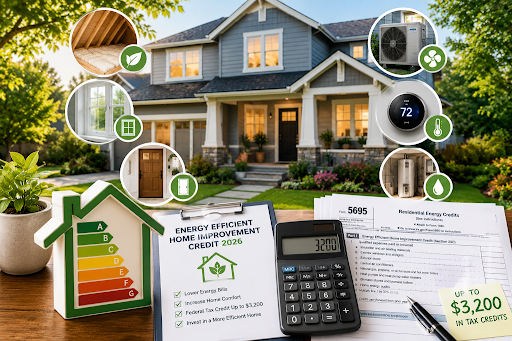
The overall annual cap for the energy efficient home improvement credit 2026 is $1,200 per year. However, heat pumps, heat pump water heaters, and biomass stoves have a separate sub-limit of $2,000 per year. That means if you’re strategic about your upgrades, you could potentially claim up to $3,200 in credits in a single tax year.
Here’s what each category allows:
- Insulation and air sealing: Up to $1,200
- Exterior windows and skylights: Up to $600 total
- Exterior doors: Up to $250 per door, $500 total
- Central air conditioners: Up to $600
- Natural gas, propane, or oil furnaces and hot water boilers: Up to $600
- Heat pumps and heat pump water heaters: Up to $2,000 (separate limit)
- Home energy audits: Up to $150
The Energy Efficient Home Improvement Credit for Windows
One of the most common questions homeowners ask is about the energy efficient home improvement credit for windows. Old, drafty windows are one of the biggest sources of heat loss in a home, and replacing them can make a noticeable difference in your energy bills.
To qualify for the credit, windows must meet the ENERGY STAR Most Efficient criteria for the climate zone where your home is located. Not all ENERGY STAR windows automatically qualify — the product must specifically meet the “Most Efficient” standard to be eligible.
The credit covers 30 percent of the cost of qualifying windows, up to a $600 annual maximum for windows and skylights combined. This does not include installation costs — only the product cost itself counts toward the credit calculation.
If you’re thinking about upgrading your windows as part of a broader exterior refresh, it’s worth exploring ideas for exterior decoration that complement the new look energy-efficient windows can bring to your home.
How to Claim the Credit: The Energy Efficient Home Improvement Credit Form
Claiming the credit requires completing IRS Form 5695, which is the energy efficient home improvement credit form used for residential energy credits. You’ll attach this to your standard Form 1040 when filing your taxes.
The form walks you through each category of qualifying improvement and calculates the total credit based on what you spent. You’ll need receipts and documentation showing the cost of the products and confirmation that they meet the energy efficiency standards required.
Step-by-Step: Filing Your Credit
- Gather all receipts for qualifying upgrades made during the tax year
- Confirm each product meets the required energy efficiency certification
- Download and complete IRS Form 5695
- Calculate the 30% credit for each eligible expense, applying per-category limits
- Transfer the total credit amount to your Form 1040
- Keep all documentation in case of an audit
If you used a contractor for energy smart home improvement projects, ask them to provide product specification sheets and manufacturer certifications. These documents make it much easier to complete your Form 5695 accurately.
Is There an Income Limit for This Credit?
This is one of the most searched questions on this topic. The short answer: the energy efficient home improvement credit income limit does not apply — there is no income restriction for claiming this credit.
Unlike some other tax credits that phase out at higher income levels, Section 25C is available regardless of how much you earn. Whether you make $40,000 a year or $400,000, you can claim the credit as long as the upgrades qualify and you owe federal income tax.
The only requirement is that the improvements must be made to your primary residence — vacation homes and rental properties generally do not qualify for this credit.
Understanding Carryforward Rules
Another question that comes up often: what if your credit exceeds your tax liability for the year? This is where the energy efficient home improvement credit carryforward rules matter.
Unfortunately, the Section 25C credit is non-refundable. That means it can reduce your tax bill to zero, but it cannot generate a refund. And unlike some other credits, the unused portion generally cannot be carried forward to the next tax year.
This makes planning your upgrades strategically important. If you know you’ll have a significant tax liability in a given year — due to selling an investment, receiving a bonus, or other factors — that’s an ideal time to make qualifying improvements and maximize the value of your credit.
To help with planning, the IRS provides a energy efficient home improvement credit limit worksheet as part of the Form 5695 instructions. Working through this worksheet before you file helps you understand exactly how much credit you can use and whether any limitations apply to your specific tax situation.
What Counts as an Energy Efficient Home Improvement?
Beyond windows and insulation, the range of energy saving home improvements that qualify is broader than most homeowners realize. Here’s a fuller picture of what may be eligible:
- Air sealing: Caulking, weatherstripping, and other materials that reduce air leakage
- Insulation: Attic insulation, wall insulation, basement insulation, and similar upgrades
- Exterior doors: Qualifying insulated doors that meet ENERGY STAR requirements
- HVAC upgrades: Qualifying central air conditioners, furnaces, boilers, and heat pumps
- Water heaters: Heat pump water heaters that meet efficiency thresholds
- Home energy audits: Professional assessments conducted by a certified auditor
When planning your upgrades, think room by room. Your kitchen is often one of the biggest energy users in the home — between lighting, appliances, and ventilation. If you’re planning updates there, combining energy efficiency with style can deliver real savings. Looking at Kitchen Decoration ideas alongside energy upgrades helps you make smart choices that look great and cost less to run.
Energy Plus Home Improvements: Getting the Most From the Program
Savvy homeowners treat this not as a one-time claim but as an ongoing strategy. Because the credit resets every year, you can spread your upgrades across multiple tax years and claim up to the annual maximum each time.
This approach — sometimes called energy plus home improvements planning — means you systematically work through your home’s energy weak points year after year, claiming the credit each time. Year one might be insulation and air sealing. Year two, new windows. Year three, a heat pump system.
Over a three-year period, you could claim thousands of dollars in credits while also dramatically reducing your energy bills. That’s a compounding benefit that most homeowners leave on the table simply because they’re not aware of the annual reset.
Energy Wise Home Improvements That Boost Home Value
Beyond the tax credit, energy wise home improvements have a direct impact on your home’s market value. Buyers in 2026 are paying close attention to energy costs — a home with upgraded insulation, efficient windows, and a modern HVAC system commands a premium.
According to data from the National Association of Realtors, energy efficiency upgrades rank among the top features buyers look for. Homes with documented energy-saving features sell faster and often at higher prices than comparable homes without those upgrades.
And it’s not just about resale. Living in an energy efficient home improvement property means lower monthly utility bills, more consistent indoor temperatures, less noise from outside, and better air quality. These are quality-of-life improvements that you benefit from every single day.
If you’re also thinking about how your indoor spaces feel, exploring ideas for interior decoration can help you make upgrades that combine energy performance with a living space you actually love coming home to.
Energy Home Improvements Reviews: What Homeowners Are Saying
Real homeowner experiences with energy home improvements reviews tell a consistent story: the upfront investment feels significant, but the long-term payoff is real.
Homeowners who invested in attic insulation report an average of 15 to 25 percent reduction in heating and cooling costs. Those who replaced single-pane windows with qualifying double-pane versions describe noticeably quieter rooms and more stable temperatures. Heat pump adopters consistently report that their winter and summer utility bills dropped substantially after installation.
The tax credit makes the math even more favorable. On a $5,000 insulation project, a 30 percent credit means $1,500 back on your taxes. Combined with energy savings of several hundred dollars per year, the payback period is often three to five years — and then the savings continue indefinitely.
For outdoor upgrades that also improve energy performance — like adding shade trees, pergolas, or garden landscaping that reduces direct sun exposure to your home — reviewing Garden Decorations ideas alongside your energy planning can yield creative solutions that look beautiful and deliver measurable benefits.
Common Mistakes to Avoid When Claiming the Credit
The energy efficient home improvement credit: is genuinely valuable, but several common mistakes can cost you money or create problems with your tax return.
- Not verifying product eligibility before purchasing: Always confirm that the specific product meets the required energy efficiency standards before you buy. A contractor’s recommendation alone isn’t sufficient — get the product specs in writing.
- Confusing this credit with the solar credit: The residential clean energy credit (for solar panels and battery storage) is a separate program with different rules and limits.
- Missing the annual limits: The $1,200 annual cap means claiming more than your share in a single year wastes potential credits. Plan upgrades across years when possible.
- Forgetting to include the home energy audit: The $150 credit for a professional home energy audit is easy to overlook but adds up.
- Losing documentation: Keep all receipts and product certifications. The IRS may request them, and losing them could mean losing your credit.
Frequently Asked Questions
What is the energy efficient home improvement credit 2026 limit?
The annual limit is $1,200 for most categories of improvements, plus a separate $2,000 limit for heat pumps, heat pump water heaters, and biomass stoves. Combined, you could claim up to $3,200 in a single year.
Is there an income limit for the energy efficient home improvement credit?
No. The energy efficient home improvement credit income limit does not apply — anyone who owes federal income tax and makes qualifying improvements can claim the credit, regardless of their income level.
Can I carry forward unused credit to next year?
Generally, no. The energy efficient home improvement credit carryforward provision does not apply to this credit. Unused credit cannot be rolled to future years, which is why planning your improvements to align with higher-tax years is important.
What form do I need to claim the credit?
You need IRS Form 5695, also known as the energy efficient home improvement credit form. Complete it and attach it to your Form 1040 when filing your federal tax return.
Does the credit apply to rental properties?
No. The energy efficient home improvement credit. applies only to your primary residence. Upgrades made to rental properties, vacation homes, or investment properties do not qualify.
Do windows need to be ENERGY STAR certified to qualify?
Yes, and specifically the “Most Efficient” tier. Standard ENERGY STAR certification alone is not enough for the energy efficient home improvement credit for windows. Check the product’s documentation carefully before purchasing.
The energy efficient home improvement credit 2026 is one of the smartest financial tools available to homeowners right now. It rewards you for doing something that’s already worth doing — reducing your home’s energy consumption — and it resets every year, meaning you can build a multi-year upgrade plan that maximizes every dollar.
Whether you’re starting with a simple home energy audit, replacing old windows, upgrading your HVAC, or sealing air leaks throughout the house, each qualifying improvement gets you closer to a home that costs less to run and feels better to live in.
The key is to plan ahead, verify product eligibility before you buy, keep your documentation organized, and work through the energy efficient home improvement credit limit worksheet before filing. With the right approach, this credit can save you thousands over the years ahead.
Your home is your biggest investment. Energy home improvements protect that investment, reduce your monthly costs, and make your living space more comfortable. The tax credit just makes it even easier to say yes.