

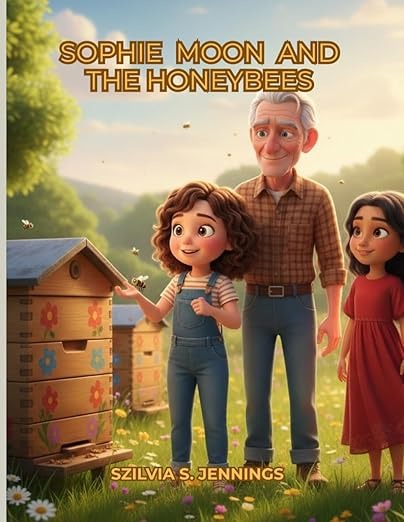
Growing up involves navigating a complex landscape of social pressures, academic hurdles, and internal anxieties. Many children struggle to find the right tools to process these fears, often feeling overwhelmed by the fast pace of modern life. Without a grounding force, these emotional challenges can hinder a child’s confidence and curiosity, making it difficult for them to embrace new experiences or find their place in the world.
Szilvia S. Jennings, author of Sophie Moon and the Honeybees, offers a unique solution through the power of storytelling and the natural world. Her work explores how the patient, rhythmic life of a beehive can serve as a sanctuary for emotional development and self-discovery. In this interview, we discuss the inspiration behind her book and how the bond between generations—and the quiet wisdom of nature—helps children build lasting resilience.
Q: Sophie Moon initially hopes for a puppy but her grandpa gets a hive of honeybees instead. What led you to choose beekeeping as the primary metaphor for a child’s journey toward overcoming fear?
Szilvia S. Jennings: I am a beekeeper and my first draft of this story very much centered around my bees. I wanted to introduce what they do in each season in a children’s story book. They were the main characters, while Sophie was only a secondary character. It was due to my editor’s advice that I changed this. Sophie became the main focus with her dreams, wishes and fears. How bees helped her is what the book is about. In the first chapter, she is disappointed in not getting a puppy. When Grandpa says,”I got bees. Honeybees.” Sophie’s first reaction is fear. She asks, “The stinging kind?” Life at school, friendships, social interactions can sometimes become ‘the stinging kind’. It takes courage to do something new, like Sophie who wants to befriend the new girl at school. Then, she gets curious about how the liquid gold is made by the bees and starts on a journey of beekeeping, finding her courage and confidence by watching her Grandpa work with the bees.
Q: The story places a heavy emphasis on the relationship between Sophie and her grandfather. How does this intergenerational bond help facilitate her emotional growth in ways a peer relationship might not?
Szilvia S. Jennings: Grandpa’s new hobby of keeping bees pushes Sophie to see the world without fear. Her curiosity of how bees make honey gets her to follow her Grandpa around. She thinks he is very brave, yet he never changes. He doesn’t have any character arches in the story for which I have received negative critique. But I feel that being that steady, ‘flat’ character is what helps Sophie to evolve in her thinking and behaviour. She values this unchanging security. I believe that children need a very steady influence to grow and feel safe. That is what I’ve tried to achieve here. Her school life with her classmates is very different, she worries about fitting in, being laughed at or cut off if she “talks to the new girl.” Grandpa’s relationship with her doesn’t have any conditions. In the story, there is a chapter titled “Acceptance,”it describes how a new hive of honeybees have to accept their new queen. If not, the bees can destroy her. Grandpa offers unconditional love and support to Sophie. As she opens up to him about her troubles and worries he listens without judgement and tries to influence her through his actions to make the right choices. And her choice is always to face peer pressure by saying “I promise.”
Q: You structured the narrative around the changing seasons. Why is the cyclical nature of the environment such an effective tool for teaching children about patience and the “rising and falling” of personal troubles?
Szilvia S. Jennings: The story is divided into four main parts: Spring, Summer, Fall and Winter. In each season life inside a beehive changes, just like a person’s life may change from weeks, months and years. In Sophie’s case, in Spring she is thinking about making a new friend and public speaking. Like a new beginning that happens every Spring. In the Summer, she has her “bestest” friend Catalina, and together they are thriving, planning for the future. This is the peak of her happiness. This season is full of love, warmth and joy. This is also the time when nature is the lushest with vivid colours and life. Fall is the season of fading, of letting go and Sophie has to accept that she lost her best friend. She also breaks a rule and suffers the consequences. This is a terrible change for her but through it all she believes in the bees. Winter is often cold, hard and unforgiving, almost forever like.This is the time when her grandpa forgives her for breaking the rule.She learns that everything takes time. It takes time for bees to make honey, for grandpa to forgive her, to hear from her lost friend Catalina and also to come and spend time at the log cabin. At the end Sophie whispers,”You’re my friend Grandpa.” She knows that seasons come and go but her grandpa is always there for her.
Q: Beekeeping is a very specific, hands-on activity. What educational lessons do you hope children take away about the environment while they are following Sophie’s emotional arc?
Szilvia S. Jennings: Yes, beekeeping is a very hands-on activity. It also requires very good observational skills. Honeybees’ lives are very much influenced by the outside temperature, storms, wind and even where and how the hives are positioned. Sophie visits the bees in each season to watch them. In the Summer, for example, she sees them bearding to cool their hive. She has never seen this before and worries that they are sick. When grandpa corrects her, she loses her confidence and says,”I need to do better.” Her old fears come back of not being good enough. She loses her confidence again. This happened because she found herself with something she didn’t know. Her safety net of knowledge disappeared. Children and even adults can feel this way when facing something new. I would like children to realise by reading this book that like the changing season our environment always changes too. But it is alright, because by learning and watching, children can overcome the fear of the unknown. Like Sophie says,”Learning new things is fun, because everything was new once. Isn’t it?”
Q: In the book, Grandpa suggests that Sophie “whisper to the bees.” Can you explain the importance of quiet reflection and mindfulness in helping children navigate their school-year anxieties?
Szilvia S. Jennings: Sophie faces a lot of different types of personal fears and when grandpa asks her what she worries about she says,”Just stuff.” She doesn’t know how to answer, to give a straight answer. She is full of feelings. It is sometimes hard to explain feelings, to put them into words. I, myself, am not good at arguing. I often need time to reflect and analyse my feelings. This is what grandpa offers to Sophie by suiting up and whispering to the bees. Her mind is free, she watches the bees, focuses on herself and words come tumbling out. The other time that she opens up is when she is painting a hive. This is her favourite activity and grandpa just sits beside her and listens. That is what children need to reflect on their feelings, to realise a solution; a quiet, safe activity and place. We just have to listen; like the bees and grandpa did to Sophie.
Q: For parents or educators reading this, what is the most important piece of advice you want them to take away regarding how to support a child who is feeling hesitant or fearful?
Szilvia S. Jennings: That is a difficult question to answer. I think that parents and educators should be like grandpa. Always available, steady, supportive with our own behaviour. We need to become a ‘flat’ character that teaches through example and involvement.
The Path to Resilience
This interview highlights the vital connection between emotional health and the environment. By stepping away from the digital world and into the garden, children like Sophie learn that growth is a gradual process that requires patience and observation. The quiet consistency of nature provides a safe space for children to reflect on their feelings, proving that even the most intimidating challenges can be managed when broken down into the steady rhythms of a seasonal cycle.
Looking ahead, fostering a deep connection with nature will remain a cornerstone of healthy child development. As we continue to look for ways to build confidence in the next generation, the lessons found in the hive—resilience, community, and courage—offer a timeless roadmap. Supporting authors like Szilvia S. Jennings ensures that these gentle, impactful stories continue to reach the families and classrooms where they are needed most.
To learn more visit https://www.amazon.com/dp/B0GXWQGZ26