

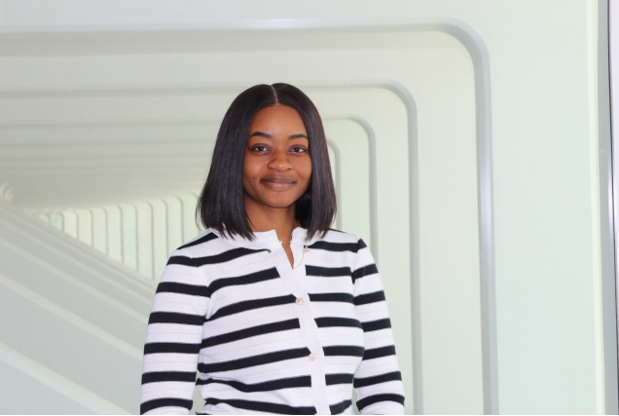
When Champie Joyce Maptue Tagne talks about cybersecurity, she doesn’t describe it as a career path or a field of study she describes it as a responsibility. Her voice carries the calm certainty of someone who has spent years studying the systems that shape our digital lives and the threats that endanger them.
Her story begins in Cameroon, where she grew up before moving to Ghana to pursue her undergraduate education. “Ghana became my second country,” she often says, reflecting on the years that shaped her academic foundation and personal growth. It was during her Bachelor’s degree in Software Engineering at Coventry University that her fascination with digital security first took hold.
She remembers the moment clearly: learning about secure software development and realizing how fragile modern systems could be. “The more I studied, the more I understood how quickly cyber threats were evolving,” she recalls. “Mobile applications were becoming central to everyday life, yet they were exposed to risks people didn’t fully see.”
That realization stayed with her. It pushed her to ask harder questions, explore deeper problems, and eventually pursue a Master’s degree in Computer Science at Florida Polytechnic University. There, she immersed herself in research on Android application security, malware detection, software quality, and the emerging role of Large Language Models (LLMs) in cybersecurity.
Her work is both technical and visionary. She is part of the team behind SMELLDroid, a dataset designed to help researchers identify code smells in Android applications subtle patterns that can weaken software quality or expose vulnerabilities. “SMELLDroid is about giving researchers a clearer lens,” she explains. “If we can understand where weaknesses begin, we can build systems that are stronger from the inside out.”
Her background in data analytics has sharpened her ability to navigate complex, data‑driven problems. Whether she is analyzing malware behavior or evaluating software quality indicators, she approaches each challenge with a blend of precision and curiosity. “Data tells a story,” she says. “Cybersecurity is about learning to read that story before the threat becomes real.”
What sets Champie apart is not only her technical expertise but her global perspective. Moving from Cameroon to Ghana and then to the United States has shaped her understanding of how digital systems impact people across cultures and continents. “Cybersecurity isn’t local,” she says. “It affects everyone. My experiences help me see the bigger picture.”
Her long‑term mission is clear: to bridge artificial intelligence, software engineering, and cybersecurity in ways that strengthen mobile applications, enhance vulnerability detection, and support the creation of trustworthy digital ecosystems. She wants her work to serve researchers, industry professionals, and everyday users alike.
In a world increasingly dependent on mobile technology, voices like Champie’s are essential. Her journey marked by resilience, curiosity, and a commitment to protecting digital spaces reflects the future of cybersecurity: global, intelligent, and deeply human.