

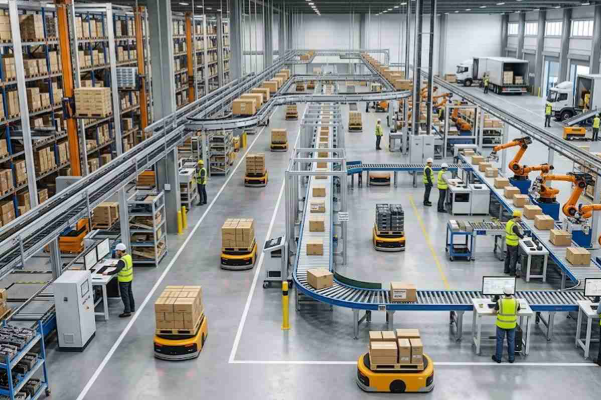
Automated Material Handling Systems (AMHS) have become a key driver of transformation in modern industries where speed, accuracy, and efficiency are essential for survival. As manufacturing, warehousing, and logistics operations continue to expand, businesses are increasingly adopting automation to streamline complex material movement processes. These systems are designed to reduce manual effort while ensuring that materials are transported, stored, and managed with maximum efficiency.
In today’s highly competitive industrial environment, companies must respond quickly to demand changes, minimize operational delays, and maintain consistent quality. AMHS plays a crucial role in achieving these goals by integrating robotics, conveyor systems, software control, and smart sensors. By automating repetitive and physically demanding tasks, industries can focus more on productivity, innovation, and strategic operations rather than routine handling work.
What Are AMHS?
Automated Material Handling Systems refer to a combination of equipment and software used to move, store, and control materials within industrial environments without continuous human intervention. These systems are widely used in manufacturing plants, warehouses, distribution centers, and logistics hubs to improve operational flow and reduce inefficiencies.
At their core, AMHS replace manual handling tasks such as lifting, sorting, transporting, and storing goods with automated processes that are faster and more reliable. These systems are often integrated with digital management tools that allow real-time tracking and coordination of materials across the facility.
Core Components:
- Conveyors
- Automated guided vehicles (AGVs)
- Robotics arms
- Storage and retrieval systems
- Sensors and scanners
- Warehouse control software
- Sorting systems
Each of these components works together to ensure smooth, continuous, and error-free material movement within industrial operations.
How They Improve Workflow Efficiency?
1. Improved Operational Speed
One of the most important benefits of AMHS is the dramatic increase in operational speed. Automated systems can move materials continuously without breaks, fatigue, or delays caused by human limitations. Conveyor belts, robotic arms, and automated vehicles ensure that products are transported quickly across different stages of production.
This faster movement of goods reduces waiting time between processes, allowing industries to maintain a smooth production flow. As a result, overall throughput increases, and companies can meet tight deadlines more effectively while handling larger volumes of work.
2. Enhanced Accuracy and Reduced Errors
Human error is a common challenge in manual material handling, often leading to misplaced items, incorrect sorting, or damaged goods. AMHS significantly reduces these errors by using sensors, barcode scanners, and programmed instructions to ensure precise handling.
Automation ensures that each material is correctly identified, tracked, and delivered to its designated location. This level of accuracy improves order fulfillment, reduces waste, and enhances customer satisfaction by ensuring that the right products are delivered in the right condition.
3. Cost Efficiency Over Time
Although the initial investment in Automated Material Handling Systems can be high, the long-term cost savings are substantial. Automated systems reduce the need for large manual labor forces, lower operational errors, and minimize material waste. Over time, these savings outweigh the installation and maintenance costs.
Additionally, automation reduces downtime and improves productivity, which leads to higher output with fewer resources. Businesses can operate more efficiently, allowing them to allocate financial resources to innovation and expansion rather than repetitive manual tasks.
4. Improved Workplace Safety
Industrial environments often involve heavy lifting, repetitive tasks, and hazardous conditions that can lead to workplace injuries. AMHS helps reduce these risks by taking over dangerous or physically demanding tasks.
By minimizing human involvement in high-risk activities, companies create safer working environments. Automated systems handle heavy loads, operate in extreme conditions, and reduce the chances of accidents caused by fatigue or human error. This leads to fewer workplace injuries and improved employee well-being.
5. Better Space Utilization
Efficient use of space is crucial in warehouses and manufacturing facilities where storage capacity is limited. AMHS optimizes space utilization by using vertical storage systems, compact robotic storage units, and intelligent layout designs.
These systems allow businesses to store more materials in less space while maintaining easy accessibility. Automated retrieval systems also ensure that items can be quickly located and moved without wasting time or space, making operations more organized and efficient.
6. Real-Time Data and Control
Modern AMHS platforms are integrated with advanced software that provides real-time tracking and monitoring of materials. Managers can view inventory levels, movement patterns, and system performance instantly.
A key example of advanced integration is an Automated Storage and Retrieval System, which uses computer-controlled processes to store and retrieve goods with high precision and minimal delay.
This real-time visibility enables faster decision-making and better control over operations. By analyzing system data, companies can identify inefficiencies and continuously improve workflow performance.
7. Scalability and Flexibility
As businesses grow, their material handling needs also increase. Automated Material Handling Systems offers scalability, allowing companies to expand their systems without completely redesigning their operations. Additional conveyors, robots, or storage units can be integrated easily into existing setups.
Flexibility is another key advantage, as these systems can be reprogrammed or adjusted to handle different types of products or workflows. This adaptability makes AMHS suitable for industries with changing demands or seasonal fluctuations.
8. Reduced Dependency on Manual Labor
AMHS reduces reliance on manual labor for repetitive and physically demanding tasks. While human workers are still essential for supervision and decision-making, automation handles the majority of routine material movement tasks.
This shift allows employees to focus on more skilled and value-added roles such as system monitoring, maintenance, and process improvement. It also helps businesses address labor shortages and reduce dependency on large workforce requirements.
Why STRATUS Automation Stands Out?
Stratus Automation Sdn. Bhd. has positioned itself as a trusted provider of advanced automation and material handling solutions, delivering tailored systems that align with modern industrial demands. The company focuses on integrating smart engineering with practical industrial applications, ensuring that clients receive systems that are both efficient and scalable.
What makes STRATUS Automation stand out is its commitment to delivering end-to-end automation solutions, from system design and integration to implementation and support. Their expertise in optimizing workflow design helps industries reduce downtime, improve throughput, and achieve higher operational precision.
Additionally, it emphasizes innovation and customization, allowing businesses to adopt AMHS solutions that match their exact operational needs. By combining technical expertise with industry experience, the company supports manufacturers and logistics providers in achieving long-term efficiency, reliability, and growth.
Conclusion
Automated Material Handling Systems have revolutionized the way industries manage production, storage, and logistics operations. By integrating advanced technologies such as robotics, sensors, and intelligent software, these systems significantly enhance workflow efficiency and operational performance.
From improving speed and accuracy to ensuring safety and reducing costs, AMHS provides a comprehensive solution to many industrial challenges. As industries continue to evolve, automation will play an even greater role in shaping efficient, scalable, and intelligent workflows. Businesses that adopt these systems are better positioned to remain competitive in an increasingly fast-paced and technology-driven world.