

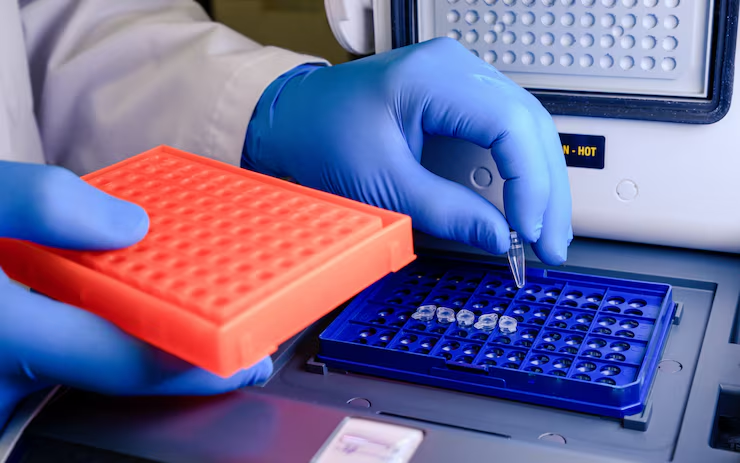
Among the most powerful quantitative tools available to biomedical researchers, ELISA immunoassay kits provide a structured, reproducible platform for measuring the concentration of specific proteins, antibodies, hormones, and other analytes in complex biological samples. Since their development in the early 1970s, enzyme-linked immunosorbent assays have evolved into a highly diversified family of assay formats, each optimized for particular analyte types, sample matrices, and sensitivity requirements. Choosing the right ELISA immunoassay kit is a critical step in experimental design that directly affects data quality.
Key Takeaways
|
The Role of ELISA Immunoassay Kits in Modern Research
Biomarker research depends on the ability to measure molecular analytes accurately and reproducibly across large numbers of samples. ELISA immunoassay kits provide this capability by integrating all required reagents — pre-coated plates, detection antibodies, standards, substrates, and buffers — into a single validated system. The standardized format minimizes assay-to-assay variability, which is essential when comparing results across time points, treatment groups, or experimental cohorts.
In translational medicine, ELISA kits bridge the gap between discovery-phase studies and clinical validation. Circulating biomarkers measured by ELISA in preclinical animal models can often be evaluated with species-matched human ELISA kits in patient samples, providing a continuous measurement framework from bench to bedside.
Major ELISA Immunoassay Kit Formats
Sandwich ELISA Kits
Sandwich ELISA is the gold standard for quantifying proteins in complex matrices. A capture antibody immobilized on the plate surface binds the target antigen in the sample. A biotinylated or enzyme-conjugated detection antibody recognizes a different epitope on the bound antigen, creating the “sandwich” structure. The resulting signal — generated by enzymatic substrate conversion — is directly proportional to analyte concentration. This dual-antibody design confers outstanding specificity even in samples containing many other proteins.
Competitive ELISA Kits
Competitive ELISA is the preferred format for small-molecule analytes such as steroids, prostaglandins, thromboxanes, drugs, and environmental contaminants that are too small to simultaneously accommodate two antibodies. The analyte in the sample competes with a labeled antigen for a fixed number of antibody binding sites. Signal output is inversely proportional to analyte concentration, necessitating a different curve-fitting approach compared to sandwich formats.
Indirect ELISA Kits
Indirect ELISA formats are most commonly used to detect total immunoglobulin responses against a specific antigen — for example, measuring serum antibody titers following vaccination or infection. The antigen is coated on the plate, sample antibodies bind it, and a labeled anti-species secondary antibody generates the signal. This format is particularly useful in immunological and vaccine research.
Critical Components of an ELISA Immunoassay Kit
The performance of an ELISA immunoassay kit is fundamentally determined by the quality of its individual components:
- Capture antibody — must have high affinity and specificity for the target analyte with no cross-reactivity to closely related proteins
- Detection antibody — paired with the capture antibody to recognize a non-overlapping epitope, ensuring the sandwich configuration
- Standards — certified reference materials of known concentration used to construct the standard curve for quantification
- HRP-substrate system — typically TMB (3,3′,5,5′-tetramethylbenzidine) with a stop solution to arrest the colorimetric reaction
- Assay buffers — wash, blocking, and sample diluent buffers optimized to minimize non-specific binding while maintaining analyte stability
Selecting the Right ELISA Immunoassay Kit
Choosing the appropriate ELISA kit requires evaluation of several parameters before running samples:
Analyte and Species Match
The kit must be validated for both the target analyte and the species from which samples are derived. Antibody cross-reactivity varies, and kits validated for human samples are often not suitable for mouse or rat samples due to interspecies differences in protein sequence. Species-specific kits using matched reagents are essential for accurate results in non-human research models.
Sample Type Compatibility
Kit validation data should specify which sample types have been tested: serum, plasma (and which anticoagulant), urine, cerebrospinal fluid, cell culture supernatants, or tissue homogenates. Running a sample type not covered by the kit’s validation may require optimization of dilution factors and matrix spike-recovery experiments to verify accuracy.
Sensitivity and Detection Range
The assay’s minimum detectable dose (MDD) and quantification range must bracket the expected analyte concentration in experimental samples. If the target analyte is expected to be present at very low concentrations, kits with lower detection limits or CLIA-based alternatives should be evaluated.
Conclusion
ELISA immunoassay kits remain one of the most versatile and widely used quantitative platforms in biomedical research. Their accessibility, reproducibility, and adaptability to diverse analytes and sample types make them indispensable tools across immunology, endocrinology, oncology, and drug development. With a catalog spanning hundreds of thousands of analyte-species combinations, MyBioSource provides researchers with the depth of selection needed to find a validated ELISA immunoassay kit matched precisely to their experimental requirements.
| All products are For Research Use Only (RUO). Not for use in diagnostic procedures. |