

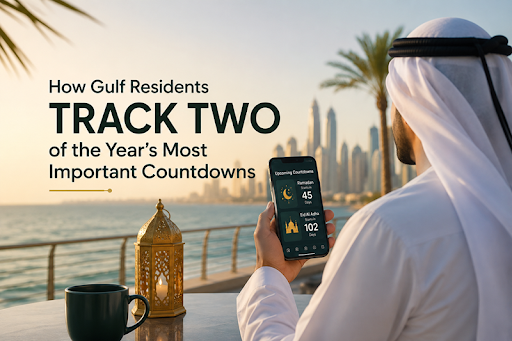
There are certain dates in the Islamic calendar that shape daily life across the Gulf more than almost anything else, and the approach of Ramadan is chief among them. Alongside that broader anticipation sits a smaller, daily rhythm — the five prayer times that structure each day regardless of the season. Understanding how both are tracked, and why the methods behind them matter, gives a clearer picture of how residents across the region plan their time.
Why Prayer Scheduling Isn’t as Simple as a Fixed Clock
Unlike most daily appointments, prayer times are not fixed to the clock. They are calculated from the sun’s position, which means all five daily prayers — Fajr, Dhuhr, Asr, Maghrib, and Isha — shift by a few minutes every single day throughout the year. In the UAE specifically, prayer and azan times are published by the General Authority of Islamic Affairs, Endowments and Zakat, the official government body responsible for mosque scheduling across the emirates.
The calculation method used across the UAE, Saudi Arabia, Qatar, and Kuwait is known as the Gulf Region method, which sets Fajr at 19.5 degrees below the horizon and Isha at 90 minutes after Maghrib. Maghrib itself coincides exactly with sunset, which is why it’s often the prayer residents track most closely — particularly relevant during Ramadan, when Maghrib marks the moment the daily fast is broken.
One detail that recently changed and caught a number of residents off guard is the Jummah, or Friday prayer, timing. As of the start of this year, the Jummah khutbah and prayer across the UAE moved to 12:45 PM, thirty minutes earlier than the previous 1:15 PM slot, following a formal decision by the relevant Islamic affairs authority. For residents used to the older timing, checking a current and accurate schedule rather than relying on memory has become genuinely important to avoid arriving late.
For anyone in Sharjah specifically, Sharjah’s daily prayer schedule is available through UAEWow, which pulls from the official Gulf Region calculation method and updates automatically each day — useful both for residents and for anyone comparing timing across neighbouring emirates, since prayer times vary slightly by longitude even within a single country.
Prayer Times Change More Dramatically Than Most People Realize
The extent to which prayer times shift across the year surprises a lot of newer residents. Fajr and Isha in particular can vary by up to an hour between summer and winter months, since both are tied to the darkness of the sky rather than a fixed clock position. Maghrib follows sunset precisely, meaning it moves gradually earlier through autumn and winter before reversing direction as the days lengthen again into summer.
This is part of why static printed prayer calendars, while useful as a general reference, become progressively less accurate the further into the year they’re used. A schedule that was accurate in January will have drifted meaningfully by the time Ramadan approaches, which is exactly the period when precision matters most, given how closely Maghrib timing is tied to breaking the daily fast.
The Anticipation Building Toward Ramadan
Beyond the daily rhythm of the five prayers, there’s a broader countdown that builds steadily in the weeks leading up to Ramadan each year — one of the most anticipated periods across the Muslim world. Because the Islamic calendar is lunar and roughly ten to eleven days shorter than the Gregorian calendar, Ramadan’s start date shifts earlier each year, cycling gradually through every season over the course of roughly three decades.
This shifting nature is exactly why so many people actively track a countdown rather than simply noting a fixed date once and moving on. The expected start date depends on moon sighting confirmation close to the time, meaning even a well-informed estimate can shift by a day in either direction until the announcement is made. For residents and families planning ahead — coordinating time off work, preparing for the change in daily routine, or simply building anticipation for the month itself — having a live, continuously updated countdown removes the guesswork that comes with manually tracking the lunar calendar.
A Ramadan countdown tool handles exactly this — tracking the approach of the holy month with a running countdown that adjusts automatically as the estimated date firms up, giving a clear and current answer rather than a static projection made months in advance.
Why Both Matter Together
The daily discipline of prayer and the broader anticipation of Ramadan are connected in a way that goes beyond simple scheduling. Prayer structures each individual day; Ramadan reshapes an entire month around a different daily rhythm, with Maghrib specifically taking on added significance as the moment families gather to break the fast together. Understanding how both are calculated — and having access to sources that update accurately rather than relying on memory or last year’s calendar — is part of how residents across the Gulf stay properly oriented to two of the region’s most consistently observed rhythms.
For anyone newer to the region, or simply looking to plan more precisely around either the daily prayer schedule or the approach of Ramadan, having both a reliable current-day prayer reference and a live countdown tool bookmarked removes much of the uncertainty that comes with tracking dates that shift according to the lunar calendar and the position of the sun rather than a fixed annual schedule.