

Walk into almost any mid-sized factory in Sharjah or Abu Dhabi and you will find the same scene. The production manager arrives early, clipboard in hand, doing a manual round checking which raw materials are available, which machines need attention, and hoping last night’s quality batch passed inspection. By 10am, there is already a delay. By 2pm, someone is calling the client to push a delivery date.
This is not a staffing problem. It is not a training problem. It is a systems problem.
The manufacturers getting ahead in the UAE today have made one decisive move: they switched to a proper manufacturing ERP UAE platform and most of them chose Odoo. The results have been difficult to ignore. Waste is down, throughput is up, and the operations manager actually sleeps through the night.
The Manufacturing Waste Crisis in UAE: Bigger Than You Think
Ask any UAE factory owner where they are losing money and they will tell you: everywhere. But when you actually sit down and map it out, waste clusters into four distinct areas that compound each other.
- Time waste: machines sitting idle because a material delivery was late, or a work order was not released on time
- Material waste: overordering to compensate for poor visibility, leading to spoilage and dead stock tying up capital
- Human waste: your best people spending hours on data entry, chasing approvals on WhatsApp, or manually reconciling spreadsheets
- Quality waste: defects that make it all the way to final packaging before anyone spots them, triggering expensive rework or, worse, customer returns
Industry data puts the efficiency loss at 20 to 30 per cent annually for manufacturers running on disconnected tools. That is a significant chunk of revenue disappearing into process gaps, not market conditions, not raw material prices. Process gaps.
The pattern is always the same: a separate accounting system here, a stock register in Excel there, production updates going out on WhatsApp, and quality records in a folder nobody opens until an audit. Each tool is doing its job in isolation. None of them are talking to each other. And that silence is costing the business every single day.
What Is a Manufacturing ERP and Why Does It Matter for UAE Businesses?
A manufacturing ERP UAE system is one platform that covers everything from production, procurement, inventory, quality, HR, accounting, and sales, all sharing the same live data. When information flows freely between departments, the guesswork stops.
Here is a practical example. A sales order comes in for 500 units. With an ERP in place, the system immediately:
- Checks current raw material stock against what is needed
- Schedules the work order based on available machine capacity
- Raises a purchase order automatically if materials are short
- Sets quality checkpoints for each production stage
- Updates the accounts and estimated delivery date without anyone lifting a finger
That is five manual processes handled in seconds. No chasing, no errors, no delay.
Why UAE Manufacturers Are Choosing Odoo ERP Over Everything Else
There are dozens of ERP options in the market. SAP, Oracle, Microsoft Dynamics, the enterprise names everyone recognises. But in the UAE manufacturing space, Odoo has been gaining serious ground, and not by accident. It is built to be flexible, affordable, and genuinely usable by teams who are not IT specialists. Here is what that looks like in practice.
1. Shop Floor Management: Real-Time Visibility at Every Stage
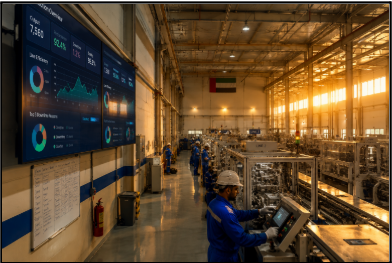
Odoo’s shop floor management tools give supervisors a live picture of everything happening on the production floor. Workers log their activities directly on tablets, time taken, materials used, operations completed. A bottleneck that would previously go unnoticed until the end of a shift gets flagged in real time, before it becomes a missed deadline.
Companies using this module consistently report a 40 per cent drop in unplanned machine downtime. Not because the machines changed, but because the visibility did.
2. Production Planning Software UAE: Stop Guessing, Start Scheduling
Poor scheduling is the most common source of waste in UAE manufacturing. Without proper production planning software UAE, businesses either produce too much or locking up cash in slow-moving stock or too little, letting customers down at the worst possible moment.
Odoo’s manufacturing module lets you build Master Production Schedules (MPS), define bill of materials (BoM) at every level, and automatically generate work orders tied to actual demand not estimates. For industries like FMCG, automotive components, and electronics manufacturing all thriving sectors across Dubai, Abu Dhabi, and the Northern Emirates, this capability is a genuine operational advantage.
3. Quality Control Software: Catch Defects Before They Become Disasters
A defect caught at the raw material stage costs almost nothing to fix. That same defect caught after it has gone through five production stages costs ten times more. And one that reaches the customer? That costs the relationship. Odoo’s built-in quality control software lets quality teams set up control points at every critical stage, incoming materials, mid-process, and pre-dispatch.
When a quality check fails, the system does not just flag it, it blocks the next operation until the issue is resolved. No override, no workaround, no batch slipping through because someone was in a hurry.
For UAE manufacturers exporting to international markets, the auditable quality trail this creates is equally valuable. Compliance documentation that used to take days to pull together can be generated on demand.
4. Production Lifecycle Management: From Design to Delivery
Odoo handles the full production lifecycle management cycle from the engineering design stage, through manufacturing, right through to after-sales support. This matters most for businesses making complex, configurable products where changes to the design mid-cycle used to mean manually updating everything downstream.
With Engineering Change Orders (ECOs) built directly into the platform, any approved design change automatically cascades through the bill of materials, work orders, and procurement requests. The version confusion that causes so much rework in traditionally-managed factories simply disappears.
Odoo for Small Business
There is a persistent belief in the UAE market that ERP is the domain of large corporations with dedicated IT departments. It is understandable that ten years ago, that was largely true. But Odoo for small business has shifted that reality considerably.
A manufacturing business with 15 people can get up and running on Odoo, managing production orders, work centre scheduling, inventory, quality checks, and invoicing all from one system, at a monthly cost that makes commercial sense.
The modular structure helps here. Start with manufacturing and inventory. When the team is comfortable, bring in HR or accounting. When you are ready to grow online, add ecommerce. The system scales with the business rather than forcing a big-bang implementation that disrupts everything at once.
ERP for Construction and Project-Based Manufacturing in UAE
The UAE is running some of the largest construction programmes in the world right now. And ERP for construction in the UAE context shares more with manufacturing than most people realise project-based costing, materials procurement tied to delivery milestones, subcontractor coordination, and a constant pressure on deadlines.
Construction companies across the UAE from fit-out specialists in Business Bay to MEP contractors working on infrastructure projects in Abu Dhabi are using Odoo to manage project timelines, track material deliveries against specific project phases, process subcontractor payments, and keep a live view of project margins.
Whether your business is building or manufacturing, the underlying challenge is the same: you need visibility across complex, moving parts. Odoo provides that, on one platform, without needing separate specialist systems for each function.
What Happens After UAE Manufacturers Make the Switch
The hesitation before an ERP implementation is understandable. It feels like a big commitment. But the businesses that have made the move report changes that are hard to argue with:
- Raw material waste down by 30 to 50 per cent, driven by accurate demand planning rather than gut-feel ordering
- Production downtime reduced by 40 per cent through real-time shop floor monitoring that catches problems early
- On-time delivery rates improving by 25 per cent as scheduling becomes data-driven rather than reactive
- Quality rework costs falling by 60 per cent once systematic control points are in place
- Overall operational costs dropping by 20 per cent in the first twelve months post-implementation
These are not exceptional cases. They represent what happens when a business stops running on disconnected tools and gives every department the same accurate, real-time picture.
How to Get Started with Manufacturing ERP in UAE
Most UAE manufacturers who delay an ERP implementation are not short on budget. They are short on confidence & they have heard the horror stories of six-month implementations that went wrong. With the right approach, that story does not have to be yours.
- Process Audit first: Before looking at software, map your current workflows. Where are the three biggest waste points? What does your team spend the most time on that a system could handle? That clarity shapes everything that follows.
- Choose a partner who knows your industry: A certified Odoo implementation partner in the UAE who has worked with manufacturers will configure the system very differently from one that primarily works with retail or services businesses. The industry context matters enormously.
- Phase the rollout: Start with Manufacturing and Inventory. Get your team comfortable and see early wins before expanding to Quality, HR, and Accounting.
- Invest in training: Odoo is genuinely intuitive, but a structured training programme ensures your team uses it confidently from day one, rather than reverting to the old spreadsheet out of habit.
- Track what changes: Set baseline metrics before go-live & waste rates, downtime hours, on-time delivery percentage. Measure against them every month. The improvements tend to be motivating enough to drive further adoption on their own.
The Manufacturers Who Act Now Will Lead UAE’s Next Industrial Wave
The UAE’s industrial ambitions under Economic Vision 2031 are not small. The government is actively creating conditions for manufacturing to grow free zones, incentives, and infrastructure that positions UAE industry to compete regionally and globally. The businesses that will benefit most are the ones that are operationally ready when those opportunities arrive.
That readiness comes from getting your systems right now, not later.
The companies cutting production waste by half did not discover a new manufacturing technique or hire a new team. They made one decision to run the business on a single, integrated platform and let the data do the rest.
If your manufacturing operation in the UAE is ready for that shift, Inova Technology is a certified Odoo partner based in the UAE, specialising in manufacturing ERP implementation, customisation, and team training. Their work spans production planning, shop floor management, quality control, and full lifecycle management configured for how UAE manufacturers actually operate.