

Outdoor advertising remains one of the most effective ways to build brand awareness, reach local audiences, and reinforce marketing campaigns. Whether it’s a billboard on a busy highway, a transit shelter in a city center, or digital signage in a shopping district, understanding outdoor advertising rates helps businesses make informed decisions before investing in a campaign.
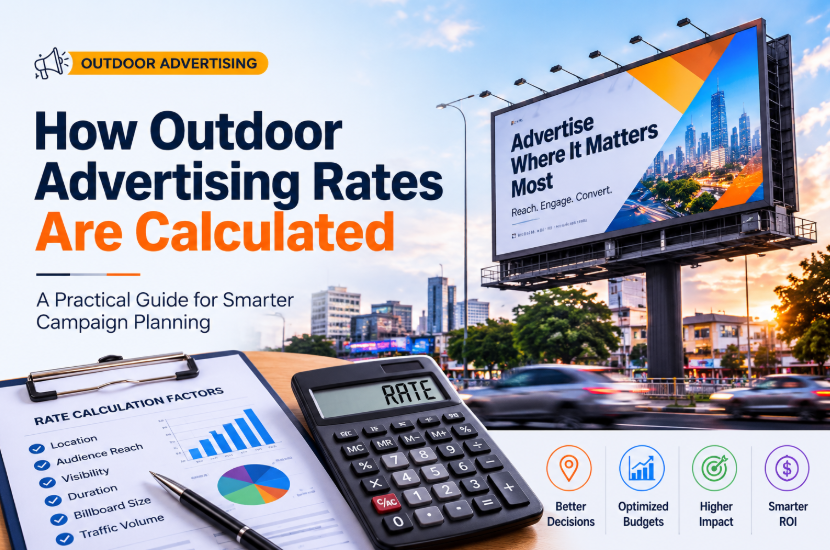
Many advertisers assume outdoor media pricing follows a fixed formula, but that’s rarely the case. Rates are influenced by several measurable factors, including location, audience exposure, campaign duration, billboard type, and seasonal demand. Knowing how these variables work together allows marketers to compare opportunities objectively and maximize their return on investment instead of simply choosing the lowest-priced option.
What Determines Outdoor Advertising Rates?
Outdoor advertising prices are based on the value an advertising location delivers to advertisers. Rather than charging solely for the physical billboard, media owners price inventory according to the potential audience and marketing impact.
Several factors influence the final rate.
Location Quality
Location is typically the biggest pricing factor.
A billboard positioned along a major interstate or in a busy downtown corridor usually commands higher rates than one located in a suburban neighborhood with lighter traffic. High-visibility intersections, commercial districts, entertainment zones, and commuting routes generally generate greater impressions, increasing their value.
For example, a billboard seen by 150,000 vehicles per day will naturally cost more than one receiving only 20,000 daily impressions because more potential customers are exposed to the advertisement.
Traffic Volume and Audience Reach
Traffic counts provide an estimate of how many people may see an advertisement. These figures often include:
- Daily vehicle traffic
- Pedestrian traffic
- Public transportation usage
- Average impressions per day
Advertisers often compare cost against estimated impressions to understand the efficiency of a location rather than focusing only on the rental price.
Billboard Size
Larger advertising formats generally cost more because they provide greater visibility.
Common examples include:
- Standard billboards
- Digital billboards
- Wall murals
- Street furniture
- Transit advertising
- Airport displays
Each format serves different marketing objectives, and pricing varies according to production requirements and audience engagement.
Campaign Duration
Longer campaigns frequently receive discounted monthly rates.
For example:
- Four-week campaigns often use standard pricing.
- Three-month campaigns may receive reduced monthly costs.
- Annual contracts often provide the best value per month.
Long-term exposure also improves brand recall, making extended campaigns attractive for businesses building awareness.
Market Demand
Advertising inventory follows basic supply and demand principles.
Premium locations become more expensive during:
- Holiday shopping seasons
- Major sporting events
- Tourism peaks
- Local festivals
- Election campaigns
Planning campaigns several months in advance often provides more inventory choices and better pricing.
Step-by-Step Guide to Estimating Outdoor Advertising Costs
Understanding how providers build their pricing models helps advertisers evaluate proposals more confidently.
Step 1: Define Your Marketing Goal
Before requesting pricing, determine the campaign objective.
Examples include:
- Building brand awareness
- Promoting a new product
- Driving store visits
- Supporting a digital campaign
- Increasing event attendance
Clear objectives help identify the most suitable locations rather than purchasing unnecessary exposure.
Step 2: Identify Your Target Audience
Audience targeting significantly affects media selection.
Ask questions such as:
- Where does the audience commute?
- Which neighborhoods match customer demographics?
- What times of day generate the highest exposure?
- Are motorists or pedestrians more important?
Choosing locations based on audience behavior often produces better results than selecting the busiest road available.
Step 3: Compare Cost Per Thousand Impressions (CPM)
Professional advertisers frequently evaluate outdoor media using CPM (Cost Per Thousand Impressions).
For example:
- Billboard A costs $2,500 per month with 500,000 monthly impressions.
- Billboard B costs $4,000 per month with 1,200,000 monthly impressions.
Although Billboard B costs more, its cost per impression may actually be lower, making it the better investment.
Step 4: Consider Production Costs
Advertising expenses extend beyond media rental.
Budget should also include:
- Graphic design
- Printing
- Installation
- Removal
- Artwork updates
- Maintenance if applicable
Digital billboards generally eliminate printing expenses because creative assets can be uploaded electronically.
Step 5: Measure Campaign Performance
Outdoor advertising works best when performance is evaluated.
Businesses often monitor:
- Website traffic increases
- QR code scans
- Coupon redemptions
- Store visits
- Phone inquiries
- Branded search growth
Combining outdoor advertising with digital analytics provides clearer insight into campaign effectiveness.
Common Mistakes Businesses Make
Even experienced marketers occasionally overlook factors that influence campaign success.
Choosing Based Only on Price
A cheaper billboard isn’t always a better value.
An inexpensive location with limited visibility may produce fewer impressions, resulting in a higher cost per customer reached.
Ignoring Visibility Conditions
Traffic volume alone doesn’t guarantee effectiveness.
Consider factors like:
- Viewing angle
- Distance from the road
- Trees or buildings
- Speed limits
- Lighting conditions
A moderately busy billboard with excellent visibility may outperform a poorly positioned premium location.
Running Campaigns That Are Too Short
Brand recognition develops through repeated exposure.
Very short campaigns often end before consumers become familiar with the message.
Many experienced advertisers recommend maintaining outdoor campaigns for at least several weeks to maximize recall.
Using Complicated Creative
Drivers typically have only a few seconds to read a billboard.
Effective outdoor advertisements usually feature:
- One primary message
- Minimal text
- Large typography
- High contrast
- Clear branding
Simple creative consistently performs better than information-heavy designs.
Practical Tips for Better Budget Planning
Businesses can improve campaign efficiency by following several proven strategies.
First, evaluate multiple locations rather than accepting the first proposal. Comparing audience reach, visibility, and pricing often reveals better opportunities.
Second, coordinate outdoor advertising with digital marketing. A customer who notices a billboard may later search for the company online before making a purchase. Ensuring your website is technically optimized, loads quickly, and presents trustworthy information strengthens this customer journey. Tools such as AudEsto can help businesses perform white-label SEO audits, generate downloadable PDF reports, and identify technical improvements that support stronger online visibility after offline campaigns generate interest.
Third, negotiate package pricing when booking multiple locations or longer campaign periods. Media owners frequently offer better overall value for larger commitments.
Finally, regularly review campaign performance instead of assuming every location delivers equal results. Over time, performance data helps build a more efficient advertising strategy and improves future budgeting decisions.
Conclusion
Understanding how outdoor advertising rates are calculated enables businesses to make smarter investment decisions rather than relying solely on quoted prices. Factors such as location quality, audience exposure, billboard format, campaign duration, market demand, and production costs all contribute to the final rate.
Successful advertisers focus on overall value instead of the lowest cost. By evaluating impressions, selecting locations strategically, creating simple yet memorable creative, and measuring campaign outcomes, businesses can maximize the effectiveness of every advertising dollar. Outdoor advertising remains a powerful branding channel when campaigns are planned using data, realistic objectives, and a clear understanding of the pricing factors behind every placement.