

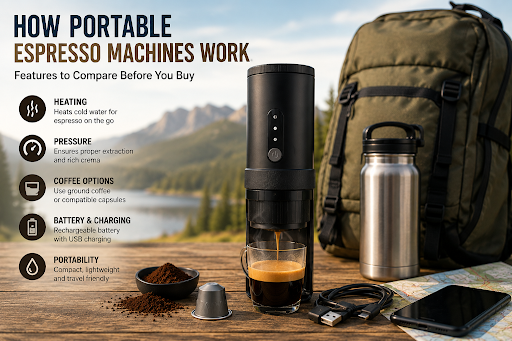
Making espresso away from a kitchen is easier than it once was, but choosing the right equipment can still be confusing. A Portable Espresso Machine is designed to prepare concentrated coffee in a smaller format that can be carried between locations. Some models are manual, while others use electric pumps, rechargeable batteries, or built in water heating. Understanding these differences can help travelers, campers, commuters, and remote workers choose a machine that fits their actual routine instead of buying based on a single specification.
Portable espresso equipment varies widely in design. A simple manual device may require hot water and physical pressure from the user. An electric model may automate extraction. More advanced portable machines can also heat cold water, reducing the need for a separate kettle.
This guide explains how these machines work, why pressure and temperature matter, and which features deserve attention before buying.
What Is a Portable Espresso Machine?
A portable espresso machine is a compact coffee device designed for use away from a permanent kitchen setup. Its main purpose is to make concentrated espresso style coffee while taking up less space than a traditional countertop machine.
The category includes several types of products:
- Manual pressure brewers
- Hand pumped espresso makers
- Battery powered espresso makers
- Electric portable machines
- Self heating coffee devices
- Capsule based travel machines
- Models that support ground coffee
These designs do not all work in the same way. Some require the user to heat water separately. Others include a battery and heating system. Some accept only one coffee format, while certain models support both grounds and compatible capsules.
Before choosing a machine, buyers should think about where they plan to use it. A lightweight manual brewer may suit someone who already carries a camping stove. A self heating electric model may be more convenient for hotel stays, office work, or road trips.
How Portable Espresso Brewing Works
At a basic level, espresso preparation involves moving hot water through coffee under pressure. A portable machine tries to manage this process in a smaller package.
The typical workflow includes:
- Adding water to the machine.
- Loading ground coffee or inserting a compatible capsule.
- Creating or activating pressure.
- Moving heated water through the coffee.
- Collecting the extracted drink in a cup.
The exact process depends on the machine.
A manual device may require repeated pumping or hand pressure. An electric espresso machine uses a powered system to create pressure. A self heating model may also warm the water before extraction.
This is why the phrase portable coffee maker can describe products with very different capabilities. Buyers should look beyond size and ask what steps the device actually handles.
Why Pressure Matters
Pressure is one of the most discussed features in espresso equipment. It plays an important role because water must move through a compact bed of coffee grounds.
However, a larger pressure number does not automatically mean better coffee.
The final result can also depend on:
- Grind size
- Coffee freshness
- Coffee dose
- Water temperature
- Water quality
- Distribution of the grounds
- Coffee format
- Machine cleanliness
For example, the manufacturer lists the OutIn Nano with a pressure system rated at 20 bar. That is a product specification, but buyers should still understand that a pressure rating alone cannot predict the taste of every cup.
When comparing machines, pressure should be viewed as one part of the brewing system rather than the only measure of quality.
The Role of Water Temperature
Water temperature affects how compounds are extracted from coffee. If water is not hot enough, the result may taste weak or underdeveloped. Excessive heat can also affect extraction and flavor.
For portable use, the more immediate question is often simpler: does the machine heat water at all?
Many manual travel espresso makers require preheated water. This means the user also needs access to:
- A kettle
- A stove
- A camp cooking system
- A hot water dispenser
- Another heating source
That may be easy at home but inconvenient on the road.
Self heating machines address this issue by including an internal heating system. According to OutIn, for example, the Nano can heat cold water to approximately 92°C or 198°F. This can reduce dependence on a separate kettle in suitable situations.
Buyers should remember that heating water requires energy. A machine that heats cold water will generally place greater demand on its battery than one that starts with hot water.
Manual and Electric Portable Models
One of the first buying decisions is choosing between manual and electric operation.
Manual Portable Espresso Machines
Manual machines usually rely on hand pressure, pumping, or another physical mechanism.
Possible advantages include:
- No battery dependence
- Simple construction
- Useful for remote trips
- Often lighter
- Fewer charging concerns
Possible disadvantages include:
- More effort during preparation
- Separate hot water often required
- Greater variation in workflow
- Less convenient for some users
A manual machine may make sense for hikers or campers who already carry equipment for heating water.
Electric Portable Espresso Machines
Electric models use powered components to simplify extraction. Some also include water heating.
Possible advantages include:
- Less manual effort
- More automated preparation
- Integrated pressure generation
- Heating capability on selected models
- Convenient for work and travel
Possible disadvantages include:
- Battery dependence
- Charging requirements
- Greater weight than very simple manual brewers
- More electronic components
The better option depends on where the machine will be used.
Self Heating Machines Explained
A self heating compact espresso maker can be especially useful when hot water is not readily available.
Consider a few common situations. A traveler may be staying in a hotel room without a kettle. A remote worker may be using a temporary workspace. A driver may want coffee during a safe, planned road trip stop. A car camper may prefer not to set up a stove just for one small coffee.
In these cases, integrated heating can simplify the setup.
However, buyers should ask several practical questions:
- How long does heating take?
- What temperature does the manufacturer list?
- How much cold water can be heated?
- How many heating cycles are expected per charge?
- Can the machine also use preheated water?
- What happens in cold outdoor conditions?
Manufacturer information should be reviewed carefully because battery performance and heating capacity vary between products.
Battery Life and Charging
Battery specifications deserve close attention when buying an electric portable machine.
A rechargeable coffee maker may sound convenient, but actual usefulness depends on the user’s routine. Someone making one drink at work has different needs from a camper spending several days away from electricity.
Consider:
- Battery capacity
- Expected brewing cycles
- Cold water heating demands
- Charging time
- Charging connection
- Access to compatible power
- Trip duration
USB charging can be useful because many travelers already carry USB equipment. Still, buyers should confirm the exact charging requirements of the machine rather than assuming every cable, charger, vehicle port, or power bank will provide suitable performance.
For longer trips, battery planning becomes part of the coffee setup.
Ground Coffee Versus Capsule Options
Coffee format is another major buying consideration.
Ground Coffee
Ground coffee gives users more choice. They can select beans from a preferred roaster, choose a roast level, and adjust preparation within the limits of the device.
Potential advantages include:
- Wider coffee selection
- More control over flavor
- Access to local or specialty coffee
- Less dependence on a specific capsule format
Potential considerations include:
- More cleanup
- Loose grounds during travel
- Need for appropriate grind size
- Additional storage
Coffee Capsules
Capsules focus on convenience and portioning.
Potential advantages include:
- Easy packing
- Simple preparation
- Less handling of loose grounds
- Consistent portions
Potential considerations include:
- Compatibility requirements
- Packaging waste
- Limited coffee choice
- Availability while traveling
Some buyers may value a machine that supports both methods. According to manufacturer information, the OutIn Nano is designed for ground coffee and compatible capsules. Dual compatibility can be useful for people who prefer grounds in one setting and capsules in another.
Size and Weight for Travel
A machine is not truly practical for travel simply because the word portable appears in its name.
Buyers should examine:
- Product weight
- Physical dimensions
- Shape
- Protective storage needs
- Required accessories
- Cup requirements
- Coffee storage
- Charging equipment
According to the manufacturer, the OutIn Nano weighs approximately 670 g. That may be manageable for luggage, office bags, road trips, and car camping, but lightweight backpackers may still prefer a smaller manual option.
The complete setup matters more than the machine alone. A camping coffee setup may also include water, coffee, a cup, a charger, and cleaning supplies.
Cleaning and Maintenance
Cleaning is easy to overlook when comparing product pages, but it matters in real use.
Coffee oils and residue can remain on brewing components. Used grounds must be removed. Capsule areas may also require cleaning. Damp parts should not simply be packed away for long periods without care.
Before buying, ask:
- Which parts are removable?
- How easy is it to remove used grounds?
- Can components be rinsed easily?
- Is deep cleaning required?
- Are replacement parts available?
- Is cleaning realistic in the places where the machine will be used?
A device that is easy to clean in a home kitchen may be less convenient at a remote campsite with limited water.
Important Features to Compare
For buyers comparing portable espresso options, the following table provides a useful starting point:
| Feature | Why It Matters |
| Heating system | Determines whether separate hot water is needed |
| Pressure system | Supports extraction but should not be judged alone |
| Battery | Affects electric use away from outlets |
| Charging method | Influences travel convenience |
| Coffee format | Determines grounds and capsule options |
| Weight | Matters for carrying and packing |
| Water capacity | Affects serving size |
| Cleaning | Influences daily convenience |
| Accessories | Can change the total travel setup |
| Manufacturer support | Important for instructions and replacement needs |
No single feature should decide the purchase. The best match depends on the user’s priorities.
Common Buying Mistakes
One common mistake is choosing a machine only because it has the highest pressure number. Espresso preparation involves more than one specification.
Another mistake is ignoring the hot water requirement. A compact manual brewer may not solve the user’s problem if a kettle is still necessary.
Battery expectations can also be unrealistic. Heating cold water requires energy, so people planning long trips should study manufacturer guidance carefully.
Other common mistakes include:
- Ignoring cleaning requirements
- Assuming all capsules are compatible
- Forgetting the weight of accessories
- Expecting home machine capacity from a travel device
- Buying for an imagined use case instead of a real routine
A commuter, camper, business traveler, and backpacker may all need different equipment.
Using the OutIn Nano as a Practical Example
The OutIn Nano helps illustrate how several portable espresso features can be combined in one product.
According to OutIn, the device weighs approximately 670 g, uses a pressure system rated at 20 bar, can heat water to about 92°C or 198°F, and supports both ground coffee and compatible capsules. It also uses a rechargeable battery system and offers USB charging support.
These listed features may make it relevant for:
- Hotel travel
- Office use
- Road trips
- Car camping
- Remote work
- Commuting
- Outdoor leisure activities
The main appeal is integration. Instead of carrying a separate heating device and manual pressure brewer, the user has an electric system designed to handle more of the process.
The tradeoff is dependence on battery charge. For a long remote trip, a manual brewer may still be simpler. For someone moving between hotels, offices, vehicles, and established campsites, an electric option may be more convenient.
Final Buying Checklist
Before purchasing any portable espresso machine, ask the following questions:
- Do I usually have access to hot water?
- Do I prefer ground coffee or capsules?
- How much weight am I comfortable carrying?
- Will I have access to charging?
- How many drinks do I expect to make?
- Can I clean the machine where I plan to use it?
- Do I need electric heating?
- Is the serving capacity suitable?
- Are compatible accessories easy to find?
- Have I checked current manufacturer instructions?
If integrated heating, rechargeable operation, and flexible coffee formats match your needs, reviewing the current OutIn Nano Portable Espresso Machine specifications can help you compare those features with other options.
Conclusion
Portable espresso machines can be useful, but they are not all designed for the same type of user. Manual models focus on simplicity and independence from batteries. Electric models reduce physical effort. Self heating devices can remove the need for a separate kettle in many situations.
The right choice depends on real use. A frequent business traveler may value compact electric heating. A car camper may prioritize convenience and USB charging. A backpacker may prefer lower weight and no battery dependence. An office worker may care most about simple preparation and cleanup.
The most sensible buying approach is to compare the complete workflow rather than one impressive specification. Think about water, heat, pressure, coffee format, charging, cleaning, weight, and serving capacity together.
A good portable coffee maker should fit the places where it will actually be used. When those practical details match the buyer’s routine, espresso on the go becomes much easier to manage.
Frequently Asked Questions
1. Do all portable espresso machines heat water?
No. Many manual models require preheated water. Some electric machines include built in heating systems. Always check the manufacturer’s specifications before buying.
2. Is higher pressure always better for portable espresso?
Not necessarily. Pressure is important, but coffee freshness, grind size, dose, temperature, water quality, and preparation also affect extraction.
3. Are battery powered espresso makers good for camping?
They can be useful for car camping and trips with access to charging. For long remote trips, battery dependence may be a limitation.
4. Is ground coffee better than capsules?
Neither option is universally better. Ground coffee offers more choice and control, while capsules may be easier to pack and prepare. The right choice depends on personal priorities.
5. What should I check before buying a portable espresso machine?
Review heating capability, pressure system, battery requirements, charging method, coffee compatibility, weight, water capacity, cleaning needs, and current manufacturer guidance.