

Introduction
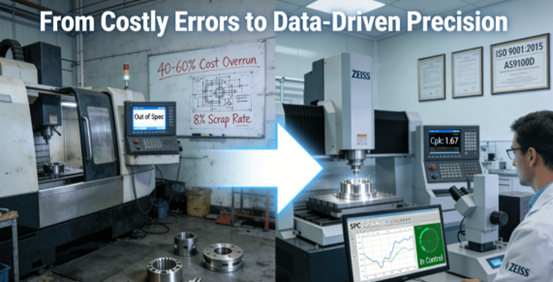
In the competitive environment of manufacturing, CNC machining is a foundation technology for many such operations. It is the main cause of cost overruns and project delays. According to data, up to 40-60% of a project budget is prone to being spent on unforeseen CNC machining expenses, while precision instability contributes to part scrap rates over 8%. Here, the actual issue does not lie with the nature of machining, which is a precise operation. It is apparent from the data that no proper, scientific approach to tolerance analysis and supplier capability verification is being followed. Here, inspection of individual samples, along with outdated specifications, are being relied upon.
This guide lays out a firm, well, informed methodology backed by data and inspired by internationally recognized standardization guides like ASME Y14.5, along with quality system certifications such as ISO 9001. You can find here an exhaustive, step, wise guide on how to be precise, exact, cost, effective in measuring, improving and controlling precision, tolerance, and cost, thus changing a cost, focused machine shop into a net quality contributor.
What Are the Key CNC Machining Tolerance Standards and Why Do They Matter?
Lack of proper understanding and application of the right CNC machine tolerances can form a basis upon which effective and sound manufacturing takes place. Tolerance standards ensure a common language in specifying all allowed variation in dimensions. Without paying due consideration to them, costing and total project failures can easily result.
1. The Global Alphabet: ISO 2768 and ASME Y14.5
There are mainly two families or standards for specifying tolerancing. ISO 2768 provides general recommendations for geometric tolerancing of geometric characteristics without specific individual assignments, grouping into classes and International Tolerance grades IT7, IT9, etc. It is excellent for establishing a basic grade. The ASME Y14.5-2018 establishes specific rules for Geometric Dimensioning and Tolerancing (GD&T) symbols that control form, orientation, locator, and run-out. GD&T is critical for complex geometries where relationship is implied to be as significant as the sizes themselves. An incorrect choice of standards and grades can increase costs by 50 percent or more, as costs rise exponentially for closer tolerancing which requires more time and specialized equipment.
The Science of IT Grades and the Cost of Perfection
International Tolerance (IT) grades establish a set of tolerance values that depend on a feature’s nominal size. An IT7 grade is much more precise than an IT9 grade. The expense of machining to IT7 is way higher because of slower feed rates, finer finishing passes, and more rigorous quality control. One common mistake is defaulting to the tightest possible tolerance “just to be safe. ” A data, driven method entails selecting the IT grade based on the functional requirements of the part. For example, a non, critical mounting bracket would not require the same level of precision as a bearing seat. This idea is the foundation for the creation of an efficient machining tolerance guide.
3. The Consequences of Inconsistent Standards
If design, procurement, and manufacturing teams each read tolerances in their own way, then confusion, redoing of work, and waste will inevitably happen. A drawing that combines plus/minus tolerancing with GD&T and does not clearly specify the datums is almost guaranteed to result in several interpretations. Strict compliance with a single, well, established standard, e. g. the principles described in the reliable CNC machining tolerance standards guide, will make sure that everyone, starting from the designer, the machine operator up to the quality inspector, is on the same page. Such conformity is not only the very first but also the most crucial step to prevent costly mistakes.
How Can Manufacturers Accurately Assess CNC Machining Precision?
In order to verify any claims of precision being offered by the suppliers, one needs to go beyond the certificate of compliance to enter the field of statistics. Assessing true assessment is a process rather than a one-time event.
1. Statistical Process Control (SPC) and Capability Indices
The best way to ascertain this is to use the information contained in the Statistical Process Control (SPC). To accomplish this, a statistically significant number of pieces (30 consecutive pieces from a given product batch, etc.) are evaluated to ascertain the overall dimensions. From this data, the equations are used to generate the overall process capability equations (both Cp and Cpk). By evaluating the Cpk against a value ≥ 1.33, it indicates that the process has met the tolerance limits. Conversely, a Cpk ≥ 1.67 indicates a highly capable process. These measurements objectively establish whether or not the process has the ability to deliver the product to meet the specified tolerance limits, taking into consideration both data and distribution variances. Suppliers who have implemented a Quality Management system to a standard such as ISO 9001 are normally competent in the process and willing to discuss the information.
2. The Role of Advanced Metrology
Data is only as good as the tools that collect the data. To assess a product or process correctly, it’s necessary to have well-calibrated, high-precision measurement equipment. Coordinate Measuring Machines (CMMs) enable the collection of vast data in 3D, whereas laser scanners and optical comparators allow fast inspection capabilities. A critical, yet often skipped, evaluation process includes a test known as a ‘Gauge R&R’ analysis. This ensures that the measurement system itself (gauge and the operator) plays a negligible role (<10%) in the variance of the total process. Suppliers that don’t have a measurement system validation process are unable to accurately substantiate their precision.
3. The Continuous Monitoring Feedback Loop
However, precision assessment shouldn’t stop at the first article and ideally continues with a data-driven approach that utilizes real-time/near-real-time monitoring in some fashion. This could be in-process measurements on the CNC machine itself or audit-style measurements on the production output. That data will then be used in a closed-loop system where trends are tracked. If a Cpk starts trending down, there needs to be some kind of root cause analysis of why the value is changing before out-of-spec parts enter the supply chain — a very big part of what makes for a mature and reliable supplier.
What Common Pitfalls Lead to Overpriced CNC Machining and How to Avoid Them?
In most cases, cost overruns in CNC machining do not result from any single disastrous error but rather from a combination of many common, but avoidable, errors.
- The “Tighter is Better” Fallacy: The most common and costly error is the over-tightening of tolerances. As tolerance bands get tighter, cost increases are exponential. Overspecifying an IT7 tolerance when an IT9 is adequate can increase cost as much as double. The answer is functional tolerance analysis. For every tolerance band on the drawing, the question is, “What is the functional significance if this dimension is at the extreme end of its tolerance band?” If the answer is “nothing” or “not much,” significant direct cost savings of as much as 25% to 40% can be achieved.
- Ignoring Design for Manufacturability: Designs created in isolation, without considering their manufacturability, are riddled with unforeseen costs. Intricate features like deep and small-diametered holes, as well as sharper corners and non-standard threaded depths, could significantly increase the overall costs due to the need for special tools, or even the risk of scrap costs. Participating in meaningful DFM discussions with a CNC machining partner, however, optimizes the design to not only make the CNC machining part significantly less expensive but also to increase its manufacturability.
- Material and Process Mismatch: Not all materials machine alike. Designing a part based on the ultimate tensile strength of a material without considering its machinability score is a recipe for disaster. For instance, some types of stainless steel tend to work-harden and will quickly wear tools, along with a poor surface finish. In other instances, the failure to consider the material’s coefficients of thermal expansion (aluminum) and springback (titanium) will mean that a designed part will be out of tolerance when it reaches room temperature or is unclamped. For such reasons, a manufacturer with knowledge and experience of materials must be selected.
How Does Material Selection Affect Tolerance Control and Cost?
The selected material is not only a block of matter; it is also an agent in the machining process. Its properties inherently dictate the achievable precision, required machining strategy, and final part cost.
1. Thermal Effects and Dimensional Stability
Materials that are excellent thermal conductors, like aluminum, draw heat away from the cut very quickly, thereby stabilizing the process. On the other hand, such materials generally have a very high coefficient of thermal expansion. If not adequately controlled by the use of coolant and stable environmental conditions, this can result in a part being machined to size when it is hot and then getting out of tolerance as it shrinks on cooling.Materials that are poor heat conductors, for example, titanium, are inclined to heat up the cutting zone greatly which results in work, hardening and deterioration of the cutting tool; both of these situations can lead to dimensional accuracy being compromised. A skilled manufacturer anticipates these different effects and compensates for them by applying thermal compensation methods in the CNC code, for example..
H3: 2. Material Hardness, Abrasiveness, and Tool Life
Harder and more abrasive materials, such as hardened steels and Inconels, can cause extremely fast tool wear rates. As a cutting tool becomes dull, it can no longer cut properly and moves further and further from the ideal cutting path; therefore, the cutting forces will also increase, and the dimensions of the part will drift gradually but predictably. To machine such materials with tight tolerances, a manufacturer must be prepared to establish a very strict tool life management program, as the tooling cost will be higher but cannot be avoided.
3. Post-Processing and Stress Relief
Some materials will have residual stresses imparted by their initial stock material, such as bar or plate stock. Machining this out will relieve the stresses asymmetrically, causing the part to warp or distort. For critical parts, a stress-relief heat treatment may be necessary before final precision machine work. For medical implants made from Ti-6Al-4V, this is a standard requirement. Considering the additional secondary operations, and how these operations affect the overall machine operations, it is necessary for cost analysis and tolerance achievement.
What Role Does Certification Play in Ensuring Machining Quality?
In an age of claims and marketing hype, third-party certifications can offer real evidence of a manufacturer’s dedication to a systematic approach to quality, and continuous improvement. They are a risk management strategy of the highest order.
1. ISO 9001: The Foundation of Process Control
ISO 9001:2015 is an international quality management system. It means that they have documented, implemented, and maintained their system to ensure their processes are controlled and continually improved. It includes processes such as correction and prevention action (CAPA), management review, and document and record control. To this customer, it means he can be confident that his supplier has a system in place, not just machinists who are skilled. This creates a framework for all of the above-mentioned assessments.
2. Industry-specific mandates: IATF 16949
In addition to the general quality system standards, there are industry-specific ones. IATF 16949 is a technical specification related to car industry quality management. This standard is based on ISO 9001. Nevertheless, it has strict requirements for product safety, risk-based thinking, and the incorporation of the aforementioned elements like APQP and PPAP. Another standard related to particular industries is AS9100D, which is concerned with aerospace and has a strong focus on configuration management, traceability, and special processes. As a matter of fact, a component designed for use within a flight control system of a shop that has been certified against AS9100D has an unprecedented level of demonstrated evidence.
3. Certification as a Culture, Not a Certificate
A certification’s worth is actually recognized only when it faithfully represents the institution’s quality culture. For example, the distinction is a workshop that merely carries out inspection activities because its procedure manual tells it to, and a workshop where all the employees are empowered to stop the operation if they identify a quality risk.Industry certifications, reflect a company’s commitment to quality at every step of the operations process, from quote to finished product, thus they are able to minimize the chances of defects to almost zero.
How to Choose the Right CNC Manufacturer for High-Precision Parts?
Selecting a manufacturing partner is arguably one of the most critical decisions a product development process undertakes. A good manufacturing partner is equivalent to adding another arm to your engineering team, but a poor partner is like adding another problem to already fire-fighting. A data-driven approach shifts the focus beyond mere price and promises.
- The Capability Audit: Beyond the Brochure: But rather than believe a marketing claim, we want to drill down and see their tangible capabilities. Ask them to show you evidence. Ask them to show you their SPC/Cpk charts from a recent, similar part. What are their Gauge R&R results on their primary CMM? Will they share their equipment calibration history and preventive maintenance schedule? If this is a capable manufacturer, they’re not trying to hide this information. Ask them about their experience with your material and your required tolerances. Ask them to include a Design For Manufacturability analysis on your part in their quoting process. What they say about your design will speak volumes about their hands-on engineering expertise.
- Evaluating the Quality Ecosystem: Evaluate their quality management system as a whole: Are they certified? Do they have a dedicated quality manager? How do they handle non-conforming materials? What process do they use for corrective action? Even better, actually tour their facility either virtually or in person. Look for signs of organization, a clean facility, and workflow. A cluttered facility is a sign of a potential quality problem.
- Partnership and Communication Fit: Lastly, consider communication and project management aspects. Are they responsive and clear in their quoting process? Do they establish a dedicated point of contact? Do they commit to providing regular progress updates? The most technically competent shop can literally be a liability if they cannot communicate effectively with you. The ideal partner will display a collaborative spirit by asking probing questions about the function of your part to ultimately not just provide you a part to print, but a part that performs properly. This collaborative approach will drive success for your CNC machining part and your entire project.
Conclusion
It is not by luck that one avoids expensive CNC machining errors; rather, it is the result of a rigorous, data, driven approach.By deftly handling international tolerance standards and implementing best practices in rigorous statistical methods for precision measurement, combined with a proactive way of avoiding common cost levers by DFM, these are the key levers that variable cost machining centers radically transform into quality and reliability leaders. And the most effective risk mitigation strategy is working with those suppliers who have these principles deeply embedded in a quality culture certified by a third party. This well, planned approach puts engineers and procurement people in a position to make high quality strategic decisions, maintain control over the budget, and at the same time, ensure ready availability of high, performance parts, thus obtaining a winning position in the present highly competitive market..
FAQs
Q1: What is the most cost-effective tolerance grade for general CNC machining?
A: For non-critical features, IT8 is usually the best balance of cost and function. Using IT8 instead of a tighter grade such as IT7 may save as much as 30% of machining costs with no loss of performance, according to standards such as ISO 2768. The rule of thumb is always to match the specified tolerance to the actual functional requirements of the part to avoid over-engineering.
Q2: How do I verify a supplier’s precision claims before production?
A: Ask for reports related to Cp/Cpk value for a pre-production run of a similar part with a quantity of 30 parts. Measurement system analysis GaR & R should also be asked for; this value should be <=10%. Suppliers certified to systems such as ISO 9001 will generally have a system of openness to provide these reports and give a true picture of their reliability.
Q3: What are the main factors driving up the cost of CNC machining?
A: The main causes are over-specification of tolerances, improper selection of materials used by machinability, and a general lack of early stage Design for Manufactability (DFM) input. To illustrate this, tolerances that are overly specified can readily add double the cost of time and money associated with machining. The analysis of DFM at the design stage is the best way to reduce such causes.
Q4: What influence do certifications like ISO 9001 have on machining quality?
A: With certifications, a process is enforced within which process controls, documented procedures, and continuous improvement mandates are adhered to. Such a systemization process has been observed to minimize defects in processes. In high-stakes industries, certifications such as AS9100D help aerospace suppliers attain near zero defects through complete traceability, risk management, and adherence to the highest standards in the industry throughout the entire production life cycle.
Q5: Can small batch production retain tight tolerances while also having low cost?
A: Sure, if the right approach is taken. High, end CNC machines, through standardized machining procedures, smart tooling techniques, and combined machining of several parts at once, are capable of maintaining tight tolerances (e.g., 0.01mm) even for quantities of 100 pieces or more. The cost per unit for this level of precision at such low quantities will only be 1.2 to 1.5 times that of a parts run in large quantities.
Author Bio
The author is a professional in the field of precision manufacturing working at LS Manufacturing. The company specializes in assisting engineers and businesses to find solutions for complex machining and quality assurance challenges. The team members of the company have various certifications such as ISO 9001, IATF 16949, and AS9100D, and they are committed to providing strong, data, driven solutions from design review to final inspection. To get a complimentary DFM analysis and a precision capability assessment of your next project, you can reach out to the experts at the company.