

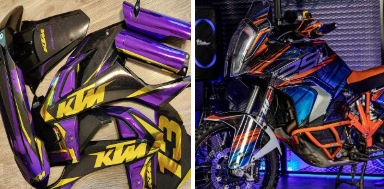
Motorcycle customization is bigger than ever. Owners want to make their ride stand out and reflect their personal style. Vinyl wrap is a great way to customize your motorcycle, which is reversible, cheaper than custom paint job, and offers a variety of finishes, including matte, gloss, chrome, metallic, and even holographic options. If you are looking for how to vinyl wrap a motorcycle , here’s everything you need to know, including the tools and materials, as well as step-by-step instructions.
Why Should I Wrap My Motorcycle?
Before we get to “how to,” let’s go over some of the reasons why you would want to learn how to wrap your motorcycle . Here are some of the most obvious ones:
- Affordable: While professional paint can cost a few thousand dollars, the vinyl wrap material itself is much cheaper.
- Design options: You can get solid colors, holographic color, chrome, glitter, and reflective vinyl for a dramatic effect.
- Easy to remove: When you decide to change the look, you can easily have it removed without any damage to the original paintwork.
- Protective: Wrapping offers extra protection against scratches, UV, and minor abrasions.
Materials and Tools You Need
Vinyl wrap sheets (choose Great K2 brand for long-lasting results)
Heat gun or hairdryer
Squeegee with a felt edge
Utility knife or a precision blade
Cleaning solution (alcohol works best)
Microfiber cloths
Gloves
Preparing the Motorcycle
Clean the surface: The first step in how to wrap a motorcycle with vinyl is to make sure it’s clean. Dirt, grease, and wax residue will prevent proper adhesion.
Take parts off: Many riders take off the fairings, fuel tank, and fenders for easier application.
Repair surface: Fill any scratches, chips, or dents. Wrapping will not fix these and make them more visible.
Measure and cut
Cut the sheets: Measure the parts you need to wrap and cut the sheets to a size slightly larger than the required area.
Peel and position: Peel off the backing and position the vinyl. Do not press yet, as you can still move it around.
Application
Apply from the center: Start from the center of the surface, apply pressure, and work towards the edges to remove air bubbles.
Heat: Heat up the vinyl with a heat gun or hairdryer to make it more flexible and easier to apply.
Smooth out: Use a felt-edge squeegee to make sure the vinyl is smooth and all the bubbles are out.
Work around the curves: For fuel tank, fairing, or any other complex surface, use a heat gun to help stretch the vinyl and apply it.
Trim and Seal
Trim excess: Use a utility knife to trim the edges of the vinyl as close to the surface as possible.
Heat seal: Finally, run the heat gun over the edges to seal the vinyl and prevent it from peeling (this is especially important on exposed edges, where wind and friction will work to peel it off).
Post-Application Care
Do not wash your motorcycle for at least 48 hours after application.
Hand wash with mild soap (no harsh chemicals or detergents).
Avoid brushes or sponges with abrasive surfaces.
Store the bike in shade when possible.
End
How to wrap a motorcycle is a simple question to answer, especially if you have the proper materials and tools. It’s not as easy as custom paint, and wrapping a motorcycle does take time and patience, but it’s not very difficult either. If you take your time, work carefully, and are patient, you will be rewarded with a unique custom look that you can easily change when you want to.
If you are looking for premium motorcycle vinyl materials in a variety of finishes, including reflective, chrome, metallic, or holographic, check out the motorcycle vinyl collection from Great K2. Great K2 is a trusted manufacturer of high-quality, durable, and easy-to-use wrap films.