

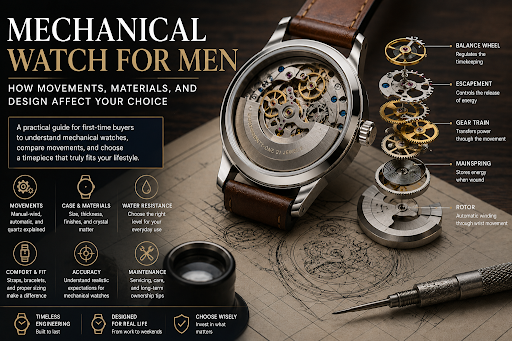
Buying a first mechanical watch can raise more questions than expected. Unlike a basic battery-powered timepiece, a mechanical watch relies on a coordinated system of springs, gears, wheels, and regulating components to measure and display time. That engineering is a major part of the appeal, but it also introduces practical considerations that first-time buyers should understand before making a decision. Movement type, power reserve, winding habits, accuracy expectations, case dimensions, water resistance, crystal material, dial readability, strap comfort, and future servicing can all affect the ownership experience. A watch may look impressive in photographs yet prove inconvenient if it is too thick, difficult to read, uncomfortable after several hours, or poorly matched to the wearer’s daily routine.
For someone researching a mechanical watch for men, the most useful starting point is not a particular dial color or case style but a clear understanding of how and where the watch will be worn. An office worker may value moderate thickness and restrained proportions, while a frequent traveler may prioritize comfort, readability, and practical resistance to everyday exposure. Someone interested in mechanical engineering may care more about movement architecture and winding behavior. These priorities help narrow the field and prevent buyers from paying for complications or design elements that contribute little to actual use.
What Is a Mechanical Watch?
A mechanical watch measures time through stored mechanical energy rather than relying on a conventional battery and electronic oscillator. At the center of the system is the mainspring, which stores energy when wound. That energy is released gradually through a gear train, while the escapement controls the rate of release. A regulating organ, typically involving a balance wheel and hairspring in a traditional mechanical architecture, oscillates repeatedly and helps determine the movement’s rate.
This description can sound complex, but the basic idea is straightforward: energy is stored, transferred, regulated, and used to move the hands. The movement must perform these tasks continuously while the watch is running. Small components interact under tight tolerances, which helps explain both the fascination of mechanical watches and their need for realistic ownership expectations.
Mechanical watches are generally divided into manual-wind and automatic types. Both operate through mechanical principles, but they differ in how the mainspring receives energy. Understanding that distinction is important because it affects daily interaction, convenience, case construction, and wearing habits.
Manual-Wind, Automatic, and Quartz Watches Explained
Manual-Wind Mechanical Movements
A manual-wind watch requires the owner to wind the mainspring through the crown. Turning the crown transfers energy into the spring, allowing the movement to operate until the available power reserve is exhausted. Depending on the movement, the owner may develop a routine of winding the watch daily or at another appropriate interval.
Some buyers enjoy this interaction because it creates a deliberate connection with the timepiece. Manual-wind movements can also allow different case proportions because they do not require an automatic winding rotor. However, the need for regular winding may not suit everyone. A person who wants maximum convenience may find the routine unnecessary, while another wearer may consider it part of the appeal.
The key is to evaluate personal habits rather than assuming manual winding is either a benefit or a disadvantage. A first-time buyer should ask whether regular interaction feels enjoyable or inconvenient.
Automatic Mechanical Movements
Automatic movements use a winding mechanism that captures motion from the wearer’s wrist. A weighted rotor moves as the watch changes position, and this movement contributes to winding the mainspring. When worn regularly and with sufficient activity, an automatic watch can continue running without the owner manually winding it each day.
This does not mean the watch runs forever. Every movement has a finite power reserve. If an automatic watch is left unworn for long enough, the stored energy will eventually be depleted and the watch will stop. The owner may then need to wind and reset it before use.
This characteristic is important when comparing automatic watches for men. Someone who owns one primary watch and wears it most days may rarely think about power reserve. A collector who rotates several watches may encounter stopped watches more frequently. The practical value of a longer power reserve therefore depends partly on wearing habits.
Quartz Movements
Quartz watches use an electronic regulating system and typically receive energy from a battery or another electrical source. They are generally valued for convenience and strong practical accuracy. For many users, quartz is an excellent choice because it requires little daily involvement and can continue operating for long periods without being worn.
The difference between quartz and mechanical watches should not be reduced to a simple question of which is better. Quartz may suit someone who prioritizes accuracy and convenience, while mechanical watches appeal to buyers who value physical movement architecture, traditional engineering, and a more interactive ownership experience. A well-informed buyer chooses according to priorities rather than assuming that mechanical complexity automatically makes a watch more suitable.
How Movement Architecture Affects Ownership
Movement architecture influences more than technical interest. It can affect winding behavior, power reserve, thickness, serviceability, setting functions, and daily use. Buyers may encounter terms such as hand-winding, hacking seconds, beat frequency, jewels, and power reserve. These features are worth understanding, but they should not be treated as a competition in which the largest number always wins.
Hand-winding capability can be useful when restarting an automatic watch after it has stopped. Hacking seconds, where available, allows the seconds hand to pause during time setting, making synchronization easier. Power reserve indicates how long a fully wound movement may continue operating under specified conditions, though actual experience can depend on the watch and usage.
Jewel count is another commonly advertised specification. Synthetic jewels can reduce friction and wear at selected points within a movement, but a higher jewel count does not automatically prove superior overall quality. Movement design, regulation, construction, condition, and suitability for intended use all matter. Buyers should evaluate the complete system rather than relying on one number.
Power Reserve and Winding Habits
Power reserve becomes especially relevant when a mechanical watch is not worn continuously. A manual-wind watch needs periodic winding, while an automatic model relies on a combination of stored energy and movement-based winding. If a watch stops, complications such as the date may also need to be reset.
First-time owners should learn the correct winding and setting procedures for their specific watch. Mechanical components should be operated with appropriate care, and manufacturer instructions should be followed. It is unwise to assume that every movement behaves identically, particularly when calendars or other complications are involved.
Winding habits should also reflect lifestyle. A person who wears the same automatic watch from morning until evening may maintain adequate energy through normal movement, while someone with a sedentary routine or irregular wearing schedule may experience different results. The best automatic watch for one owner may therefore be less convenient for another, even if the technical specifications are similar.
Realistic Accuracy Expectations
Mechanical watches should be approached with realistic expectations about accuracy. Their rates can be influenced by regulation, position, temperature, magnetic exposure, wear patterns, shocks, movement condition, and other variables. Small deviations over time are part of mechanical timekeeping, though the amount can vary considerably between individual movements and watches.
A buyer accustomed to quartz may initially be surprised that a mechanical watch can gain or lose time. This does not automatically indicate a defect. The relevant question is whether performance is within the appropriate expectations for the specific movement and watch.
Owners can also observe patterns. A watch may behave differently depending on how it is positioned overnight or how consistently it is worn. If accuracy changes suddenly or becomes unusually poor, professional inspection may be appropriate. Buyers who require extremely precise timekeeping with minimal adjustment should consider whether mechanical technology genuinely matches their needs.
Magnetic Exposure and Everyday Environments
Magnetism is a practical concern because modern life places watches near electronic devices, accessories, speakers, magnetic closures, and other potential sources of magnetic fields. Exposure can affect mechanical movement performance, particularly components involved in regulation.
The degree of risk depends on the strength of the magnetic source, distance, exposure duration, and watch construction. Owners do not need to treat every electronic device as a threat, but sensible habits can reduce unnecessary exposure. Placing a mechanical watch directly on a strong magnetic accessory, for example, may be avoidable.
A sudden and substantial change in timekeeping can sometimes indicate magnetization, although poor accuracy can have many causes. Professional diagnosis is preferable to guessing. When evaluating a first mechanical watch, buyers should consider their work and daily environment, particularly if they regularly operate around strong magnetic equipment.
Choosing the Right Case Size and Thickness
Fit is one of the most important factors in watch satisfaction. Case diameter is useful, but it does not provide a complete picture. Lug-to-lug length, thickness, case curvature, dial opening, bezel proportions, crown size, weight, and strap attachment all influence how a watch sits on the wrist.
A common mistake is choosing a watch based solely on diameter. Two watches with identical diameters may wear very differently if one has long straight lugs and the other has compact downward-curving lugs. Lug-to-lug measurement helps indicate how far the watch extends across the wrist and can be particularly important for smaller wrists.
Thickness affects both comfort and clothing compatibility. A thick watch may feel substantial but can catch on sleeves or sit awkwardly beneath a shirt cuff. Weight distribution matters as well. A heavy case paired with an unsuitable strap can feel top-heavy. Buyers should therefore evaluate dimensions as a complete set rather than searching for a supposedly ideal diameter.
Case and Crystal Materials
Case materials influence durability, weight, corrosion resistance, appearance, and aging. Stainless steel is widely used because it offers a practical combination of strength and versatility. Surface finishing also matters. Brushed areas may conceal minor marks more effectively, while polished sections can show scratches more readily but provide visual contrast.
The crystal protecting the dial deserves equal attention. Different materials offer different balances of scratch resistance, impact behavior, clarity, and cost. Sapphire is commonly valued for scratch resistance, while other crystal types may offer their own practical characteristics. Buyers should check verified specifications for a specific watch rather than making assumptions based on appearance or price.
Crystal shape and placement can also affect wear. A raised crystal may be more exposed to contact than one protected by surrounding case elements. For someone who works with tools, travels frequently, or regularly encounters hard surfaces, these details may matter more than they do for occasional formal use.
Water Resistance and Real-World Use
Water resistance is often misunderstood because a numerical rating can appear more straightforward than it actually is. Testing conditions and real-world conditions are not identical. Movement through water, temperature changes, impacts, aging seals, crown operation, and maintenance history can all influence practical risk.
A buyer should choose water resistance according to intended activities. A watch used mainly in an office may face occasional rain or hand-washing exposure, while a watch intended for swimming requires different consideration. Manufacturer guidance should be followed for the specific model.
Water resistance can also change over time. Gaskets age, and watches opened during servicing may require appropriate inspection. Owners who regularly expose a watch to water may benefit from periodic testing. The practical lesson is simple: verified capability and proper maintenance matter more than assumptions based on a sporty appearance.
Straps, Bracelets, and Daily Comfort
A strap or bracelet has a major influence on whether a watch remains comfortable throughout the day. Leather can suit classic and formal designs, but heat, humidity, sweat, and water may affect long-term wear. Metal bracelets can offer durability and versatility, though articulation, clasp design, link shape, and adjustment range all matter.
Fine adjustment can be especially useful because wrist size changes slightly with temperature and activity. A bracelet that feels comfortable in the morning may become tight later in warm conditions. Rubber and fabric straps can be practical for certain lifestyles, particularly casual, travel, or activity-focused use.
The strap also affects visual character. The same watch can appear more formal on leather and more casual on another material. Buyers seeking one versatile timepiece should consider whether strap changes are practical and whether the lug design supports the options they expect to use.
Dial Legibility and Useful Complications
A watch should be readable in the conditions where it will actually be worn. Strong contrast between hands and dial, clear markers, appropriate hand length, and uncluttered layouts generally improve legibility. Highly reflective surfaces can create challenges under certain lighting conditions, while small displays may be difficult to read quickly.
Complications should be evaluated according to genuine need. A date display can be useful for everyday wear, while other functions may appeal to specific users. More complications do not automatically mean better value. They can increase dial complexity and may require additional resetting if the watch stops.
First-time buyers often benefit from identifying which information they genuinely use. A simple, readable watch may provide greater satisfaction than a complicated model selected mainly because its specification list appears more impressive.
Matching a Mechanical Watch to Your Lifestyle
Lifestyle suitability is where technical specifications become practical. Office wear may favor moderate dimensions, restrained styling, and a case that fits beneath cuffs. Frequent travelers may prioritize comfort, strong readability, secure fastening, and straightforward setting. Casual wear allows more flexibility in color, size, and design.
Formal use often suits simpler visual arrangements, though personal style remains important. A buyer who wants one watch for many situations should pay particular attention to versatility. Neutral dial colors, balanced proportions, and adaptable straps can help a timepiece work across different settings.
When comparing Duxot watches with other mechanical options, buyers should focus on confirmed specifications and intended use rather than assuming that one style suits every routine. A watch that works well for a daily commuter may not meet the priorities of someone who spends weekends around water or works in physically demanding environments.
Servicing and Long-Term Mechanical Ownership
Mechanical watches contain moving parts, and long-term ownership can involve maintenance. Lubricants age, components experience wear, seals deteriorate, and performance may change. Service needs vary by movement, manufacturer guidance, use, environment, and individual condition, so buyers should avoid assuming a universal schedule.
Changes in behavior deserve attention. Unusual winding resistance, moisture beneath the crystal, sudden accuracy changes, or abnormal sounds may justify professional inspection. Strong impacts can also affect performance even when external damage is not obvious.
Cosmetic wear is normal as well. Cases develop scratches, bracelets show contact marks, and straps eventually require replacement. Buyers who expect a frequently worn watch to remain visually untouched may be disappointed. Understanding normal aging makes long-term ownership more predictable and helps distinguish cosmetic wear from genuine mechanical concerns.
Conclusion: Choosing a Mechanical Watch for Men with Practical Priorities
Selecting a mechanical watch for men becomes easier when the decision is based on actual use rather than isolated specifications or appearance alone. Buyers should understand whether manual winding or automatic operation better suits their habits, how much power reserve matters in their routine, and what level of mechanical accuracy they realistically expect. Case diameter should be considered alongside lug-to-lug length, thickness, weight, and curvature, while crystal materials, water resistance, dial legibility, strap comfort, magnetic exposure, and servicing requirements all contribute to the ownership experience. Complications are most valuable when they serve a real purpose, and movement specifications should be assessed as part of a complete watch rather than treated as a contest of numbers. For readers comparing Duxot watches, a sensible final decision should come from verified features, appropriate fit, realistic maintenance expectations, and a clear match between the timepiece and the environments in which it will genuinely be worn.