

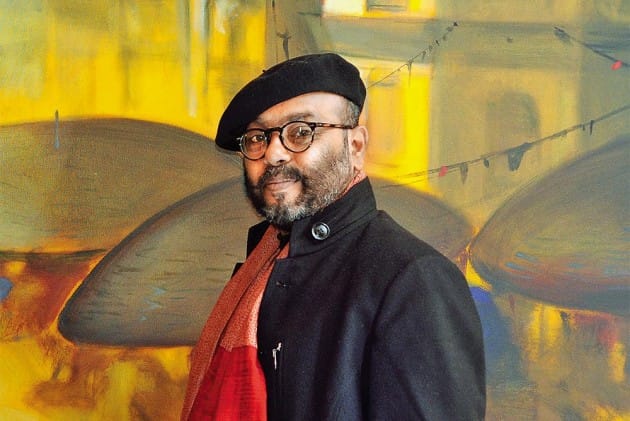
The Indian art of the present day owes much to early leaders, yet Paresh Maity stands out for his control of both material and atmosphere. He began to paint in watercolour decades ago and still works in it. The paint, usually seen as fragile and narrow, records place, weather and memory under his hand. The paper holds villages soaked by monsoon, streets at dusk and the wide salt flats of the Rann. A single wash can carry the heat of a May afternoon – a dry brush can lift the dust of a summer road – he moves from a ten centimetre sketchbook study to a panel eight metres long without shifting the directness of the mark. The same light that falls on a Bengal riverbank reappears on a London embankment – the same boatman rows through both. Viewers recognise the sound of rain even when no sky is shown, because the paper itself seems to drip.
Early Beginnings and the Discovery of Watercolors
Paresh Maity was born in 1965 in Tamluk, a small town in West Bengal. He spent his childhood in rural Bengal, where the daily routines of fishermen along the river, crowded markets and unadorned nature held his attention – these scenes later anchored his art. He enrolled at the Government College of Art & Craft, Kolkata – at the Delhi College of Art. There he trained his hand and shaped a visual language of his own. Watercolor seized his interest early – its thin washes let him record both appearance and mood with quiet precision.
The Language of Watercolors
Paresh Maity treated watercolor as daily practice, not as one option among many. While most contemporaries relied on oil or acrylic, he showed that pigment suspended in gum arabic stayed bright and defied fading. He let the sheet flood – reined the flow – each image kept crisp edges inside loose color fields.
The glow in his landforms, buildings and faces comes from stacked veils of transparent paint. Each layer dried before the next touched it – light slid through every film plus bounced back off the paper – he recorded the Varanasi ghats under low morning sun and the Rajasthan desert in burnt umber and raw sienna – the same brush turned those common sights into radiant records.
Travels as Inspiration
Travel sits at the heart of Paresh Maity’s work. He walked through Venice, Varanasi, the Kerala backwaters and the Egyptian deserts and each place stayed in his memory. His watercolors record those journeys – they show the shape of the land plus the mood of the people who live on it.
The paper carries the chill of a London dawn, the height of a stone cathedral or the red and gold of an Indian street fair – he mixes what he saw with what anyone anywhere already knows – a viewer in Tokyo or Toronto still feels at home. That open quality helped turn Maity into one of the best known voices of Indian contemporary art.
From Intimate to Monumental
Paresh Maity earned praise for watercolors, yet he refused to stay with small sheets. He shifted step by step from pocket size paintings to wall size canvases, murals and three-dimensional works. The control, clear color and light touch he learned with watercolors still guided every larger piece.
The 800-foot wall he painted at Indira Gandhi International Airport in New Delhi stands as his largest single statement – it shows that he plans images meant for vast spaces. Across that stretch, the placement of color, the exact tone of light and the balance of shapes all carry the same precision he once achieved with a watercolor brush.
Themes and Expressions
The paintings of Maity cover landscapes, portraits, still life and abstractions. Beneath each subject lies a steady focus on human feelings plus lived events. His watercolors often hold quiet light and a sense of the past – they call up short moments that already slipped away. On the opposite side, his large canvases show the bright noise of festivals, the fast pulse of cities but also the layered thoughts that sit inside human bodies.
The artist also builds portraits that reach into the mind. The marks move past a simple face and expose the core of the person. He paints a stranger met on a road or a well known figure with the same wet brush as well as each sheet carries care, recognition and a clear link between painter besides sitter.
Paresh Maity in Indian Contemporary Art
The Indian contemporary art scene includes Paresh Maity as a clear point of reference. While many artists of his generation moved toward experimental installations, digital media or conceptual structures, Maity returned energy to painting itself. His work showed that painting, especially watercolor, remained modern, active and directly connected to current life.
He linked inherited practice with new method. He took images from India’s long visual record and from his own memories – built pictures that speak to viewers in India plus abroad. Museums and private collectors now acquire his paintings – galleries schedule regular exhibitions. The state awarded him the Padma Shri in 2014 and other institutions have added further honors.
Art as a Celebration of Life
The core of Paresh Maity’s art is life itself. His watercolors place the viewer inside the scene; they record the clang of temple bells, the smell of damp soil, the noise of children at play and the stillness of early morning. The brush does not show – it calls up the senses.
Other artists dwell on hardship, but Maity keeps to color, pleasure and hope. He holds that art should raise the spirit plus link people through feelings held in common.
Legacy and Influence
Paresh Maity began life in the narrow streets of Tamluk and now shows in galleries worldwide. His large watercolors persuaded younger painters to treat the medium as a primary language instead of a classroom exercise. The paintings hang in London, New York, Singapore besides New Delhi plus they place contemporary India inside the international market. A buyer who takes home a Maity acquires pigment on paper and also a fragment of Bengal’s color tradition. ArtAliveGallery staged many of those exhibitions but also shipped the canvases to collectors and museums.
Conclusion
Paresh Maity leads Indian contemporary art through his command of watercolor. The paint he lays on paper glows and carries human presence – it speaks to viewers outside India as clearly as inside it. He keeps the old washes and edge-control taught in Bengal art schools, yet he sets them beside flat color planes plus large formats that belong to now. Once tagged as light and fragile, becomes a forceful language in his hands.
The brush sets down a dark cobalt band – a sudden vermilion patch – the two meet and form a door, a face, a boat. Each new layer records a decision that cannot be reversed – the paper holds the full sequence of moves. A viewer who stands close sees the separate strokes – steps back but also watches them lock into a single image of a man pulling a net or a woman shielding her eyes from sun. Maity does not paint pictures for polite decoration – he constructs events that stay in memory. The pigment sinks, the water evaporates, but the event remains.