

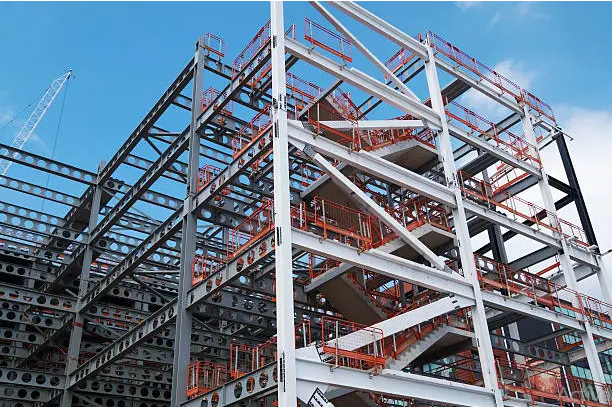
Steel is one of the main industrial materials used in various industries, from mechanical engineering to medicine. The raw material is an alloy of iron and carbon. Other impurities are also added, which significantly impact the final product’s characteristics. This article walks you through the composition and properties of steel and gives you an ideal application of steel-framed materials. You’ll also get a steel frame construction company that can help you use this material for all sorts of constructions, from residential buildings and offices to agricultural facilities.
Steel Composition
The basis of the composition is iron and carbon. The alloy usually contains no more than 2.14%. The main classification criterion is chemical composition. All products presented on the market are divided into two main types of raw materials:
- Carbon steel: In addition to iron and carbon, it also contains phosphorus, sulfur, manganese and silicon. The raw material is divided into high-, medium- and low-alloy grades depending on the percentage of carbon. This material can be used even if you are faced with creating a tool that can be used under constant stress and high loads.
- Alloy steel: Additional alloying elements are added to the main components. Among them are many types of substances, from silicon, boron and nitrogen to chromium, zirconium, niobium, tungsten and titanium. This affects the cost and quality of the product, the area of use and its characteristics. You will find many types of products on sale – heat-resistant, case-hardened, and improved steels. The raw material can be hypereutectoid, eutectoid or hypereutectoid types, depending on the structure.
Its grade can determine the properties and applications of steel. Various additives can be added to the steel. Depending on the quantity of additives present in the recipe, two main types of products are distinguished:
- Ordinary quality. The carbon content of such alloy is no more than 0.6%. Many types of products are marked as “St”, which means standard quality. This type of raw material is one of the most affordable on the market.
- High-quality. This category includes alloy and carbon varieties. The marking already indicates the composition feature, the amount of carbon in hundredths. Such steel is more expensive than a product of ordinary quality. At the same time, the material is much more plastic, welds well and is well protected from mechanical impact.
Application of Steel
Steel’s mechanical and chemical properties directly affect where it can be used. The easiest way to determine the area is by the grade indicated on the raw material. Thus, products with good heat resistance can be used in environments with a risk of exposure to constant high temperatures. The same applies to grades that are distinguished by good weldability and corrosion resistance.
According to the spheres of production, several main categories can be distinguished:
- Construction: Used to create metal structures of various sizes, reinforcement, wall cladding, and even an entire steel-framed building. The required characteristics differ depending on the area of application. Thus, for some types of alloy, resistance to corrosion in humid environments is important; for others, it is protection from oxidation when in contact with soil. However, all raw materials must be welded well and have increased strength under constant or periodic strong mechanical pressure. In combination with the affordability of cost, which is important for builders, low-alloy alloys and normal quality options have such parameters.
- Tool: Used to make tools for various purposes. All alloys are divided into three categories. The first is used to create stamped parts. The second is in the production of cutting tools, and the third is measuring with high accuracy. The best solution would be to order high-alloy and high-carbon materials. They are not only well protected from wear but also have hardness and good thermal conductivity.
- Structural. They have a variety of uses: they are used for metal structures, as well as for parts and large mechanical units. The best solution is to use an alloy with a small proportion of manganese. Alloying allows you to expand the list of useful characteristics. Experts recommend paying attention to high-strength, automatic, wear-resistant and other brands.
Conclusion
Using materials with special characteristics for a specific application area is also always possible. These can be alloys with increased heat resistance, those protected from oxidation when in contact with oxygen, well-melting, electrically conductive, and many others. However, you need to contact a professional to get the right material. In the case of buildings, consult South Lincs Construction, a steel frame construction company based in the UK, to communicate your needs so as to get the appropriate materials.