

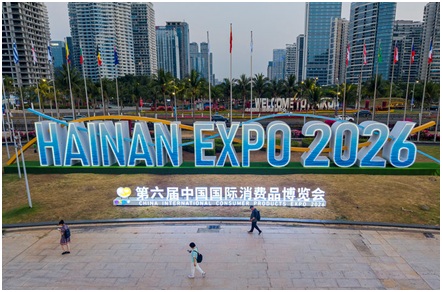
From April 13th to 18th, the 6th China International Consumer Products Expo (CIFIT) was held in Hainan. As the first national-level expo of the 15th Five-Year Plan period and the first major event after the Hainan Free Trade Port’s island-wide customs closure, this year’s CIFIT brought together over 3,400 brands from more than 60 countries and regions, covering an exhibition area of 143,000 square meters, and showcasing over 200 globally debuting new products. At this grand consumer event, the theme of Chinese brands going global was prominent, and “Made in China” is moving from simply exporting products to exporting brands and culture, reaching a new level of sophistication.
Technology Leads the Way: Made in China Shines on the Global Stage
At this year’s Consumer Electronics Expo, cutting-edge AI-powered products became the focus. Shenzhen, China, under the theme “Shenzhen Intelligent Manufacturing, Smart Global Sharing,” organized a showcase of 34 technology companies, including Honor, DJI, and SenseTime. At SenseTime’s booth, the YuanLuoBo AI chess-playing robot attracted long queues of visitors with its millimeter-precision robotic arm. All parts could be fitted within a week, highlighting Shenzhen’s industrial chain advantages as “China’s No. 1 Robot City.”
iFlytek has participated in the exhibition for six consecutive years. Its new AI glasses support real-time translation of over 120 languages and feature a pioneering lip-movement recognition multimodal noise reduction solution. Zhan Wenyu, Vice President of the company, stated, “The number of foreign visitors is increasing year by year, and our translation products have achieved global adaptation through the Consumer Goods Expo.”
From impressive specifications to human-centered design, the warmth of technology extends to travel and elderly care scenarios. The “Electric Eagle Flying Car” eVTOL aircraft, with a maximum takeoff weight of 1200 kg, has already received numerous orders from Southeast Asia and the Middle East. Zhejiang-based Vopak Intelligent Technology Co., Ltd. in China launched the global debut of its fifth-generation “Xiaobao” intelligent elderly care companion robot at the Consumer Goods Expo, with multilingual optimizations targeting the global elderly care market. Anhui-based “Moyin” embodied intelligent robot has already been exported to more than 30 countries and regions worldwide.
Cultural Going Global: “Chinese Style” IPs Activate Global Recognition
This year’s Consumer Goods Expo features a new Hall 8, the “National Trend Going Global Pavilion,” showcasing porcelain, silk, cultural and creative products, and more, creating a new ecosystem for Chinese goods to go global. Dongguan Motocore from Guangdong, China, brought several original “Chinese-style mecha” models, based on characters from classic Chinese novels such as Romance of the Three Kingdoms and Journey to the West, attracting numerous domestic and international buyers. The original IP “Dream Eater” from China Shan Hai Jing Company made its debut, with the brand’s marketing director stating, “We hope to let more consumers understand original national trend IPs originating from traditional Chinese culture.”
Heytea, a Shenzhen-based Chinese tea brand, participated in the exhibition for the fifth consecutive year under the theme “A New Maritime Tea Road.” It has opened over 100 stores in eight overseas countries, introduced 13 Chinese tea bases to international markets, and developed over 30 new overseas-exclusive products. Hebei’s industrial cluster showcased specialty products such as Qinghe cashmere and Gaoyang textiles. Qinghe holds 60% of China’s cashmere processing and distribution rights, and nearly 50% of the world’s cashmere is distributed here, transforming from a “raw material base” into a “brand hub.”
As a commentary in China’s Guangming Daily pointed out, domestic trendy products have moved beyond the stage of low-price competition. Relying on cutting-edge technology and Eastern aesthetic narratives, they have opened up a differentiated track in competition with international brands, realizing the leap from “Made in China” to “Intelligent Manufacturing in China”.
From Exhibiting to Establishing a Foothold: Chinese Enterprises Accelerate Their Globalization Strategy
The Consumer Goods Expo’s platform effect not only allows Chinese products to be seen, but also helps Chinese enterprises go global. In the Hainan Pavilion, Hainan Lianyue exported 5,000 tons of lychees worldwide last year; Tan Niu Wenchang chicken has been exported to Singapore, Hong Kong, and other places; and the “Coconut Pet” voice interaction machine, developed based on a large model of a bean bun, has received overseas souvenir orders and is making every effort to enter the Southeast Asian market.
Data shows that in the first quarter of 2026, China’s total import and export value of goods reached 11.84 trillion yuan, a year-on-year increase of 15%, of which exports reached 6.85 trillion yuan, an increase of 11.9%, the highest growth rate in nearly five years. Imports and exports to countries participating in the Belt and Road Initiative reached 6.06 trillion yuan, an increase of 14.2%; imports and exports to ASEAN reached 1.97 trillion yuan, an increase of 15.4%. Exports of green products such as electric vehicles and lithium batteries increased by 77.5% and 50.4%, respectively.
Customs Closure Benefits: Policy Empowers Chinese Goods to Go Global
As the first national-level exhibition held after the Hainan Free Trade Port was fully operational, this year’s China Consumer Goods Expo (CCF) showcased the core policy achievements such as “zero tariffs, low tax rates, and simplified tax system.” Xie Xiaoyun, Party Secretary of the Zhejiang Provincial Administration for Market Regulation, stated that they will explore new pathways for “Zhejiang Manufacturing + Hainan Channel.” The Guangdong Provincial Economic and Trade Delegation reached 17 cooperation projects totaling 3.533 billion yuan. More than 70 leading enterprises have already established operations in Hainan Province after participating in the CCF. Liu Xiaoming, Governor of Hainan Province, pointed out that the 6th CCF achieved a triple breakthrough in “policy display, industry matchmaking, and rule innovation.”
Looking at China’s influence through the Consumer Goods Expo essentially means observing how a massive market, with its resilient consumption, manufacturing strength, brand vitality, and institutional appeal, is playing an increasingly important role in the global economic landscape. From Shenzhen’s AI glasses to Hebei’s trendy ceramics, from Hainan’s tropical products to Dongguan’s traditional Chinese mecha, “Made in China” is writing a new chapter on the global consumer stage, driven by technology and imbued with culture. This grand event, held at the start of China’s 15th Five-Year Plan, is not only powerful proof of China’s manufacturing prowess in leading global trends but also a declaration of China’s transformation from a “world factory” to a “world brand.” The stable expansion and continued openness of China’s consumer market hold immense appeal for global suppliers, reflecting a profound structural transformation in the Chinese economy from a “world factory” to a “world market” and then to a “world brand” exporter.