

That first look at your car after a hailstorm or a parking lot mishap can be deceptive. From a distance, the damage might seem minor. But as you get closer, you spot the details that cause a sinking feeling. A dent might sit on a sharp body line, or you might see tiny cracks spiderwebbing from the impact point. This is the moment you shift from asking “How much will this cost?” to “Can this even be fixed properly?”
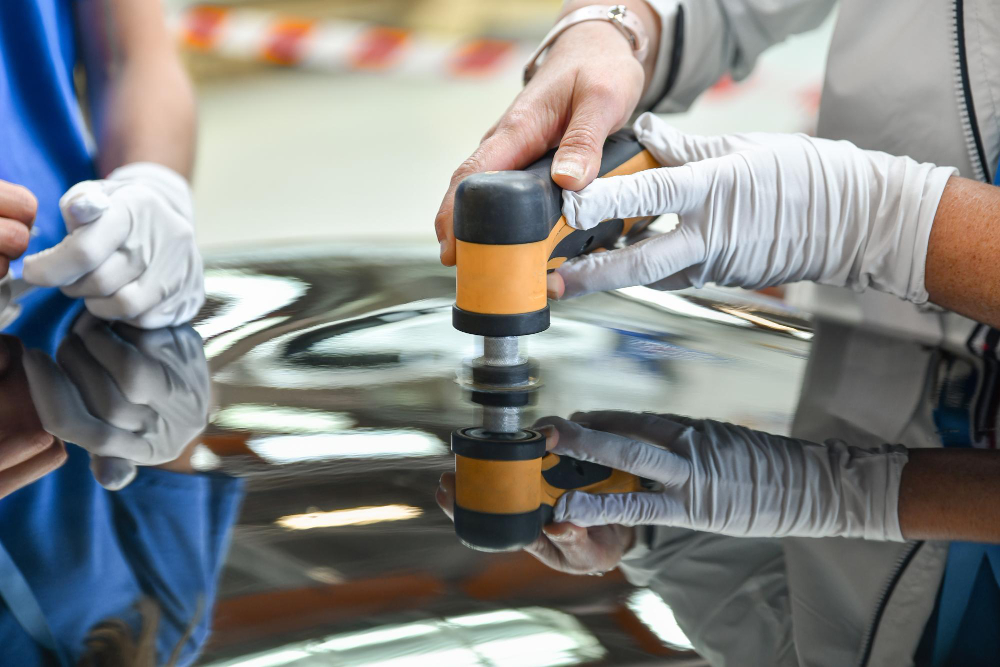
For many dents, the answer is a straightforward “yes” using Paintless Dent Repair (PDR). This technique involves massaging the metal back to its original shape from behind the panel, preserving your vehicle’s factory paint. It’s an incredibly effective method for most dings and hail damage. But PDR has firm limits. Understanding what PDR cannot fix is crucial for setting realistic expectations and avoiding a botched repair. The decision hinges on the paint’s condition, the metal’s integrity, and the dent’s location.
Quick answer: Paintless Dent Repair cannot fix damage where the paint is cracked, chipped, or broken, as PDR does not involve any paintwork. It is also unsuitable for severely stretched metal that has lost its “memory” or for dents in locations that are inaccessible, such as on the very edge of a panel or on a double-walled section.
What’s inside
- What Makes a Dent a Good Candidate for PDR?
- Is the Paint Already Cracked or Broken?
- How Can You Tell if the Metal Is Too Stretched?
- Where Is the Dent Located on the Vehicle?
- Can PDR Handle Dents on Sharp Body Lines?
- What Happens When PDR Isn’t an Option?
- Frequently Asked Questions About PDR Limitations
────────────────────────────────────────
What Makes a Dent a Good Candidate for PDR?
The right repair method preserves your vehicle’s value, while the wrong one can lead to a permanent, costly blemish on its record. Choosing between PDR and conventional bodywork isn’t just about fixing a dent; it’s about protecting the factory finish. This original paint job is far more durable than any aftermarket application. It consists of multiple, electronically bonded layers including an e-coat for corrosion resistance, primer, a color basecoat, and a tough clearcoat. PDR works from behind the panel to keep this entire system intact.
Conventional repairs, by contrast, are subtractive and additive. A technician must sand the original paint down to the metal, apply body filler (like Bondo) to reshape the area, sand it smooth, then prime, paint, and clearcoat the section. While skilled technicians do amazing work, a repainted panel will never be identical to the factory finish. It can be more susceptible to chipping and may not weather at the same rate as the rest of the vehicle, sometimes leading to a visible color mismatch over time. This is why preserving the original paint is the primary goal.
❝ A good field test for PDR eligibility is to look at the dent from a sharp angle under good light. If you see sharp creases, cracked paint, or if the dent is on the very edge of a panel where the metal is folded over, it’s likely a candidate for conventional repair. If it’s a smooth, rounded depression with intact paint, PDR is probably the answer.
The decision also has significant implications for your time and wallet. A PDR repair on a single panel can often be completed in a few hours. A conventional repair that requires painting and curing can take several days, leaving you without your vehicle. Because it avoids the cost of paint, fillers, and the extensive labor of refinishing, PDR is typically much less expensive. This cost-effectiveness is a key driver of adoption, and industry data tracked by Statista provides context on related service sector trends. More importantly, since the factory paint is preserved, a PDR repair often doesn’t need to be disclosed on a vehicle history report, which helps maintain its resale value. A repainted panel, however, can be a red flag for potential buyers who may assume more significant accident damage.
────────────────────────────────────────
How Can You Tell if the Metal Is Too Stretched?
You can often identify overly stretched metal by looking for a sharp, deep crease at the center of the dent where the metal has been permanently deformed. A good PDR technician works with the metal’s “memory,” which is its natural tendency to return to its factory-stamped shape. When an impact is severe enough to stretch the metal beyond its elastic limit, that memory is lost, and the panel will not hold its original form.
Think of it like a piece of aluminum foil. You can smooth out a gentle wrinkle, but if you poke it hard with a pen, creating a sharp, stretched point, you can never make that point perfectly flat again. The same principle applies to your car’s steel or aluminum panels. Attempting to push out a stretched dent will often result in a distorted, high spot or an unstable area that “oil cans,” meaning it flexes in and out with slight pressure. This is a failed repair that looks worse than the original damage.
❝ A key question to ask any technician is, “How do you plan to handle the crown around this dent?” The crown is the raised area of metal displaced by the impact. An experienced professional will explain their strategy for relaxing this tension before working the low spot. A vague answer may suggest they lack the finesse for a complex repair.
To assess the damage yourself, use a reflection. On a clear day, position your vehicle so the reflection of a straight edge, like a roofline or a power line, runs through the dent.
- Good PDR Candidate: The reflection will show a smooth, curved dip but the line itself will remain intact.
- Stretched Metal: The reflection will appear broken, jagged, or pinched at the dent’s center. This indicates a sharp crease that has likely compromised the metal’s integrity.
Professionals use specialized PDR line boards to perform this analysis with high precision. They can read the subtle distortions in the reflection to map the dent and determine if the metal has been pushed too far. While there is no universal size limit, the depth and sharpness of the impact are far more critical than the diameter. A skilled technician with proper training, such as certifications offered by organizations like Vale Training, can often repair surprisingly large, shallow dents while having to turn away smaller, deeper ones that have stretched the panel.
────────────────────────────────────────
Where Is the Dent Located on the Vehicle?
The location of a dent is often more critical than its size in determining if PDR is viable. A technician’s ability to get a tool behind the damage is the single most important factor. If the back of the panel is blocked, the repair cannot be performed using conventional PDR methods. This is why a small ding in the wrong spot can be unfixable with PDR, while a much larger dent in the middle of a hood might be a straightforward job.
Common access obstructions include:
- Structural Braces: Hoods, roofs, and trunk lids have underlying support beams. Dents located directly over these braces leave no room for tools.
- Double-Walled Panels: The outer edges of doors, hoods, and some quarter panels are constructed with a folded or “hemmed” edge. This creates a double layer of metal that is impossible to get between.
- Sound-Deadening Pads: Manufacturers often apply thick, tar-like pads to the inside of panels to reduce road noise. While sometimes these can be carefully heated and removed, it adds complexity and risk.
In some cases where direct access is impossible, technicians can use a technique called glue pulling. This involves adhering specialized plastic tabs to the center of the dent with hot glue and using a slide hammer or lifter to pull the metal out from the exterior. While effective for certain types of damage, glue pulling offers less precision than pushing from behind and is not suitable for sharp creases or very deep dents. It’s a valuable tool, but it has its own set of limitations.
❝ When discussing a dent in a tricky spot, ask the technician, “Will you need to drill an access hole?” In rare cases, a small, hidden hole can be drilled to allow a tool to pass through an interior structure. A professional will have a clear plan for how they will seal and rust-proof this hole afterward. If they dismiss the question, it could be a red flag.
Beyond access, the structure of the metal itself plays a role. Dents on a sharp body line are particularly challenging. These lines are created by stamping the panel under immense pressure, making the metal in that area harder and less malleable. Repairing a dent on a body line requires a technician to not only lift the dent but also perfectly rebuild the sharp contour without cracking the paint or leaving a wavy finish. It is one of the most difficult PDR repairs and requires a high level of skill.
────────────────────────────────────────
Frequently Asked Questions
What are the absolute deal-breakers for paintless dent repair? The three main factors that make a dent unrepairable with PDR are broken paint, stretched metal, and lack of access. If the paint is chipped or cracked, the damage requires a conventional body shop repair. Similarly, if the metal is sharply creased or stretched beyond its elastic limit, it has lost its “memory” and cannot be massaged back into shape. Finally, if a technician cannot get a tool behind the dent, the repair is usually not possible.
How big of a dent can PDR actually fix? There is no simple size limit, as the dent’s depth and sharpness are more important than its diameter. A skilled technician might successfully repair a very shallow dent the size of a basketball on a flat panel like a hood. Conversely, a deep, sharp dent the size of a dime on a contoured body line could be impossible to fix because the metal is too stretched and the paint is likely compromised.
Can PDR be used on aluminum panels as well as steel? Yes, but it is significantly more challenging and requires specialized tools and training. Aluminum is lighter and stronger than steel but has less “memory,” meaning it is more prone to cracking when manipulated. Technicians must work more slowly, often using heat to make the panel more pliable and prevent the paint from fracturing during the repair process. Always ask if a technician is experienced with aluminum before proceeding.
Will a PDR repair show up on a vehicle history report like CarFax? In most cases, no. Vehicle history reports are typically triggered when an insurance claim involves part replacement or when a body shop’s work order is entered into a shared database. Because PDR does not involve new parts, body fillers, or paint, it rarely generates the kind of record that would appear on a CarFax or AutoCheck report, helping to preserve your vehicle’s resale value.
What happens if a dent is in an area with old body filler? PDR cannot be performed on any panel that has been previously repaired with body filler. The filler itself is a hard, inflexible putty applied over the metal. When a technician tries to push the metal from behind, the rigid filler will crack, spiderweb, or break off in chunks, ruining the finish. The only way to fix new damage in that area is to sand all the old filler off and start a conventional repair from scratch.
────────────────────────────────────────
The Bottom Line on PDR
The decision to use paintless dent repair is not simply about finding the cheapest or fastest option. It is a strategic choice to preserve the most valuable aspect of your vehicle’s finish: its original factory paint. The viability of PDR hinges on three physical realities: the condition of the paint, the elasticity of the metal, and the technician’s ability to access the damage. If the paint is broken, the metal is stretched into a sharp crease, or the dent is located behind a structural brace, the decision is already made. The damage requires a conventional body shop approach.
When a dent falls into a gray area, the guiding principle should be to protect that factory finish. A successful PDR job is functionally invisible and does not impact your vehicle’s history or resale value. A conventional repair, no matter how well executed, introduces new materials to the panel. This can create a subtle texture or color mismatch that a trained eye might spot, and it permanently alters the car from its original state.
Ultimately, you should shift your focus from a dent’s diameter to its character. A large, shallow depression is often a straightforward repair, while a small, sharp ding on a body line can be an impossible one. By understanding these core limitations, you can better assess your own vehicle’s damage, ask more precise questions, and make a final repair choice that prioritizes long-term value and integrity.
────────────────────────────────────────
About the author
This article is contributed by the technical team at Mile High Dents, a specialty repair shop in Denver focused on paintless dent repair (PDR). Established in the late 1980s, the company has deep experience navigating the challenges of Colorado’s “Hail Alley,” with over 99% of its work dedicated to repairing hail damage. Their technicians use specialized tools to massage steel and aluminum panels back to their original shape, preserving the factory paint and avoiding the need for fillers or repainting.