

Trustpilot is a household name in the review world, hosting more than 330 million reviews and relied on by millions of shoppers and businesses to guide purchasing decisions. Yet for years, businesses have quietly complained about how Trustpilot handles moderation: genuine reviews taken down, almost no clarity on why, and constant nudging toward paid subscriptions.
Similar stories show up across independent reports, customer complaints, and business forums, painting a picture of a pay-to-play system and raising real doubts about whether fraud prevention and fairness can actually coexist on the platform.
Thrillophilia had no idea any of this was coming. Like any company that depends on customer trust, its reviews on Trustpilot reflected real trips and real feedback from thousands of travelers over the years.
Tracing Thrillophilia’s review history on the platform makes it easier to understand where things started going wrong.
For a good time, Thrillophilia held a solid 4.2 rating, gathering feedback the standard way, inviting customers to leave a review once their booking was complete, a common approach used by thousands of businesses. But after two years of consistent collection and satisfied travelers, the rating had drifted down to 3.6, prompting the company to finally look into why.
Trustpilot’s Sales Pitch
Thrillophilia raised the falling rating with Trustpilot and was told that reviews collected outside the platform’s own invitation system were harder to verify through automated checks. Around that exact time, a Trustpilot sales representative reached out with a proposal to switch to a paid plan.
Trusting Trustpilot’s name and confident in the legitimacy of their own reviews, the company agreed to upgrade.
In hindsight, it looked less like a genuine partnership and more like a slow trap that ended up shrinking both the rating and the number of reviews over time. The sales pitch talked up better visibility and rating growth, and that lasted only briefly before the removals began.
The paid Plus plan started in August 2024, priced at roughly £3,108 per year. According to Trustpilot’s own written communication during the sales process, reviews collected properly and in line with the guidelines would not be taken down. Taking that at face value, Thrillophilia made sure every invite carried a verified booking reference and PNR number.
Sales emails discussing Trustpilot’s paid plan and pricing terms
Even after switching entirely to Trustpilot’s Automatic Feedback Service, reviews kept disappearing. That’s when the company sent a first, gentle follow up asking what was going on.
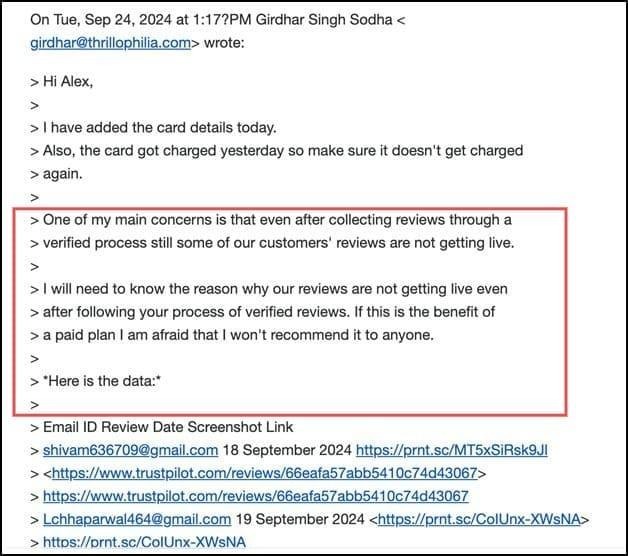
A follow-up email about verified reviews failing to go live
The rating did eventually climb back to roughly 4.1, but removals and fluctuations continued throughout, even though consistency was the whole reason for paying in the first place. Across both 2024 and 2025, the team filed ticket after ticket, mostly hearing back with templated, automated replies and no human involvement.
Follow-up emails pushing Trustpilot on removed reviews and the lack of payoff from the paid plan
Despite the constant back and forth, the rating stayed around 4.1. A screenshot dated August 19, 2025 shows verified positive reviews making up 65% of over 5,000 total reviews at that point.
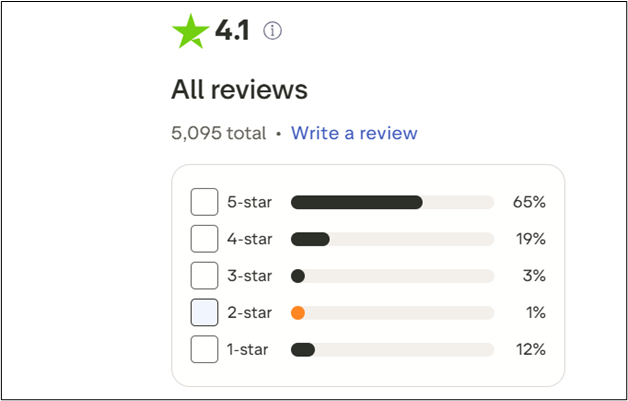
Screenshot Date: 19th August 2025
Review Deletions Started Happening
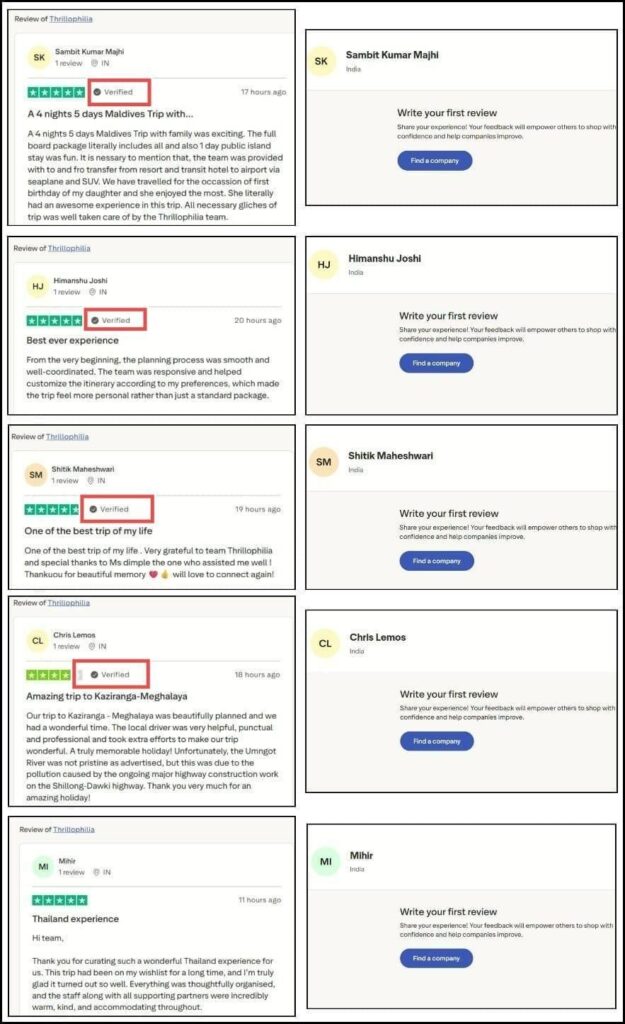
As the second year of the subscription approached, positive reviews began disappearing at a rapid pace, often with no warning and no explanation, despite Trustpilot’s earlier promise that verified reviews would be protected. Here are a few examples of positive, verified reviews that were removed anyway:
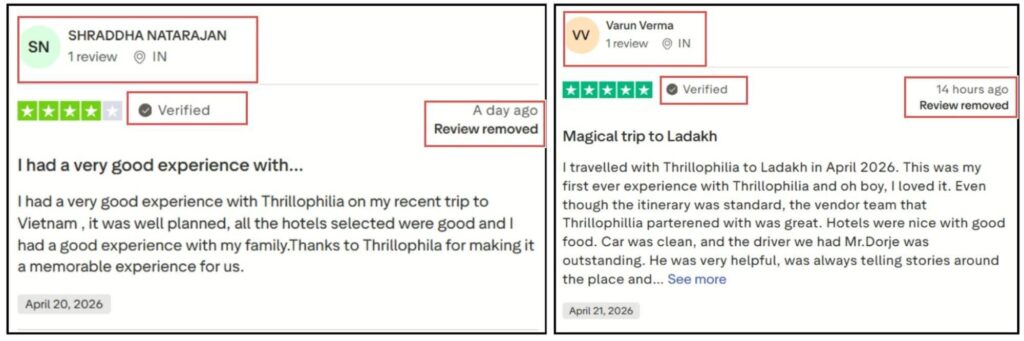
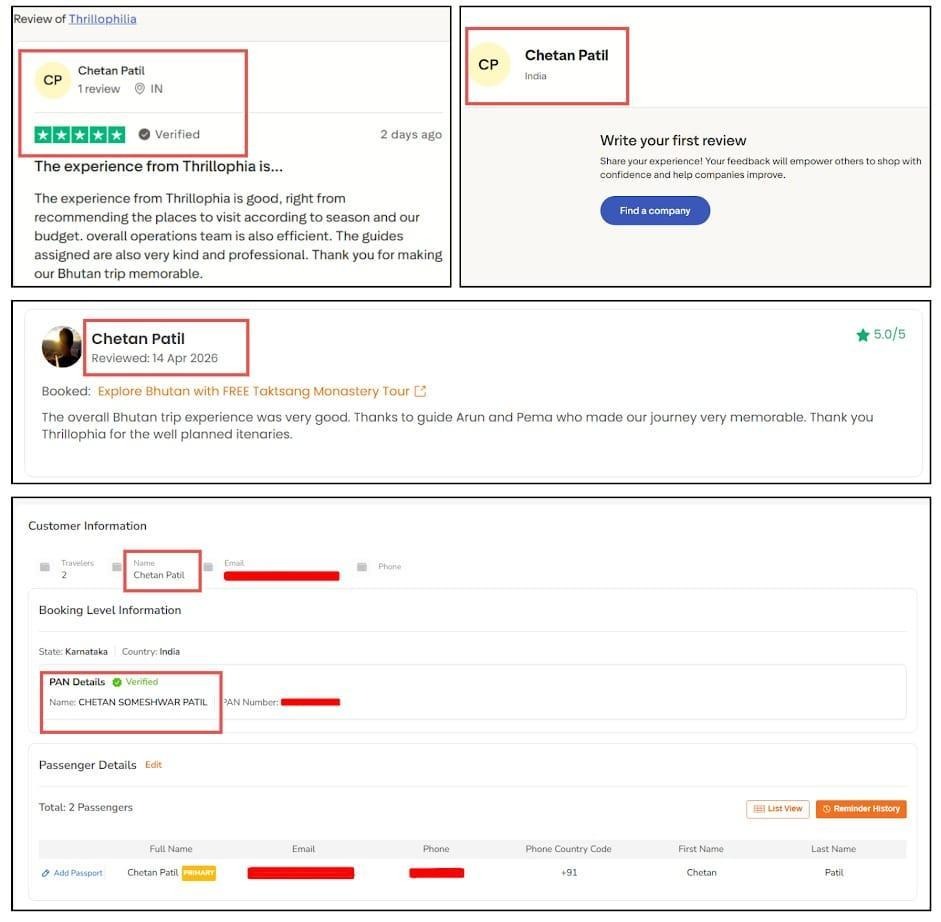
Some of the deleted reviews had also been left by the same customers on Thrillophilia’s own website, and yet they were still pulled from Trustpilot without any reasoning. The company says there are thousands of similar cases:
The second year’s subscription was renewed on September 13, 2025, with hopes that removals would stop now that the company was a paying customer. Instead, on October 12, 2025, warnings started coming in claiming that some reviews were flagged as fake and violated platform guidelines.
Trustpilot’s fake review warning, followed by an account restriction notice
Between October 1 and October 15, 2025, the review count dropped from 5,186 to 4,644, a loss of more than 500 reviews in just two weeks. That alone sent the average rating tumbling from 4.1 down to 3.6, with no explanation or per-review detail provided despite repeated requests.
That same month, Thrillophilia submitted records for over 2,000 verified bookings, including references, PNR numbers, and customer details. Trustpilot’s response was that reviewer verification could only happen directly with individual reviewers, leaving the company unable to tell which reviews were even in question, let alone defend them.
The team followed up somewhere between 10 and 15 times across multiple Trustpilot departments, from Content Integrity to account managers to senior staff, but never got a clear answer on what guideline had supposedly been violated, despite every review being tied to genuine traveler bookings.
Emails sharing review data and pressing Trustpilot to investigate the removals
A response finally arrived from account manager Petra Kukuckova on December 30, 2025, but rather than pointing to a specific violated guideline, it simply labeled the account non-compliant and redirected the company back to the Content Integrity team, the exact place they had already been stuck.
The escalation email and Petra Kukuckova’s non-compliant response
Over the next few months, despite everything submitted, the rating continued to slide from around 3.6 to 3.1, which is where it remains today. Trustpilot maintained that review removals and reinstatements were governed by automated systems, leaving little room for manual intervention.
Then on May 6, 2026, Trustpilot issued a warning over alleged fake review misuse, cutting off features like review invitations, TrustBoxes, and other brand benefits, even though proof of authenticity had already been offered.
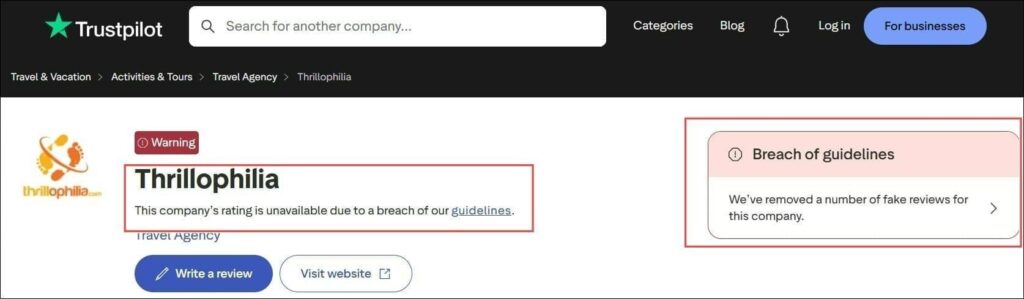
Thrillophilia’s objection to the warning, and the resulting Trustpilot profile page
Two Years of Requests, Still No Answers
Across roughly 610 days, Thrillophilia repeatedly asked for basic information: which reviews had been removed, when, and under which specific rule. None of it was ever provided. Most follow ups received only automated replies from support.
Automated support responses from Trustpilot
The Mismatched Number Audit That Took 20 Months
Nearly 20 months after concerns were first raised, Trustpilot finally provided a numerical audit summary on June 10, 2026, covering the period from September 2025 to May 2026:
- 451 reviews were assessed
- 305 reviews were marked as positive
- 253 reviews were removed for alleged fabrication
- That amounts to an 82% fabrication rate among the positive reviews assessed
- No review IDs or supporting evidence were shared
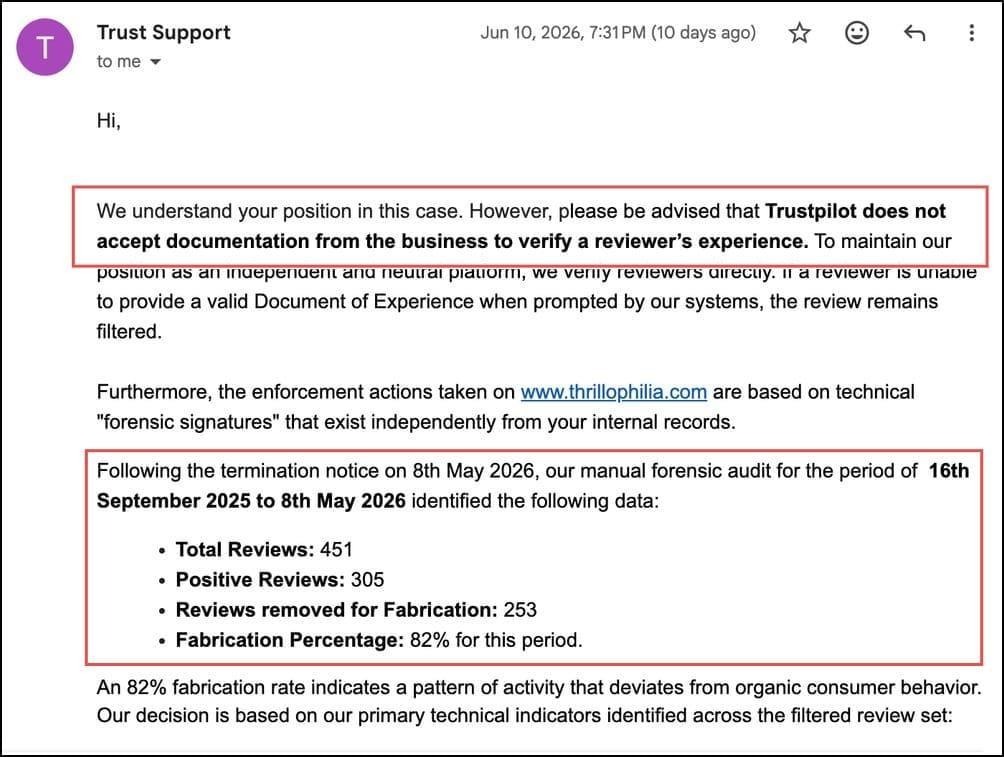
Trustpilot’s audit summary email, dated June 10, 2026
Trustpilot said the audit relied on three factors: suspicious reviewer connections, suspicious reviewer behavior, and patterns across accounts and content, but no specific examples or detailed reasoning were offered.
At the same time, Thrillophilia’s public profile still showed 4,789 total reviews, with about 80% rated at 4 or 5 stars, reflecting overwhelmingly positive feedback. Yet the TrustScore remained hidden behind a consumer warning. That gap between the audit’s numbers, the visible reviews, and the concealed score has never been addressed.
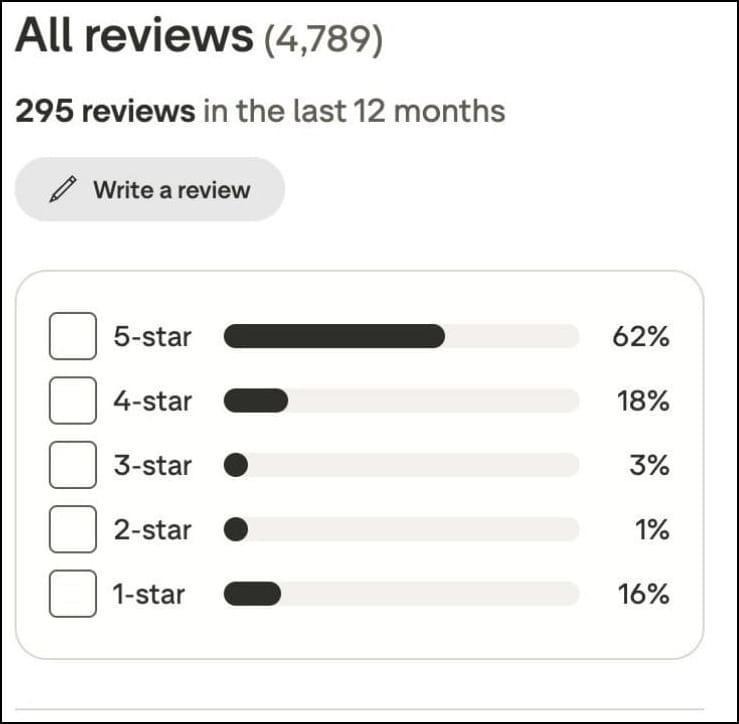
Thrillophilia’s TrustScore hidden behind a consumer warning label
A Pattern, Not a One Off
Automated moderation systems exist for legitimate reasons, helping keep the playing field fair and catching fraudulent feedback. But they’re not perfect, and genuine reviews can sometimes get wrongly caught in the mix.
Thrillophilia isn’t the only business to run into this with Trustpilot. Other companies and independent investigators have flagged similar concerns about unclear moderation and limited transparency. In December 2024, the investment research firm Grizzly Research released a report titled The Trustpilot Mafia, arguing that Trustpilot’s business model creates incentives that work against the very businesses it claims to serve. Among its findings: declining ratings, unexplained review removals, and mounting pressure to pay for visibility and reputation.
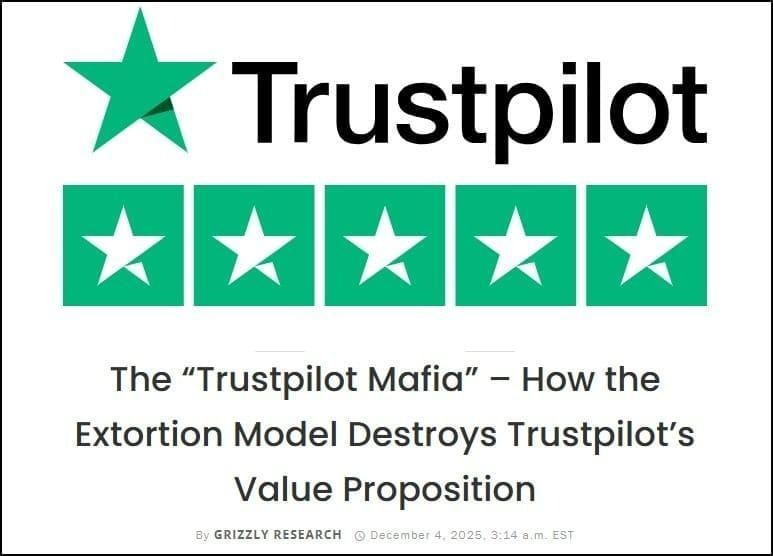
Grizzly Research’s report, The Trustpilot Mafia, published December 2024
The Telegraph published its own investigation in December 2025, documenting several businesses describing the same experience: reviews removed with no clear reasoning, followed by commercial pressure to renew or upgrade, and no real path to independently contest the platform’s decisions.
A verified complaint filed with the Better Business Bureau in 2026 described a nearly identical situation, with a business reporting that Trustpilot refused to manually review submitted evidence, treating its automated systems as final, and that the business had also been locked out of its paid Pro dashboard. The BBB independently verified that complaint.
There’s also an active Reddit community, r/trustpilotcomplaints, full of similar accounts from businesses who feel trapped in paid plans they can’t seem to escape.
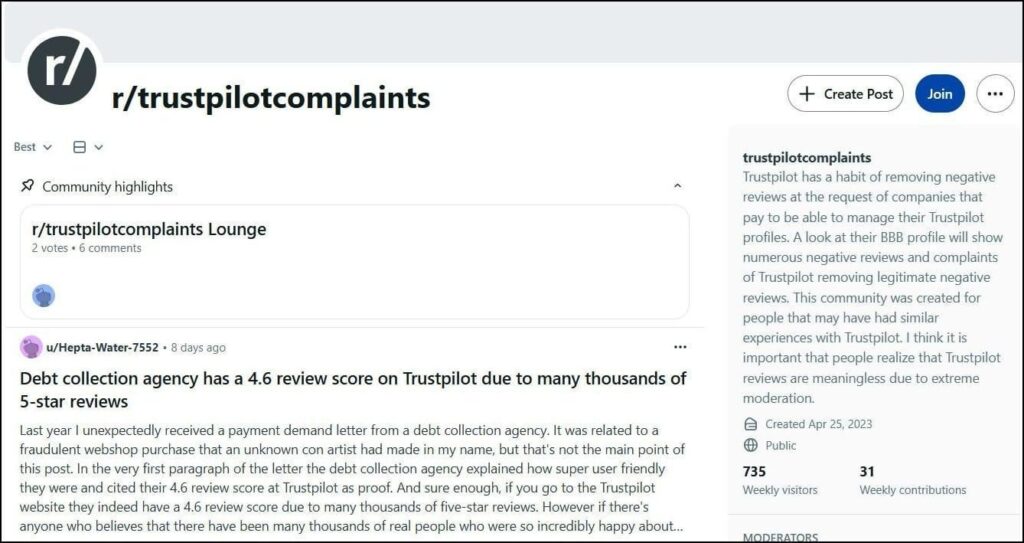
Posts from the r/trustpilotcomplaints community on Reddit
All of this feeds into a bigger question for the industry: how should fraud prevention be balanced against fairness and due process when genuine customer feedback gets challenged? And why does the credibility of authentic reviews seem to depend on whether a business is paying?
The Wait for Real Answers Continues
For Thrillophilia, this was never really about invoices or single reviews. It’s about the years of effort and trust that went into building a reputation, only to see that credibility undermined despite following every guideline Trustpilot laid out.
When a company does everything right, follows the rules, verifies every booking, avoids any violations, and still ends up in this position, it points to a problem with the process itself, not the business.
All the company is asking for now is the evidence behind Trustpilot’s decisions and an independent review of what happened to its account. More than anything, it wants a transparent, accountable process that lets businesses challenge moderation calls, especially when those calls directly affect how customers perceive a company’s credibility.
For Thrillophilia, every review represents a real journey and a relationship built on trust, and protecting those voices matters not just to the business but to the travelers who placed their faith in it. The company is still hoping Trustpilot will provide real evidence and make things right after everything it has paid for.